
 thecryptobasic.com

The Chief Investment Office of DBS Bank, the largest bank in Southeast Asia, has highlighted $XRP in a new report examining emerging risks in the crypto space.
The report, titled “Digital Assets: Quantifying Quantum Risks in Crypto,” also mentioned other major crypto projects, including Solana and Ethereum. It highlights institutional attention not just to crypto adoption, but to long-term technological threats that could reshape the industry.
Key Points
- DBS highlights $XRP alongside Ethereum and Solana, flagging rising quantum risks across crypto networks.
- Advances in quantum computing could eventually threaten blockchain security, though current capabilities remain far from dangerous.
- Faster networks like $XRP and Solana may reduce attack windows due to quick settlement times.
- DBS urges preparation, noting the industry is already developing quantum-resistant solutions.
DBS Flags Quantum Threat to Crypto Networks
According to DBS CIO Daryl Ho, advances in quantum computing could eventually challenge the cryptographic foundations that secure blockchain networks.
The report references recent Google research suggesting that a sufficiently powerful quantum computer could break Bitcoin’s elliptic curve cryptography far faster than previously expected.
While such technology is still theoretical, the timeline may be accelerating, raising concerns about future vulnerabilities.
However, DBS highlights that current quantum hardware remains far from this level. Even the most advanced systems today are nowhere near the scale required to pose an immediate threat.
$XRP, Ethereum, and Solana Could Withstand Current Risk
DBS specifically pointed to differences in blockchain design, noting that faster networks like $XRP, Ethereum, and Solana may have some structural advantages against certain types of attacks.
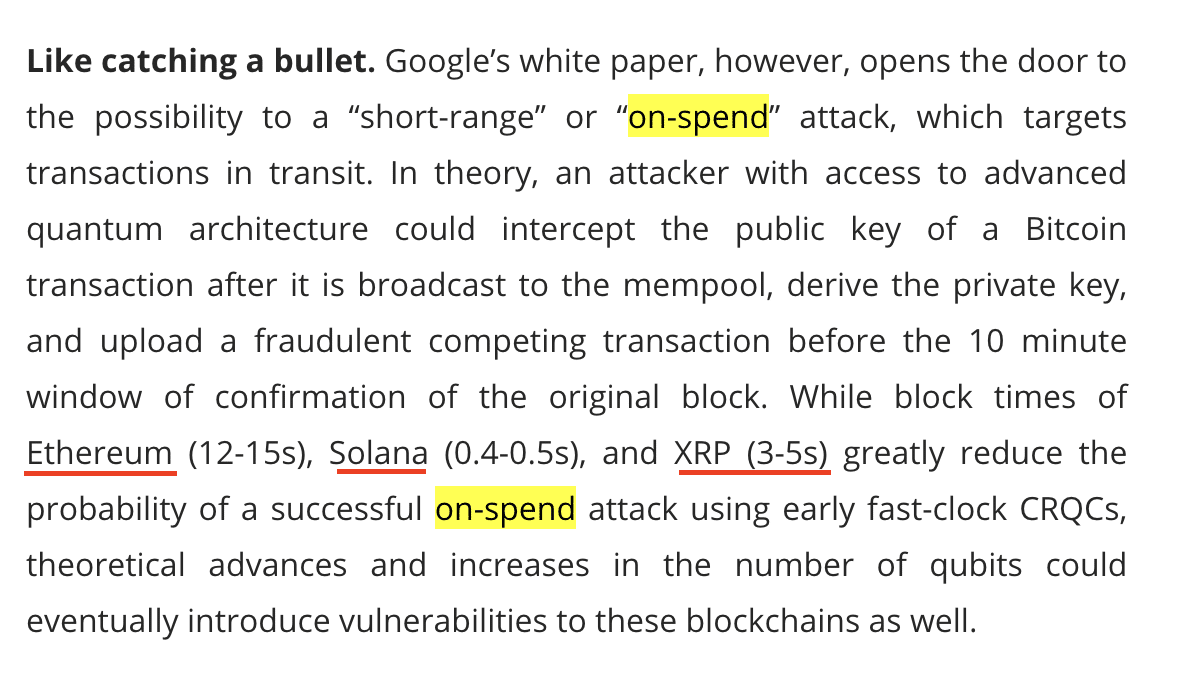
For example, transaction confirmation times vary significantly across networks. Bitcoin transactions typically take around 10 minutes to confirm. Meanwhile, $XRP settles in roughly 3–5 seconds, Solana in under a second, and Ethereum in 12-15 seconds.
This speed reduces the window for a potential “on-spend” quantum attack, where a malicious actor could attempt to intercept and override a transaction before it is finalized.
Still, the bank cautions that future improvements in quantum computing could eventually introduce risks even to faster chains.
Industry Already Moving Toward Solutions
The report notes that major blockchain ecosystems are already working on post-quantum cryptography solutions.
For instance, the Ethereum Foundation is targeting a full transition to quantum-resistant systems by the end of the decade. Meanwhile, proposals within the Bitcoin ecosystem aim to upgrade address formats and signature schemes to reduce long-term exposure.
Likewise, $XRP Ledger is testing post-quantum cryptography, including NIST-backed standards and key rotation features.
DBS frames this as a race between quantum breakthroughs and defensive innovation, with the crypto industry historically adapting quickly to new challenges.
No Immediate Panic, But Preparation Matters
Despite outlining serious long-term risks, DBS maintains that there is no need for immediate concern. The gap between current quantum capabilities and real-world threat levels remains wide.
Instead, the bank encourages preparation over panic. It advises crypto users to follow best practices, such as avoiding address reuse, using modern wallets, and staying up to date on post-quantum developments.
In its conclusion, DBS suggests that even in a worst-case scenario, the crypto ecosystem would coordinate upgrades or forks to adapt just as it has done in the past.