
 thedefiant.io
YPF Luz, the electricity subsidiary of Argentina’s largest energy company, has partnered with Buenos Aires-based blockchain infrastructure company Justoken to launch an energy tokenization platform built on $XRP Ledger (XRPL), the firms announced earlier this month.
The platform, dubbed Enertoken, tokenizes, commercializes, and manages electricity contracts via XRPL, the public blockchain originally developed by Ripple Labs, which remains a core contributor. Meanwhile, Justoken recently emerged as the largest real-world asset (RWA) tokenization platform on XRPL by total value.
Per the announcement, the new platform from YPF Luz, developed by Justoken, is aimed at corporations and large energy consumers to help manage everything from consumption tracking, to billing, to contract execution, “fully supported by tokenized energy assets recorded on blockchain.”
Martín Mandarano, the CEO of YPF Luz — the parent company of which has had a turbulent history of state and private ownership — was quoted as saying in the announcement:
“The integration of tokenized energy assets allows us to optimize processes, enhance traceability, and deliver greater transparency to our clients, reinforcing YPF Luz’s innovative profile within the energy sector.”
Justoken’s Quiet Dominance
In what the companies are calling the project’s initial phase, Enertoken launched with over $800 million in tokenized energy assets on XRPL, per the announcement, evidently referring to Justoken’s tokenized energy fund, JMWH.
Justoken’s JMWH, which, per RWAxyz, represents real megawatt-hours (MWh) of energy, backed by energy producers in Latin America, quietly become the largest tokenized asset on XRPL by total value when it launched in mid-January with over $861 million on-chain. Meanwhile, Justoken has another $832.3 million in various other tokenized commodities on Polygon.
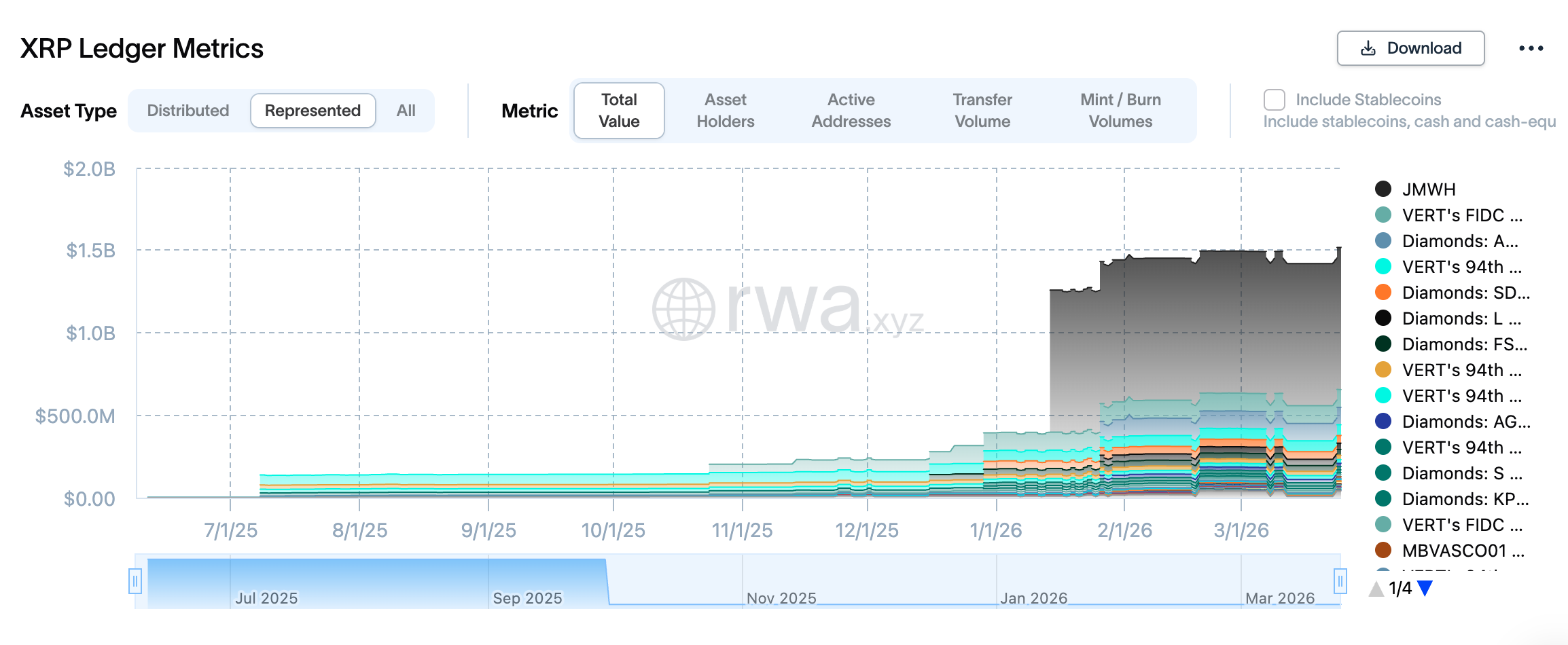
As of today, March 26, JMWH's total asset value still stands at $861 million — representing nearly 57% of all so-called represented asset value on XRPL, and a nearly 45% market share of all tokenized RWA platforms on the network.
Per RWAxyz, "represented asset value" refers to tokenized assets that exist on a blockchain but cannot be distributed or transferred on-chain — they represent a real-world commitment recorded on-chain, not freely tradable tokens.
Represented vs Distributed RWAs
Luke Judges, Partner Director at RippleX, Ripple’s open developer platform, explained to The Defiant why JMWH falls into RWAxyz’s "represented” asset category, rather than "distributed" — a distinction that indicates how these assets are used on-chain, stating, "'represented' assets operate within more controlled environments, often reflecting regulatory or contractual requirements."
In JMWH's case, the tokens operate under Argentina’s capital markets regulator Comisión Nacional de Valores (CNV)’s regime for Virtual Asset Service Providers (PSAVs), with issuance, allocation, delivery, and retirement all tied to contractual obligations. This, Judges argues, explains why Justoken opted for a “closed loop approach.”
"The blockchain serves as a verifiable record of ownership and fulfilment rather than a trading venue," Judges added.
He also noted that represented assets on XRPL are "an important starting point for many institutional use cases, with distributed assets playing a larger role as liquidity, infrastructure, and regulatory clarity continue to evolve on XRPL."
Selecting XRPL
Ariel Scaliter, co-founder and CTO of Justoken, told The Defiant that the choice of XRPL was deliberate on multiple fronts, citing speed and scalability for teams building on the blockchain network:
"XRPL was selected for several strategic reasons. First, its institutional quality stands out. Many companies in the energy ecosystem are publicly listed, which aligns with the profile of counterparties involved in this type of business."
Scaliter also cited the ability to build quickly on the XRPL EVM Sidechain before migrating to the mainnet, and flagged Ripple’s institutional legitimacy, as well as custody as a critical infrastructure consideration. He told The Defiant:
"XRPL, alongside contributions from Ripple, is well positioned to attract institutional investors. This global credibility and trust are essential for high-stakes, regulated use cases like energy tokenization."
RippleX’s Judges elaborated on the architecture: "Justoken was looking for a way to bring renewable energy credits onchain that could support both traceability and automated compliance for corporate clients, while still fitting within existing custodial structures."
YPF Luz and Its State-Backed Parent
YPF Luz is the power generation subsidiary of YPF (Yacimientos Petrolíferos Fiscales), Argentina's majority state-owned oil and gas company. The nation's largest crude producer was originally established over a hundred years ago as Argentina’s state oil company, but was privatized in 1999 and purchased by Spanish energy giant Repsol.
In 2012, Argentine President Cristina Fernández de Kirchner renationalized YPF, ousting Repsol after a dispute over slumping oil output and investment, Bloomberg reported at the time. Argentina's Congress nationalized YPF through an overwhelming lower-house vote, clearing the way for President Fernández to sign the bill into law, per Reuters.
RWA Surge
XRPL has been steadily building its RWA credentials, and now has $1.5 billion in represented asset value on chain, and over $404 million in distributed asset value, per RWAxyz.
In late 2024, Ripple announced plans to tokenize the first-ever money market fund on XRPL, collaborating with UK-based digital securities exchange Archax and global investment firm Abrdn, as The Defiant reported. Last March, Ondo Finance deployed its tokenized short-term U.S. Government Treasuries product (OUSG) on the $XRP Ledger, aiming to bring it to XRPL's institutional user base.
Zooming out, the broader tokenized RWA market tripled from roughly $5.5 billion to $18.6 billion over the course of 2025, per The Defiant's year-end analysis.
This article was written with the assistance of AI workflows. All our stories are curated, edited and fact-checked by a human.