
 thecryptobasic.com
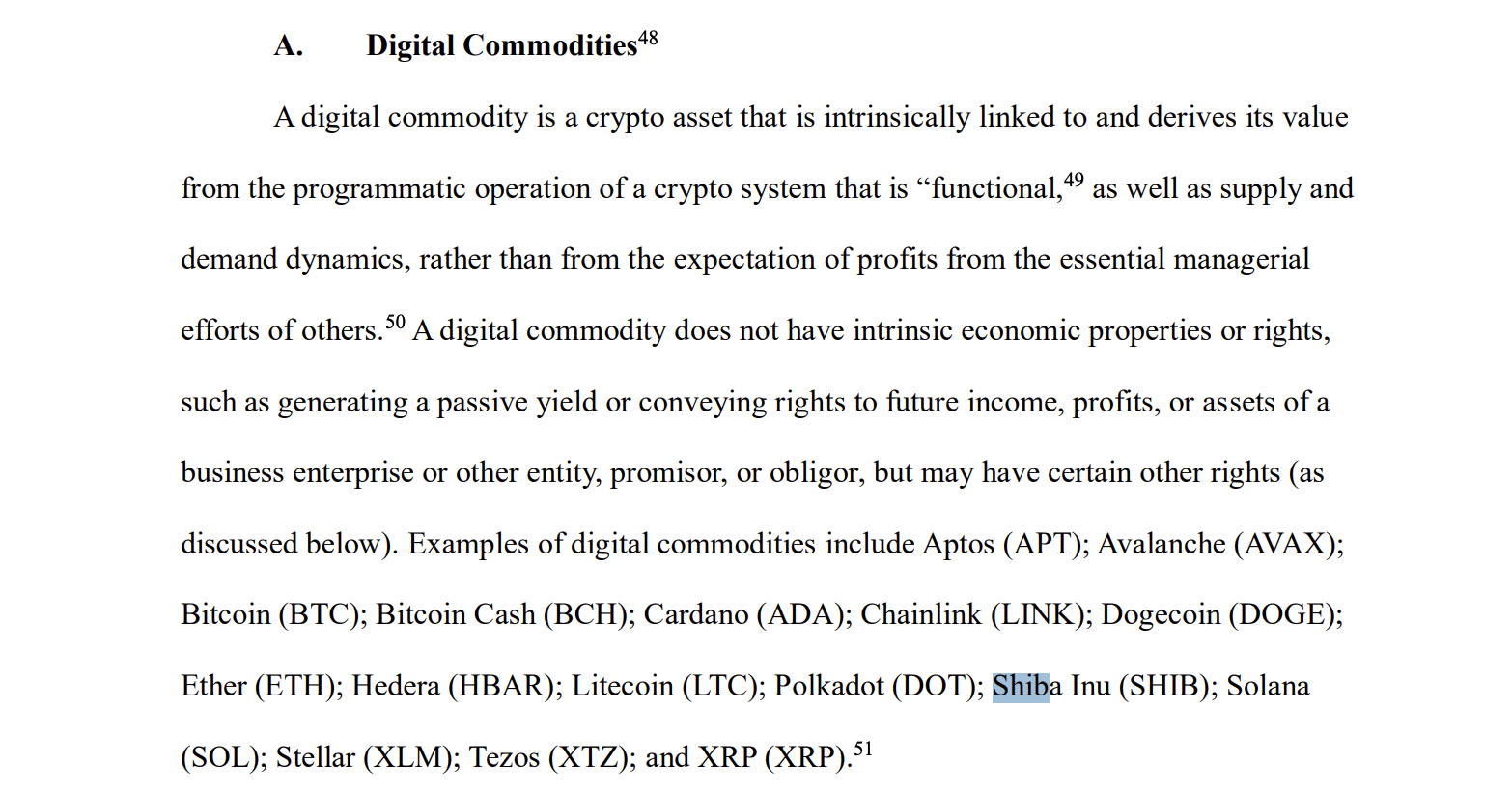
A new joint regulatory clarification from the U.S. SEC and the CFTC has classified Shiba Inu as a digital commodity rather than a security.
The agencies issued the guidance yesterday to clarify how federal securities laws apply to cryptocurrencies. As a result, they placed Shiba Inu in the same regulatory category as leading assets like Bitcoin, Ethereum, $XRP, and Cardano.
Key Points
- U.S. financial regulators, the SEC and CFTC, categorize Shiba Inu as a digital commodity, not a security.
- Shiba Inu now holds the same regulatory status as Bitcoin, Ethereum, and $XRP.
- The SEC framework prioritizes utility and function over speculation, indicating that digital commodities derive value from their role within a crypto network.
- This regulatory clarity could boost institutional interest in $SHIB, potentially strengthening the case for a spot-based U.S. ETF.
Previous Regulatory Uncertainty
This development marks a major turning point in Shiba Inu’s regulatory journey. Previously, uncertainty persisted as regulators debated whether meme coins like $SHIB could qualify as securities.
Notably, former SEC Chair Gary Gensler repeatedly argued that most cryptocurrencies fall under securities laws. However, the current administration has gradually reversed this stance. For instance, in February 2025, the SEC’s Division of Corporation Finance clarified that meme coins are not securities and are more closely akin to digital collectibles.
Consequently, the latest guidance firmly positions $SHIB within the commodity category, aligning it with the core assets of the crypto market.
Why Shiba Inu Falls Under the Digital Commodity Classification
It is worth noting that the SEC’s definition of digital commodity emphasizes function over speculation. A digital commodity derives value from its role within an operational crypto system.
According to the framework, it facilitates transactions, supports network security, and enables user participation. In line with this framework, $SHIB’s expanding ecosystem strengthens its classification.
Beyond its origins as a meme token, the project now supports payments and decentralized finance while developing additional components, including a layer-2 network, NFTs, and a metaverse initiative.
Potential Benefits
With this clarity in place, $SHIB may become more attractive to institutional investors seeking regulatory certainty. As confidence improves, the market could see stronger demand, deeper liquidity, and broader integration across financial platforms.
Moreover, the classification significantly improves the prospects for a Shiba Inu-focused ETF in the United States. Since commodity status aligns $SHIB with existing ETF frameworks used for Bitcoin and Ethereum, asset managers may now explore $SHIB-based investment products.
Notably, Grayscale Investments already considers $SHIB eligible for a spot ETF under the SEC’s Generic Listing Standards framework. Although no dedicated $SHIB ETF has been filed to date, aside from a broader basket proposal from T. Rowe Price, this regulatory clarity could encourage institutions to pursue standalone filings.
Furthermore, exchanges and financial platforms are likely to view $SHIB as lower risk from a compliance standpoint. This shift could drive wider adoption, increase listings, and strengthen its overall market position.
Ultimately, the designation of Shiba Inu as a digital commodity signals a clear transition. It moves from being perceived primarily as a speculative meme asset to becoming a recognized and functional component of the broader digital asset ecosystem.