
 beincrypto.com

The community expected the listing of Pi Network (PI) on Kraken to improve liquidity, attract new investors, and drive a strong price rally. However, the actual outcome has completely contradicted those optimistic forecasts.
Several key data points help explain the sell-off seen this week.
Trading Volume on Kraken Remains Insignificant
Market data shows that after Kraken officially announced the PI listing on March 13, 2026, the token’s price began to decline sharply. From a peak of around $0.30, PI dropped more than 40% within just a few days and now trades near $0.174 across multiple exchanges.
This performance runs counter to expectations from many analysts, who believed that access to the US market through a regulated exchange like Kraken would bring fresh capital inflows and improve liquidity.
“A Kraken listing would be more than just another exchange. It would signal that Pi Network is stepping onto the global stage. From phones to real markets, the journey is just beginning,” investor Jackie Necton stated.
In reality, after the first few days of trading, PI volume on Kraken accounted for only a small fraction of the overall market. According to CoinGecko market data, the PI/USD pair on Kraken recorded 24-hour trading volume of about $198,135, representing just 0.46% of total volume. Meanwhile, the PI/EUR pair saw only $74,330 in volume, accounting for 0.17%.
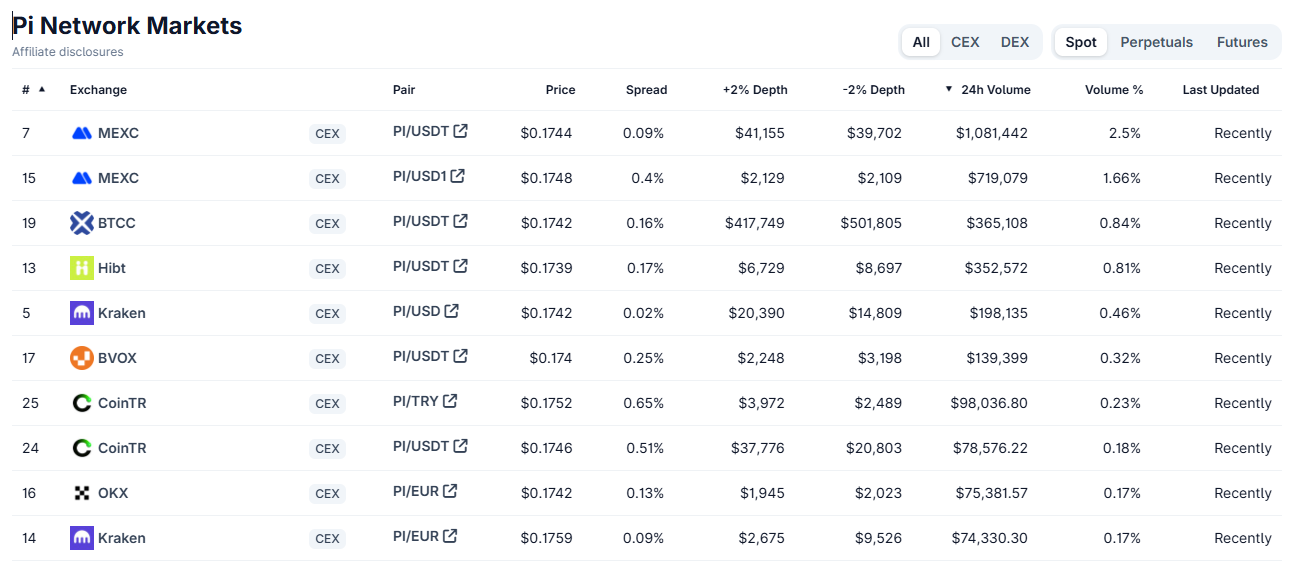
It may still be too early to draw firm conclusions, but these figures suggest that the Kraken listing has not yet attracted a significant wave of new investors.
In addition, PI supply on centralized exchanges (CEXs) has continued to rise, reaching a new high. Exchange reserve data shows that PI holdings climbed to 454 million tokens in March 2026, marking the highest level in recent history.
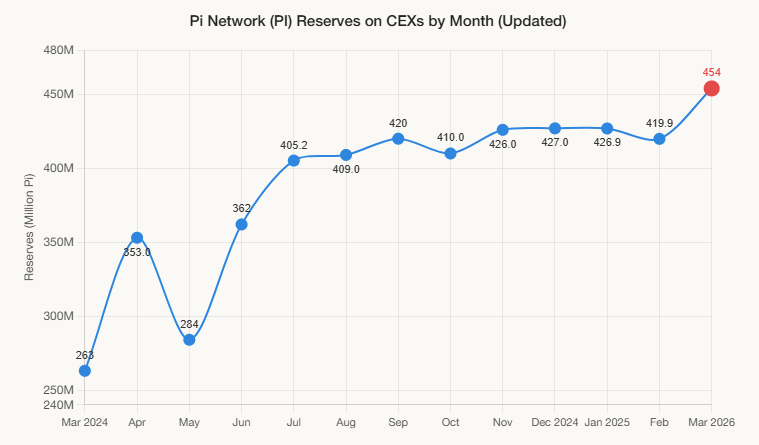
This increase reflects growing selling pressure from long-term holders, especially following periodic token unlocks and the hype surrounding Pi Day. When exchange supply becomes abundant, any new listing can turn into an exit opportunity rather than a bullish catalyst, leading to a classic “sell the news” scenario.
Protocol 20 Upgrade Lays Groundwork for Smart Contracts
However, not everything is negative. Recent updates under Protocol 20 have completed the upgrade of all mainnet nodes to version 20.2, providing the foundation for enabling smart contract functionality.
All major Pi nodes have now been upgraded to version 20.2 and are supporting protocol 20. Pi has also completed the upgrade of its Mainnet blockchain to protocol 20.
— Pi Network (@PiCoreTeam) March 18, 2026
Protocol 20 provides the foundation to enable smart contract capabilities, and the rollout of smart contracts… pic.twitter.com/fxxqgABmdI
The rollout of smart contracts will occur gradually, with a focus on real-world applications and utility. This development could spark renewed expectations as the Pi ecosystem becomes more tangible, including the potential for an internal DEX and utility-driven products.
If these real-world applications successfully attract users, PI’s liquidity and long-term value could improve more sustainably in the near future.
The post PI Drops 40% After Kraken Listing — What Went Wrong? appeared first on BeInCrypto.