
 thecryptobasic.com
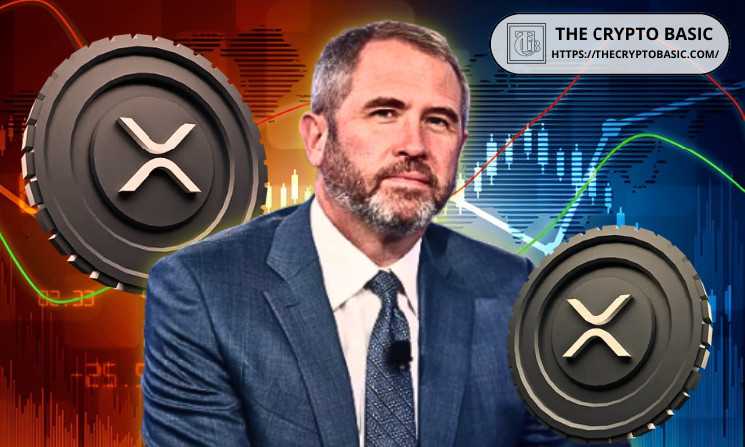
Ripple executives Brad Garlinghouse and Monica Long reflected on the hostility the company faced in its early years, suggesting that certain influential figures were afraid of $XRP technology.
Speaking at $XRP Australia 2026, they argued that recent disclosures from the Jeffrey Epstein files indicate that certain influential figures from MIT Media Lab feared Ripple’s rise. In their views, early resistance to Ripple’s technology may have gone beyond typical market competition.
Key Points
- Brad Garlinghouse and Monica Long reflected on the hostility Ripple faced during its early years.
- They acknowledged that Chris Larsen’s long-standing suspicion that influential figures were working against Ripple gained credibility after the release of the Jeffrey Epstein files.
- The documents suggest that individuals linked to Jeffrey Epstein monitored Ripple and $XRP in their early stages and warned others against investing in the projects.
- Garlinghouse added that some influential figures likely feared Ripple because its technology was far ahead of its time.
Hostility Against Ripple in Its Early Days
During a discussion at $XRP Australia 2026, Ripple CEO Brad Garlinghouse and President Monica Long revisited the intense criticism the company encountered during its early days.
Long explained that while leading Ripple’s communications and marketing efforts, she frequently noticed hostility that seemed unusually intense. She said the backlash against Ripple often felt disproportionate and difficult to explain at the time.
Garlinghouse echoed this view. He noted that Ripple co-founder Chris Larsen had long suspected that certain influential figures were working against the company. In particular, Larsen repeatedly suggested that Joichi Ito, the former head of the MIT Media Lab, held negative views about $XRP and Ripple.
Garlinghouse admitted he initially considered Larsen’s concerns somewhat conspiratorial. However, later developments made some of those suspicions appear more credible.
For instance, he pointed out that Gary Gensler, who later became chair of the U.S. SEC, had ties to the MIT Media Lab ecosystem. Furthermore, Garlinghouse said that recent disclosures from the Jeffrey Epstein files reinforced Larsen’s earlier claims.
Ripple’s Reference in Epstein Files
Indeed, the files revealed several notable references to Ripple. The Epstein files indicate that Ripple and $XRP were monitored during their early development. For example, an unidentified individual reportedly informed Jeffrey Epstein that Ripple co-founder Jed McCaleb was working on a ‘secret Bitcoin-related project,’ which later became the $XRP Ledger.
Another disclosure showed that Austin Hill, co-founder of Blockstream, advised Joichi Ito and Epstein against investing in Ripple and Stellar, describing the projects as threats to the industry.
In addition, the documents revealed that Epstein made inquiries about Gary Gensler, who later served as SEC chair during most of the Ripple lawsuit from early 2021 to early 2025.
During that period, critics often questioned the U.S. SEC’s aggressive approach in the case. Notably, Judge Sarah Netburn criticized the agency, stating that it had not shown “faithful allegiance to the law.”
Influential Figures Viewed $XRP Tech as a Threat
Looking back at Ripple’s early years, Garlinghouse suggested that the company’s technology, built around $XRP Ledger (XRPL), may have appeared threatening to some institutions. In his view, Ripple’s blockchain-based payment infrastructure was far ahead of its time and directly challenged established financial systems.
Nonetheless, despite the alleged hostility, Garlinghouse emphasized that he remains focused on building. His commentary aligns with the company’s focus on advancing its long-term mission to transform global payments by delivering faster, lower-cost settlement solutions.
Meanwhile, the company recently disclosed that Ripple Payments, which has processed more than $100 billion in transactions across over 60 markets, now provides businesses with an integrated platform that includes managed custody and unified collections.