
 thecryptobasic.com
$XRP appears in a U.S. patent from DTCC, which discusses a system for creating and managing liquidity tokens on distributed ledgers.
A U.S. patent application from Securrency and linked to the financial services giant Depository Trust & Clearing Corporation (DTCC) reveals how digital tokens like $XRP could act as bridge assets in tokenized liquidity systems.
Key Points
- The DTCC patent reveals a system where liquidity tokens encode the rules, fees, and settlement logic for converting one asset to another.
- It highlights $XRP as a bridge asset in routes like Asset A – $XRP – Asset B, taking advantage of its fast settlement and on-ledger exchange features.
- XRPL’s decentralized exchange allows issuers to create and trade tokens on-chain, which makes it technically compatible with tokenized liquidity structures.
- The document mentions how cross-ledger interoperability could allow digital assets on one blockchain to convert into tokenized securities on another using bridge assets like $XRP.
Tokenized Liquidity Could Change Financial Markets
Published as US 2024/0005409 A1 on January 4, 2024, the patent reveals a system for creating liquidity tokens that represent the relationship between two assets on distributed ledger platforms. While it emerged two years ago, the document recently began making the rounds in the $XRP community.
The patent comes from Securrency, Inc., a blockchain infrastructure company founded by Dan Doney, which later became part of DTCC. DTCC announced an agreement to acquire Securrency in October 2023, finalizing the deal in December of that year. Following the acquisition, Securrency was rebranded as DTCC Digital Assets.
Notably, the patent mentions a system where tokens show liquidity pathways, essentially describing how one asset can be converted into another. Specifically, each token could encode rules for pricing, fees, and settlement, essentially acting as a digital shortcut for asset exchanges.
$XRP and the XRPL as Liquidity Bridges
The patent specifically highlights the $XRP Ledger (XRPL) as an example of a blockchain capable of supporting these liquidity pathways. XRPL’s fast settlement and built-in decentralized exchange features make it the perfect bridge between different assets.
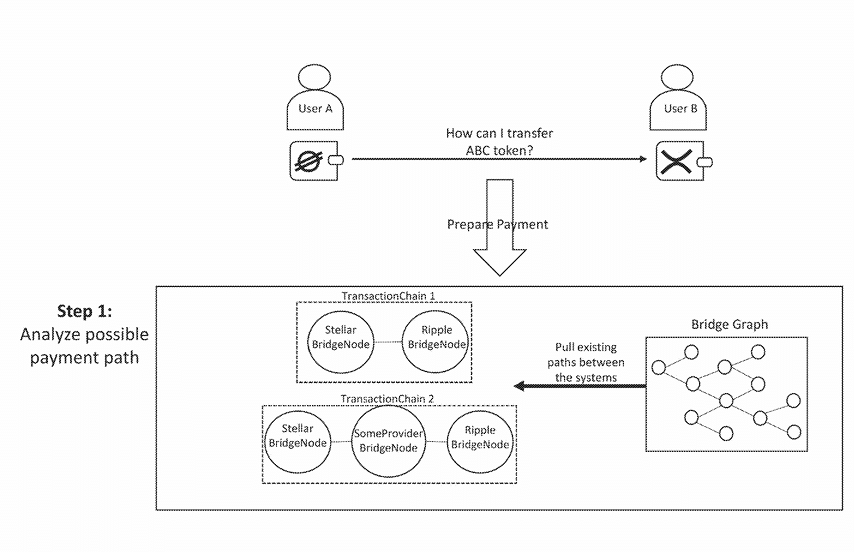
In the thesis, a liquidity token could represent a route like Asset A to $XRP to Asset B. Here, $XRP acts as the intermediary that allows value to flow between assets or ledgers that wouldn’t normally be compatible.
Interestingly, this is similar to $XRP’s bridge-asset model: instead of needing direct liquidity between every asset pair, transactions can pass through a widely available intermediary. The process reduces friction and improves execution efficiency.
The patent also highlights XRPL’s decentralized exchange infrastructure, which already allows asset issuers to create tokens, trade them on-chain, and settle transactions quickly. This makes it technically compatible with a system designed to tokenize liquidity relationships.
Turning Market Infrastructure into Tradable Assets
Generally, the document sees liquidity tokens as investable assets. A token could represent the economic value of a specific conversion pathway between two currencies, digital assets, or tokenized securities.
Notably, platforms could create a non-fungible token representing a liquidity structure and then fractionalize it into fungible units. Users would then store these tokens in digital wallets and trade them across distributed ledger networks. Essentially, investors could own pieces of liquidity corridors instead of just the underlying assets.
For instance, a token could represent the liquidity path between a stablecoin and $XRP or between $XRP and a tokenized security. When demand for a particular route grows, the token’s value could rise, introducing a new type of asset linked to market infrastructure itself.
Important Caveats
It’s important to note that the patent does not confirm DTCC plans to use $XRP in its systems. XRPL appears as one of several compatible distributed ledgers. Patents often mention multiple blockchains to show technical versatility rather than signal a firm adoption plan.
Nonetheless, $XRP’s inclusion in a patent tied to a major financial infrastructure player has sparked interest. It demonstrates that tokenized liquidity corridors can support bridge assets like $XRP, especially for cross-ledger transactions where direct liquidity is limited.