
 thecryptobasic.com
-
$XRP pundits say Ripple’s $4B expansion shows ambitions far beyond $1–$20 price expectations.
-
Nick Shukri highlights Ripple’s acquisitions signal a long-term build for global financial infrastructure.
-
Key deals include Hidden Road, GTreasury, Rail, and Palisade, enhancing liquidity, treasury, and payments.
-
Ripple aims to bridge TradFi and DeFi, boosting $XRP adoption and on-chain liquidity through its ecosystem.
$XRP commentators believe Ripple’s multibillion-dollar expansion strategy shows ambitions far beyond modest price expectations for $XRP.
Nick Shukri, a crypto commentator on X, stated that Ripple’s aggressive investment in financial infrastructure suggests the company is building toward a much larger long-term outcome for the asset.
In particular, Shukri stressed that “Ripple did not spend billions of dollars” for $XRP’s price to linger around $1, $2, and $3 or even the ambitious $20. For context, $XRP is trading at above $1.40 today.
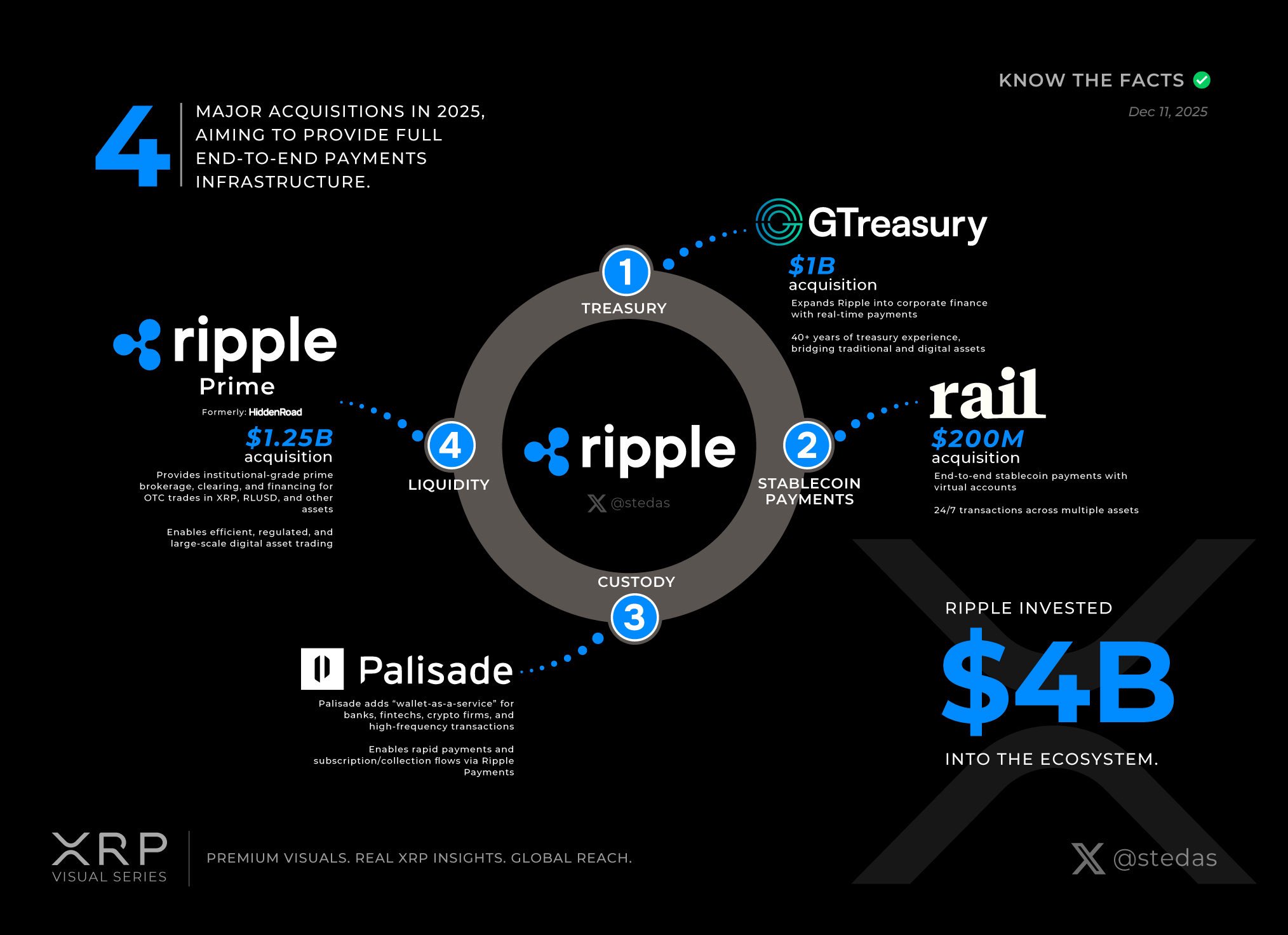
His remarks came alongside an infographic outlining four major acquisitions completed in 2025. To gether, the investments form part of Ripple’s plan to create an end-to-end global payments and liquidity infrastructure.
Key Points
Ripple’s $4B Ecosystem Expansion
According to the infographic shared by Shukri, Ripple has invested roughly $4 billion into its ecosystem, targeting key areas of financial infrastructure, including liquidity, custody, treasury management, and stablecoin payments.
One of the most notable deals is the $1.25 billion acquisition of Hidden Road, which has since been integrated into Ripple’s platform as Ripple Prime. The firm operates as an institutional prime brokerage service. It offers clearing, financing, and trading infrastructure for over-the-counter digital asset transactions, including $XRP and Ripple’s stablecoin $RLUSD.
Another major purchase was GTreasury (now Ripple Treasury), a treasury management platform acquired for about $1 billion. The company brings decades of experience in corporate treasury operations and processes trillions of dollars in payments annually.
Ripple plans to integrate blockchain capabilities into that system, introducing crypto and stablecoin functionality to corporate finance workflows.
Ripple also acquired Rail, a stablecoin payments platform, in a deal worth around $200 million. Rail provides virtual accounts and enables 24/7 stablecoin payments across multiple digital assets.
Completing the group of acquisitions is Palisade. This wallet infrastructure provider adds “wallet-as-a-service” technology for banks, fintech firms, and crypto companies. The system supports high-frequency transactions, subscription payments, and rapid settlement flows through Ripple’s payment infrastructure.
Ripple’s Strategy: Bridging TradFi and DeFi
Ripple leadership has repeatedly emphasized that these acquisitions are part of a plan to connect traditional finance with decentralized finance.
During a recent interview, Ripple CEO Brad Garlinghouse explained that the company’s acquisitions seek to build infrastructure that integrates crypto into existing financial systems.
He noted that many institutions, including corporate treasurers and financial executives, are actively searching for ways to modernize payments and settlement systems using blockchain technology.
Ripple believes its expanding suite of services, from custody and liquidity to treasury software and stablecoin payments, can serve as the bridge between traditional financial markets and on-chain infrastructure.
$XRP Role in Ripple’s Expansion
Ripple executives maintain that these investments strengthen the ecosystem around $XRP and the $XRP Ledger.
Garlinghouse has previously said the company’s acquisitions are strategically aligned with improving liquidity and utility across the network. The introduction of Ripple’s stablecoin $RLUSD deepens on-chain liquidity and supports institutional use cases.
For supporters like Shukri, the scale of Ripple’s spending suggests that the company is building financial rails that could support far greater adoption of $XRP than current price levels imply.
Moreover, a higher $XRP price benefits Ripple, considering its holding nearly 40% of the coin’s supply. In this context, a $25 $XRP price would mean about $1 trillion for the firm.