
 thecryptobasic.com
A new Japanese payment platform, Vlightup Inc., has launched a global trade finance payment system built on the $XRP Ledger (XRPL).
Popular XRPL dUNL validator Vet spotlighted the rollout, suggesting that the launch is part of Vlightup’s efforts to modernize traditional financial processes.
According to a press release, the platform introduces multi-party smart escrow functionality for Letter of Credit (LC) transactions, directly targeting the lingering inefficiencies in traditional trade finance settlement.
Key Points
- $XRP Ledger serves as a settlement infrastructure for Vlightup’s new trade finance platform.
- Vlightup aims to eliminate the final friction in traditional finance by leveraging XRPL’s native escrow functionality.
- Funds will be locked until all predefined consensus conditions are satisfied, preventing any single participant from unilaterally blocking or diverting payments.
- The new service depends on advanced smart escrow capabilities, which are expected to become fully available on XRPL.
Rationale Behind the Platform
Vlightup aims to eliminate what it describes as the “last friction” in TradFi. This includes the manual, delay-prone, and risk-exposed payment execution layer that remains even after trade documentation has gone digital.
Although global trade has steadily adopted electronic documentation, such as electronic Letters of Credit and electronic Bills of Lading, settlement execution still depends heavily on manual verification, discretionary approvals, and fragmented banking systems. As a result, delays, disputes, and fraud risks persist despite digital documentation.
Leveraging XRPL to Address Bottlenecks
To resolve these bottlenecks, Vlightup built its solution on XRPL. The company combines XRPL’s native escrow functionality with a proprietary distributed consensus algorithm to power the system.
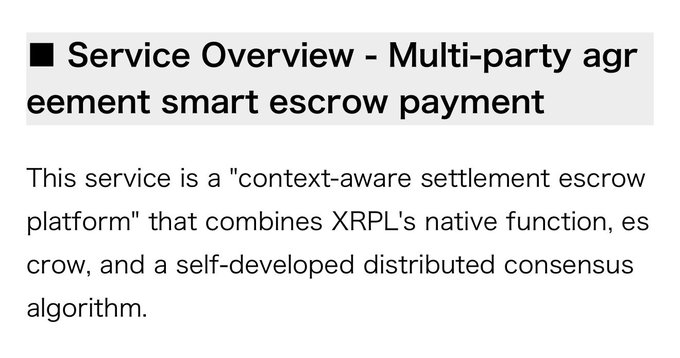
Specifically, the platform enables multi-party smart escrow settlement, where each stakeholder in an LC transaction holds distributed signature authority. Funds remain locked on the $XRP Ledger and are released only when predefined consensus conditions are met. Consequently, no single participant can unilaterally block payments or divert funds.
Notably, the development follows the activation of the Token Escrow amendment, XLS-85, which enables escrows for Multi-Purpose Tokens (MPTs) and Trust Line Tokens.
It’s worth noting that XRPL provides deterministic transaction finality, built-in escrow features, low transaction costs, and strong throughput. In addition, XRPL natively supports multi-signature governance, reinforcing its suitability for multi-party LC consensus structures. Supporters argue that these qualities make it well-suited for institutional trade settlement.
Meanwhile, Vet further noted that Vlightup’s new service hinges on advanced smart escrow capabilities once available on XRPL.