
 coinfomania.com
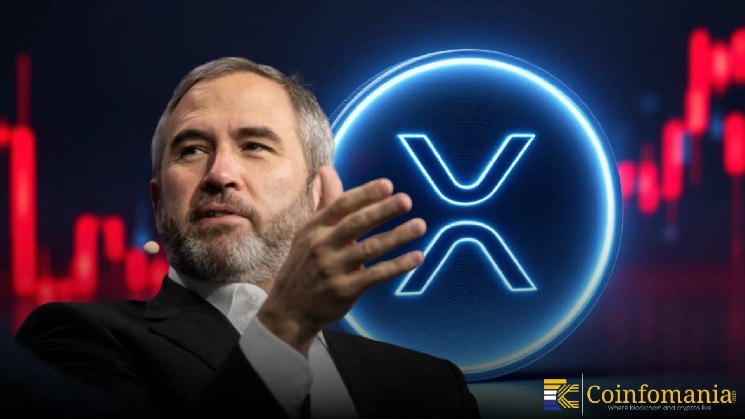
There is growing buzz around $XRP and the idea that trillions of dollars could eventually flow into its ecosystem. The debate intensified after comments from Brad Garlinghouse about the enormous size of global payments infrastructure and blockchain’s still limited role in it. While he spoke about long-term opportunity, some market participants expanded his remarks into aggressive valuation projections.
$10 TRILLION INTO #$XRP? 🤔
— John Squire (@TheCryptoSquire) March 2, 2026
Brad Garlinghouse says up to $10T could flow into #$XRP, potentially sending the price toward $178 per coin.
Mass liquidity. Institutional scale.
The shift is coming. pic.twitter.com/DtWxvETU7V
$XRP $10 Trillion Interpretation
Garlinghouse pointed out that trillions of dollars move through traditional financial systems every day, with most transactions occurring off-chain. Supporters interpreted this as an opening for blockchain-based settlement solutions, positioning $XRP as a potential liquidity bridge. Based on that view, some analysts speculate that up to $10 trillion in value could eventually move through $XRP-powered systems. However, Garlinghouse did not endorse any specific valuation target. The widely discussed $178 price projection comes from independent market speculation, not from official guidance.
How the $178 Price Target Emerged
Analysts derived the projection using a simplified calculation. They estimated potential capital inflows and divided that figure by $XRP’s circulating supply of roughly 56 billion tokens to reach a theoretical price. Although the math appears straightforward, it assumes that all projected capital would directly impact spot demand. In reality, markets operate through complex mechanisms. Liquidity distribution, derivatives markets, treasury management strategies, and institutional settlement models all influence how capital affects price. Historical examples from Bitcoin show that linear projections often overstate outcomes because markets respond to layered dynamics rather than single-variable formulas.
Why Institutions Monitor $XRP
Ripple continues to position $XRP as a bridge asset for cross-border payments, aiming to improve settlement speed and reduce transaction costs. Banks and financial institutions seeking faster global transfers may view blockchain-based liquidity as an alternative to legacy rails. If adoption expands meaningfully, transactional demand for $XRP could increase. However, institutions require regulatory clarity, technical scalability, and proven reliability before committing at scale. Real progress in these areas determines whether theoretical potential turns into measurable usage.
Sentiment and Market Psychology
Large price targets naturally attract attention, especially among retail investors. Social media often amplifies bold projections, driving short-term volatility. From a crypto today perspective, expectations can influence price action before fundamentals fully materialize. Meanwhile, experienced market participants focus on verified adoption metrics, network activity, and institutional commitments rather than headline figures. This ongoing tension between optimism and caution continues to shape broader crypto sentiment.
What Must Happen for Real Growth
For $XRP to reach transformative valuation levels, real-world integration must expand significantly. Banks and payment providers would need to incorporate $XRP into settlement flows at scale, increasing consistent transactional demand. Regulatory clarity across major jurisdictions would reduce barriers to entry, while infrastructure must handle large transaction volumes securely and efficiently. Historically, sustainable growth in crypto markets has followed steady utility expansion rather than speculative modeling alone.