
 u.today
In the world of meme coins, Dogecoin might still have the original fanbase, but when it comes to February's performance, Shiba Inu ($SHIB) is leaving $DOGE in the dust.
CryptoRank's historical return data shows an unexpected but consistent divergence: while Dogecoin has averaged negative returns in February at -2.33%, Shiba Inu has delivered a solid average of +9.26% since 2021. That is a 397% imbalance between the two coins in this particular month.
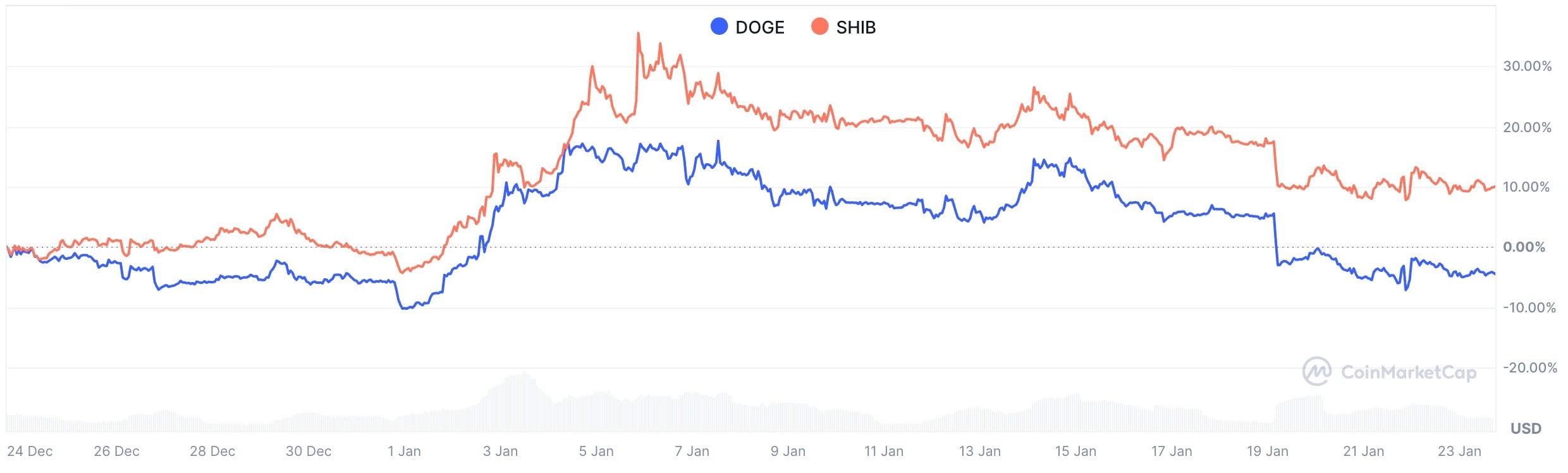
In 2024, $SHIB surged by 41.3% in February, while $DOGE took a nosedive of almost 39%. In 2023, the former stayed green again, while the latter lost 16%. Even in 2022, when everyone was getting nervous and avoiding risk, $SHIB went up by 20.3%, while $DOGE dropped by 6.05%.
Three years in a row with the same outcome — $SHIB has never had a worse February than $DOGE since its existence. Not once.
$DOGE and $SHIB are no longer playing same game
The 21Shares Dogecoin ETF (TDOG) launched earlier this week, and it has even further established $DOGE into a beta proxy for Nasdaq flows. Grayscale trust products and 2x leveraged $DOGE vehicles are drawing in institutional capital and reducing volatility.
Dogecoin has become a meme in name only, mirroring regulated index plays and becoming rather a "safe haven" meme asset. Shiba Inu, on the other hand, is still what $DOGE used to be: speculative and unregulated.
And in February, that profile pays off.
$SHIB's seasonal anomaly — a pattern of post-January decoupling and double-digit rallies — shows a regular liquidity rotation into high-beta outperformers. Based on historical heatmaps, there is a good chance that if the fractal persists, Shiba Inu will have a 15-20% lead.
So, as February nears, things are looking pretty clear for major meme coins: Dogecoin offers ETF stability, but the Shiba Inu coin has a seasonal advantage.