
 coindesk.com

Traders who prize both leverage and decentralization continue to gravitate toward Hyperliquid. The perpetuals-focused decentralized exchange has pulled further ahead of its rivals, such as Aster and Lighter, who struggle to convert short-term activity into durable trading volumes.
Over the past seven days, Hyperliquid processed about $40.7 Billion in perp trading volume, according to data from CryptoRank and DefiLlama, outpacing Aster at $31.7 Billion and Lighter at $25.3 Billion.
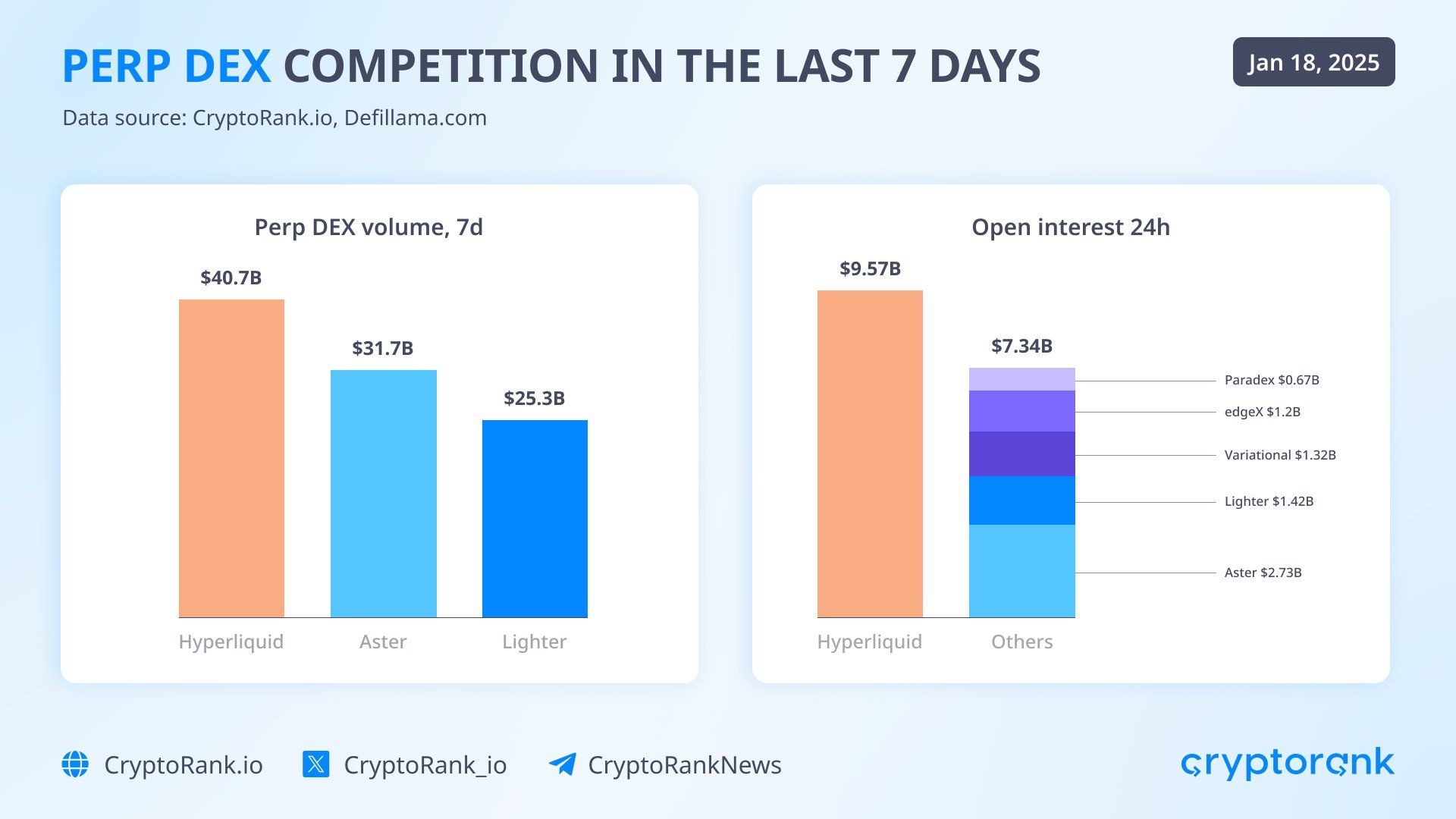
The gap is even more pronounced in open interest, a measure of where traders are willing to hold leveraged positions rather than simply rotate flow. Over the last 24 hours, Hyperliquid held roughly $9.57 Billion in open interest, while other major perp DEXs combined, including Aster, Lighter, Variational, edgeX and Paradex, accounted for about $7.34 Billion.
That imbalance suggests Hyperliquid is becoming the primary venue where traders park risk, not just chase volume.
The divergence has sharpened as incentive-driven activity fades elsewhere. Lighter, which saw volumes surge ahead of its airdrop in late December, has experienced a sharp slowdown in activity since distribution began, with weekly trading volume falling nearly threefold from its December peak of over $600 million. The drop highlights how quickly liquidity can retreat once token rewards are reduced or realized.
The pattern echoes a broader concern raised on the sidelines of Token2049 by BitMEX CEO Stephan Lutz, who warned that many perp DEXs rely on incentive-heavy models that struggle to retain liquidity once rewards normalize.
In an interview with CoinDesk, Lutz described token incentives as a form of paid advertising that can generate bursts of activity but often fails to sustain long-term risk commitment.
Lighter’s post-airdrop decline reflects that vulnerability, even as Hyperliquid’s larger share of open interest suggests it may be better positioned to retain traders when incentives fade.
Still, operational dominance has not translated into token strength. Like other exchange and DeFi governance tokens, Hyperliquid’s HYPE has come under pressure in recent weeks, reflecting persistent skepticism around emissions, value accrual and long-term economics.
For now, the market appears comfortable separating venue utility from token exposure. Hyperliquid is winning the competition for flow and leverage, but whether it can turn that lead into durable economic value for token holders remains an open question.