
 bsc.news

Table of Contents
Celestia has announced Fibre Blockspace, a new data availability protocol designed to sustain 1 terabit per second (Tb/s) of blockspace across roughly 500 validator nodes, marking a decisive shift away from throughput as the primary limiting factor in blockchain design. Introduced on January 13, 2026, Fibre operates alongside Celestia’s existing data availability layer and is aimed at applications that require extremely high bandwidth, low latency, and predictable costs at scale.
The announcement positions Celestia as moving into what it describes as a post-throughput phase. Rather than focusing on incremental gains in transactions per second, the protocol is designed to make blockspace sufficiently abundant that entire categories of markets and applications previously impractical on blockchains can operate fully onchain.
From Scarce Blockspace to Abundant Bandwidth
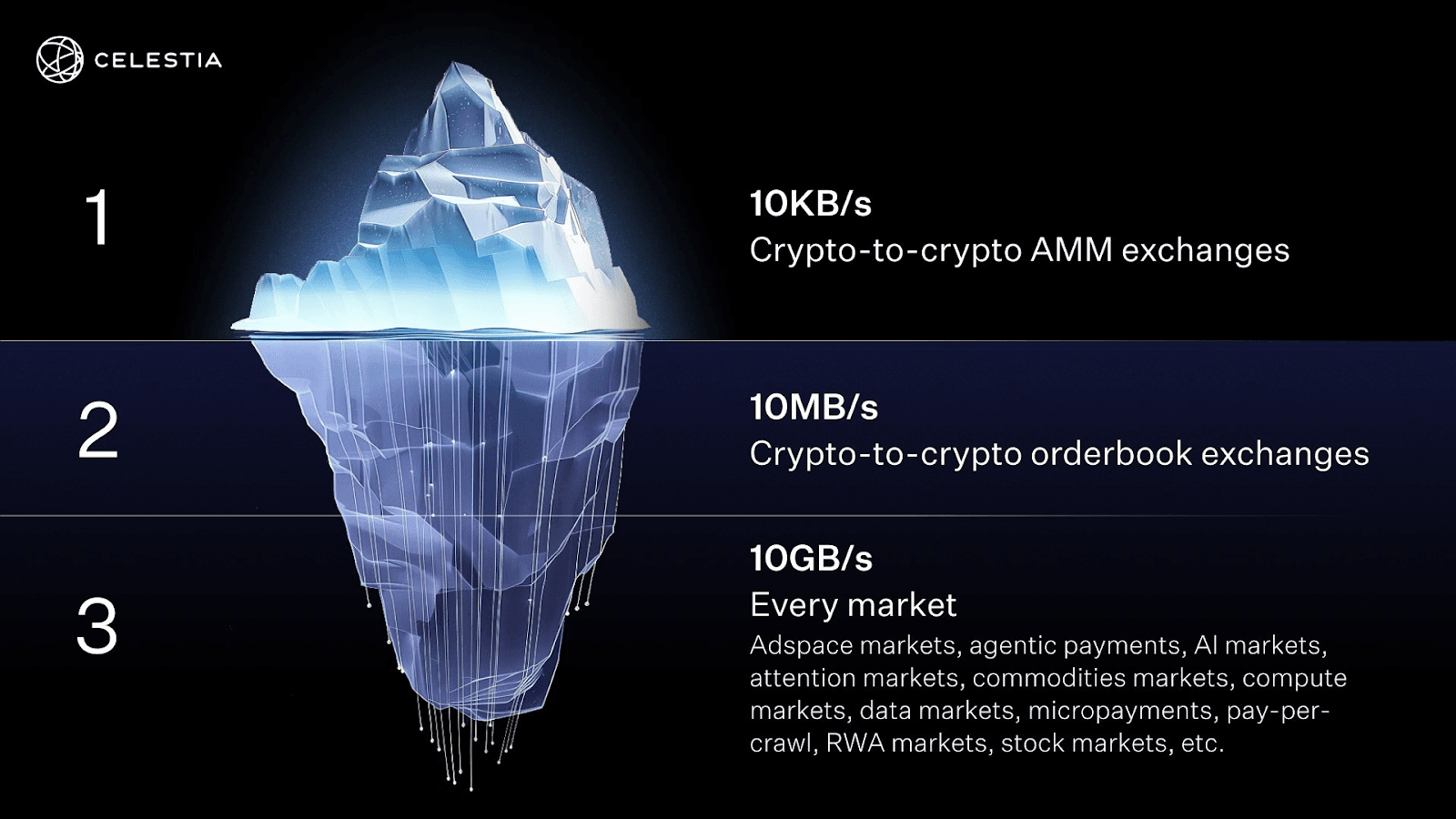
Celestia frames the evolution of blockchain throughput in three broad bandwidth regimes, each corresponding to a distinct phase of market design.
The earliest regime, roughly 10 kilobytes per second, supported automated market makers on monolithic Layer 1 blockchains. These constraints were sufficient for simple spot trading but limited the complexity and frequency of onchain interactions. Protocols such as Uniswap emerged in this environment.
The second regime, between 1 and 10 megabytes per second, enabled onchain order books and perpetual futures. This enabled more sophisticated crypto-native markets, including centralized limit-order book designs, to move onchain. Projects such as Hyperliquid and Bullet were built around these throughput levels.
Fibre targets a third regime from 1 gigabyte per second up to 1 terabit per second, which Celestia describes as sufficient for “everything markets.” At this scale, blockspace is no longer reserved for financial trades alone. Instead, it can accommodate continuous, high-volume writes tied to user actions, automated agents, and machine-driven activity.
Celestia estimates that 1 Tb/s corresponds to approximately 1.25 billion transactions per second, or roughly one transaction per second for every human on Earth. “If 10KB/s enabled AMMs, and 10MB/s enabled onchain orderbooks, then 1Tb/s is the leap that enables every market to come onchain - roughly 1 transaction per second for every human on earth, or for every agent they own,” the Celestia blog reads.
While this framing is illustrative rather than predictive, it underscores the intent to remove scarcity pricing as the dominant design constraint.
What is Fibre?
Fibre is not a replacement for Celestia’s existing Layer 1 data availability protocol. It runs in parallel, giving developers and rollup operators the option to choose based on their requirements.
Celestia L1 blockspace remains optimized for early-stage rollups and applications that prioritize maximum end-user verifiability. It supports data availability sampling, has no minimum blob size, and caps individual blobs at 8 MB.
Celestia Fibre blockspace is designed for high-throughput use cases. It enforces a 256 KB minimum blob size and allows blobs up to 128 MB, trading finer-grained flexibility for significantly higher sustained bandwidth.
This dual-track approach reflects Celestia’s modular architecture, allowing different applications to make different trade-offs without imposing a single operating mode on the entire network.
Inside the Fibre Protocol
At the core of Fibre is a new ultra-fast target="_blank" rel="noopener noreferrer">Zero-Knowledge Optimized Data Availability (ZODA). ZODA serves as an alternative to KZG commitments, which are used in several existing data availability designs, including Ethereum’s Danksharding roadmap.
According to Public resources, ZODA enables data encoding and processing that is up to 881 times faster than comparable KZG-based approaches. This improvement is central to Fibre’s ability to sustain terabit-scale throughput without overwhelming validators.
The protocol flow works as follows: A user encodes a data blob locally using the ZODA-based scheme. The encoded pieces are distributed directly to Celestia validators participating in Fibre. Validators store their assigned pieces and return signatures confirming receipt. The user aggregates these signatures and submits them, along with a blob commitment, to the Celestia L1. Fees for Fibre usage are paid on the L1, anchoring Fibre activity to the main chain.
The encoding guarantees that the original data blob can be reconstructed from any one-third of honest validators, preserving data availability assumptions even under partial validator failure or adversarial conditions.
Benchmarking at Terabit Scale
Celestia reports that the 1 Tb/s milestone was achieved during a large-scale test of Fibre’s networking layer. The benchmark used 498 Google Cloud machines distributed across North America. Each machine was equipped with 48 to 64 virtual CPUs, 90 to 128 GB of RAM, and 34 to 45 Gbps network connections.
Under these conditions, the system sustained aggregate throughput at the terabit-per-second level. Celestia has released the codebase publicly, along with instructions for running a local single-node testnet, allowing independent verification and experimentation.
While these results were achieved in a controlled environment, they represent a measured performance test rather than a purely theoretical claim.
Use Cases Enabled by Fibre Blockspace
Many of the applications Celestia highlights depend on highly abundant, low-cost blockspace with millisecond-level latency, characteristics that are difficult to achieve on conventional Layer 1 or standard Layer 2 systems.
- Adspace and attention markets become feasible when every page view can trigger a real-time onchain auction for impressions, and attention itself can be traded as a composable asset.
- Pay-per-crawl markets allow websites to set explicit prices for crawling or querying by large language models and autonomous agents, providing an alternative revenue model as traditional advertising declines.
- Agentic payments using HTTP 402-style mechanisms require reliable micropayments for API calls, data fetches, and model queries. Fibre-supported chains can function as verifiable servers for these interactions.
- Traditional assets such as stocks and commodities can be traded onchain with continuous price discovery and permissionless access to order books.
- Micropayments for content and services, including per-second streaming and per-article billing, can be coordinated natively onchain rather than through centralized subscription platforms.
- Onchain data markets enable pay-per-query databases and cross-application data joins, monetizing both reads and writes.
These categories share a common requirement for transaction volume that would be prohibitively expensive or slow under existing blockchain cost structures.
What it Means for the Crypto Landscape
Fibre’s throughput claims place Celestia beyond the performance envelope of most execution-focused chains. High-performance monolithic systems such as Solana typically report peak throughput of tens of thousands of transactions per second under optimal conditions.
Celestia’s approach differs in that it does not attempt to execute all transactions itself. By focusing exclusively on data availability and leaving execution to rollups, it aims to scale bandwidth without centralizing execution logic. This separation of concerns is central to its modular design.
What Next for Fibre Development and Beyond?
In the near term, Celestia plans to roll Fibre out to the Arabica testnet, enabling developers to integrate and test high-throughput applications. Mainnet deployment is expected to follow in stages, with incremental increases in allowed throughput rather than an immediate jump to full capacity.
Beyond Fibre, Celestia has indicated that future work will focus on improving verifiability and reducing friction for developers and end users, including enhancements to data availability sampling and rollup tooling.
Conclusion
Fibre Blockspace represents a clear inflection point in Celestia’s technical roadmap. By demonstrating sustained terabit-per-second data availability across hundreds of nodes, the project shifts attention from raw throughput constraints to the practical use of abundant blockspace.
Fibre does not guarantee adoption or eliminate the need for careful protocol design. It does, however, provide a concrete foundation for applications that depend on continuous, high-volume data flows that have historically been out of reach for blockchain systems.
Sources:
- Celestia Blog: Introducing Fibre 1Tb/s of Blockspace
- Blockchain.news: Coverage of the Fibre announcement