
 thedefiant.io

Former New York City Mayor Eric Adams is facing backlash from crypto traders after the $NYC token he promoted this week surged and then dropped sharply amid allegations of a “$2.5 million rug pull.”
At the time of writing, $NYC was trading around $0.134, or a $134 valuation. The token had a volatile first 24 hours, briefly reaching a fully diluted valuation of around $580 million before falling sharply, according to DexScreener.
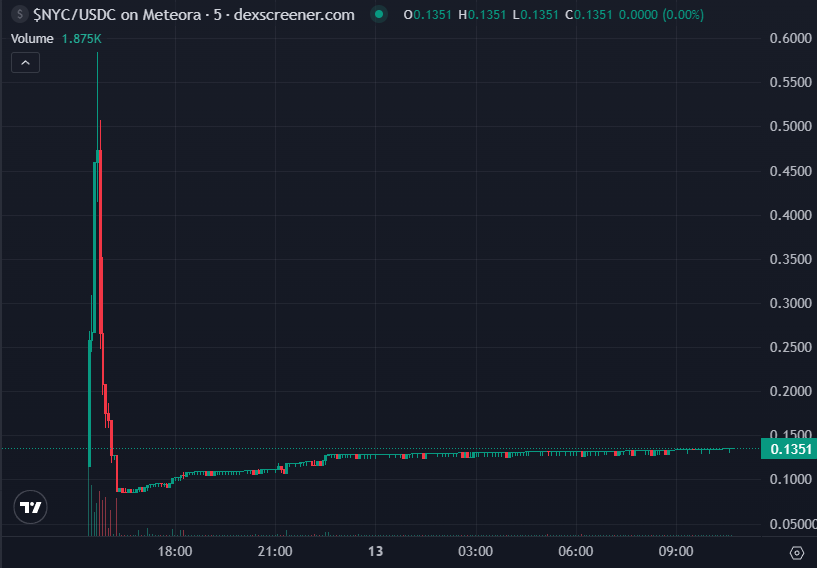
The situation highlights how quickly political hype can drive memecoins up – and how quickly they can fall when only a few wallets control most of the token supply and liquidity.
What happened?
NYC Token was introduced at a Times Square event on Monday, with Adams framing it as a crypto project meant to fight antisemitism and “anti-Americanism,” as well as educate young people on blockchain technology, according to the official website.
Shortly after launching, analysts said a wallet connected to the token’s deployer removed roughly $2.5 million in USDC near the top. Later, about $1.5 million was added back after the price had already dropped more than 60%, leaving around $900,000 still missing, according to on-chain data.
CoinGecko also displayed a warning from Rugcheck.xyz, which flagged a risk of market manipulation due to a large portion of the token being held by one or more unidentified wallets.
What’s the latest?
The official NYC Token account said on X late Monday night that its partners “rebalanced the liquidity” after strong demand at launch. The account added that it was aware of reports about liquidity being removed and that more funds were later added back.
Some users replied that the liquidity still looked unusual even after the team said it had rebalanced. Nicolai Sondergaard, a research analyst at Nansen, said in comments shared with The Defiant that the liquidity behavior “does seem to fit the umbrella term that is ‘rug pulls’.”
“If the rebalancing was to be legitimate, it would have been announced beforehand,” Sondergaard said. “It would also have made more sense to adjust the ranges instead of fully removing liquidity from the pool, only to add some again later.”
Sondergaard said the move effectively trapped traders, “forcing many to sell at a loss in a lower-liquidity environment.” He added that putting funds back later “does not undo the damage done,” and that “setting up DCA orders” also would not reverse losses, calling it “a bandaid solution.”