
 crypto.news

Polygon’s native token extended its rally for an eighth straight session, climbing to its highest level since Dec. 2 as network activity surged, alongside the company’s unveiling of the Open Money Stack — a modular, chain-neutral payments infrastructure aimed at enabling regulated, interoperable stablecoin payments and modernizing global money movement.
As part of the shift, Polygon is formally positioning itself as a payments company, with a rebrand expected in the coming weeks to reflect a fintech- and institution-focused strategy that remains compatible with existing financial rails and regulatory frameworks.
- Polygon token price rose for eight consecutive days.
- The token has jumped by over 20% from its lowest point this year.
- The Supertrend indicator has turned positive for the first time since August.
Polygon (POL), a top layer-2 network, jumped to $0.1300, up by over 20% from its lowest level this year. This rebound continued even as other top cryptocurrencies continued falling.
Data compiled by Nansen shows that the number of transactions on Polygon jumped by 20% in the last 30 days to over 178 million. Its active addresses rose by 28% to over 16 million, while the network fees jumped by 100% to $1.7 million.
The soaring fees have helped to boost the POL burn rate, which jumped to over 5 million tokens this week. A token burn is designed to boost a cryptocurrency price by reducing the tokens in circulation.
Yesterday marked an all-time high for single-day fees generated and burned on the Polygon PoS chain.
— Sandeep | CEO, Polygon Foundation (※,※) (@sandeepnailwal) January 6, 2026
3 MILLION POL (0.03% of POL's supply was burnt in a single day) pic.twitter.com/x038HlwQ0i
Polygon has benefited from large partnerships that have boosted its activity. For example, it has a partnership with Polymarket, a top player in the prediction market that was recently valued at over $11 billion.
Polygon has also inked partnerships with fintech giants like Stripe, Shift4 Payments, and Revolut, a top player in the fintech industry currently valued at over $70 billion. These companies select it because it is one of the biggest layer-2 networks in the crypto industry.
Polygon price technical analysis
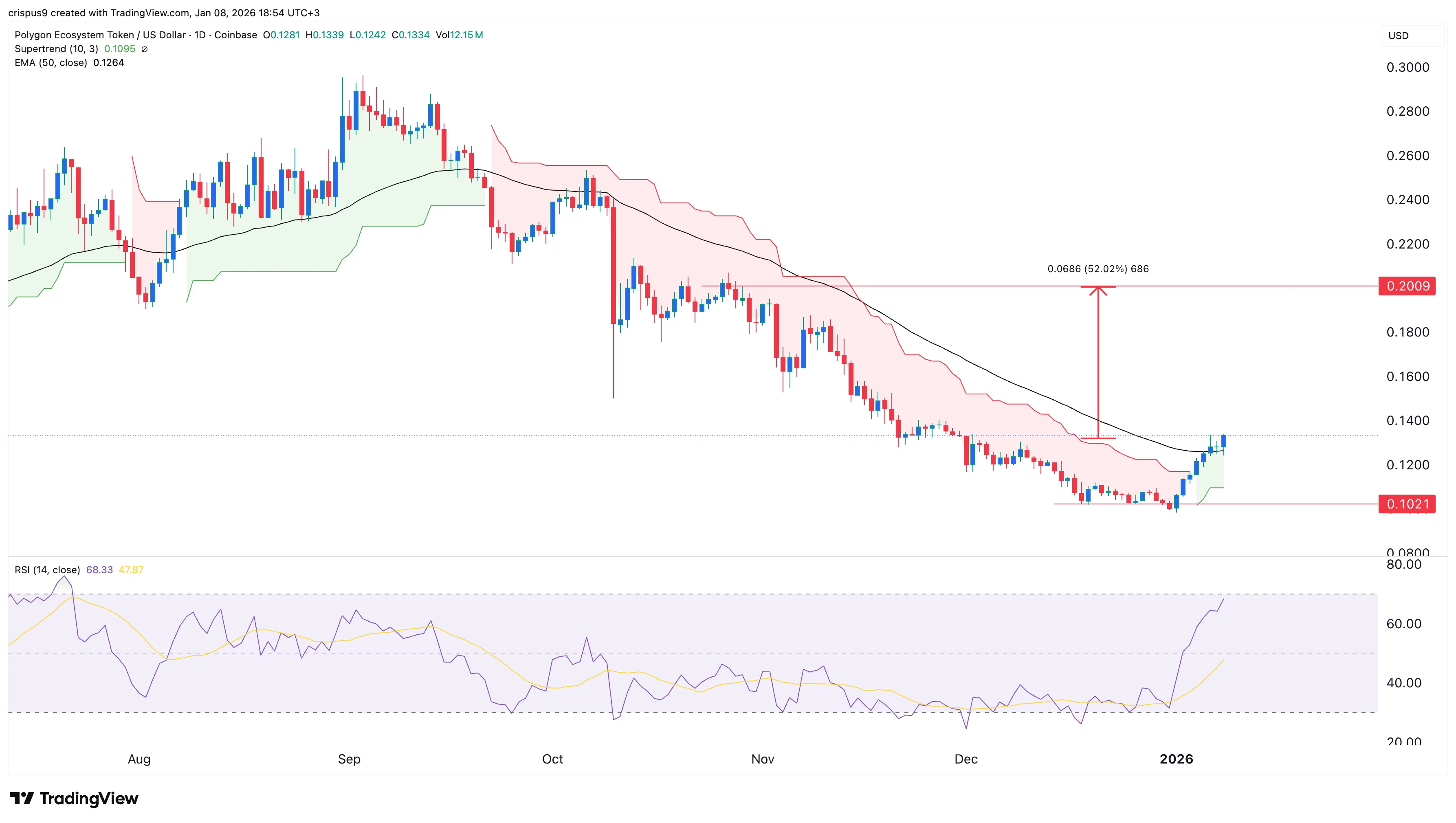
The daily timeframe chart shows that the POL price has rebounded in the past few days, moving from a low of $0.1020 to the current $0.1300.
It has moved above the 50-day Exponential Moving Average (EMA), and most importantly, the Supertrend indicator has turned green for the first time since August last year. In most cases, the Supertrend indicator is one of the most common bullish signs in technical analysis.
The Relative Strength Index has continued to rise and is now approaching the important overbought level of 70.
Therefore, the token will likely continue rising as bulls target the next key resistance level at $0.2000, up by 52% above the current level.
On the other hand, a drop below the support at $0.1020 will invalidate the bullish outlook and point to more downside.
Open Money Stack
Set to launch later this year, the Open Money Stack combines onchain settlement, liquidity, orchestration, and compliance into a single system that fintechs and financial institutions can adopt modularly. The goal is to reduce complexity and time to market while enabling fast, low-cost, cross-border payments that shield users from blockchain frictions like bridging, swaps, or gas fees.
Polygon Labs argues the timing is critical as stablecoins emerge as a core settlement layer for global payments and regulators move toward compliant tokenized-money frameworks. Citi estimates stablecoin issuance could reach $1.9 trillion to $4 trillion by 2030, a scale that will require open, interoperable infrastructure rather than closed networks.
Polygon points to its existing footprint as proof of readiness: its onchain stablecoin supply hit $3.3 billion at the end of 2025, a three-year high, and the network already supports trillions of dollars in stablecoin transfers across real-world payment use cases. That production-level experience, the company says, underpins the design of the Open Money Stack and its ambition to move global money onchain.