
 thecryptobasic.com
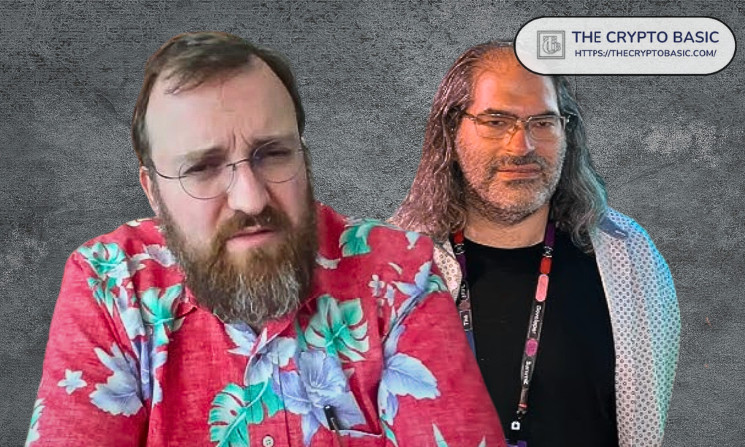
Cardano founder Charles Hoskinson has shed new light on the extensive cross-chain collaboration behind Midnight’s Glacier Drop, highlighting his direct engagement with Ripple’s CTO.
$NIGHT, the native token of Cardano’s privacy sidechain Midnight, has emerged as one of the most talked-about tokens this month. Since it began trading on December 9, it has reached a valuation of about $1.59 billion, with each token priced around $0.096.
Cross-Collaboration Made Glacier Drop a Success
Following its launch, Hoskinson has continued to discuss the project publicly. In a recent commentary, he detailed the broad cross-chain coordination that made the Glacier Drop, the first phase of $NIGHT’s airdrop, possible.
Launched in August 2025, the Glacier Drop spanned eight ecosystems across seven blockchains, including the $XRP Ledger (XRPL), Cardano, Solana, Bitcoin, and Ethereum. Although roughly 33 million users qualified for the airdrop, Hoskinson revealed that only about 1.5 million participants ultimately claimed their $NIGHT allocation.
He emphasized that the distribution deliberately avoided standard crypto launch mechanisms such as insider allocations or initial coin offerings (ICOs). Instead, every eligible participant had an equal right of refusal, reinforcing the goal of fairness and decentralization.
According to him, the Midnight Foundation took roughly 18 months to design the Glacier Drop. The extended timeline stemmed from the technical complexity of working across multiple blockchain architectures, each with its own rules, tooling, and limitations.
To execute the airdrop correctly, Hoskinson said he and his team had to understand how each supporting chain functioned. In some cases, this meant tackling challenges that had never been addressed before.
Working Directly with Ripple CTO
Notably, Hoskinson cited the $XRP Ledger (XRPL) as one of the most challenging ecosystems his team had to study for the Glacier Drop. He explained that XRPL had never supported a distribution of this scale, which forced the development team to seek direct technical guidance.
As a result, they reached out to Ripple CTO David Schwartz, the original architect of the $XRP Ledger. Hoskinson recounted sitting down with Schwartz to gain a deeper understanding of how XRPL functions and how to implement an airdrop of that magnitude.
During these discussions, both teams brainstormed practical solutions that ultimately made the $NIGHT airdrop possible on the $XRP Ledger.
UPDATE: #Cardano $ADA Founder Charles Hoskinson says $NIGHT's Glacier Drop "took 18 months to design. We had to call David Schwartz for $XRP. My engineers have to know how Solana, Ethereum, Avalanche, BNB Chain, $XRP, and Cardano works. You find stuff you like in each ecosystem." pic.twitter.com/lBJZgBJAyl
— Angry Crypto Show (@angrycryptoshow) December 29, 2025
A Shift in Mindset
Beyond the technical breakthrough, Hoskinson said the collaboration reshaped his team’s mindset. He noted that many crypto developers fall into maximalism, focusing exclusively on their own networks while dismissing others.
However, building Midnight required Cardano engineers to run nodes and develop across multiple ecosystems, including XRPL, Solana, and Ethereum. By working with different blockchains, Hoskinson emphasized that it becomes difficult to remain a maximalist, as each network reveals unique strengths.
As reported earlier, Hoskinson reaffirmed that the Glacier Drop framework extends beyond Midnight and serves as a model for launching future projects. Nevertheless, he acknowledged that further refinement is needed, adding that the team expects to fine-tune the protocol over the next six months.