
 crypto-news-flash.com

- Neuron and Hedera are expected to join NATO’s DIANA project as speculations intensify.
- A researcher has disclosed that Hedera’s aBFT is the highest level of security in distributed systems.
A leader in aviation technology and air traffic critical national infrastructure, Neuron, and public distributed ledger Hedera are reported to be making a dramatic entry into the machine economy and the defense sector.
According to reports, they are lined up for a partnership with the intergovernmental military alliance, the North Atlantic Treaty Organization (NATO). Researcher Marco Salzmann has disclosed that a press release will be out soon. Meanwhile, “the signals are already loud.”
All About the NATO and the Hedera Collaboration
On December 10, NATO announced that its flagship project, Defence Innovation Accelerator for the North Atlantic (DIANA), is selecting 150 pioneering companies from 24 NATO countries to participate in the 2026 Challenge program. As part of this, innovators would be tasked with developing dual-use technologies to solve ten critical defense and military challenges.
Shedding more light on this, Salzmann explained that the DIANA program seeks to accelerate autonomous systems, secure communication systems, encourage AI-driven defense innovations, and improve space, aviation, and sensor networks.
According to him, teams selected for the DIANA program would receive up to €400,000 ($468k) in funding. Not just that. They would also have access to NATO’s 10 accelerators and 90 test centers. Additionally, they could have direct collaboration with military end users and also benefit from “long-term adoption pathways into the defense and civilian sectors.”
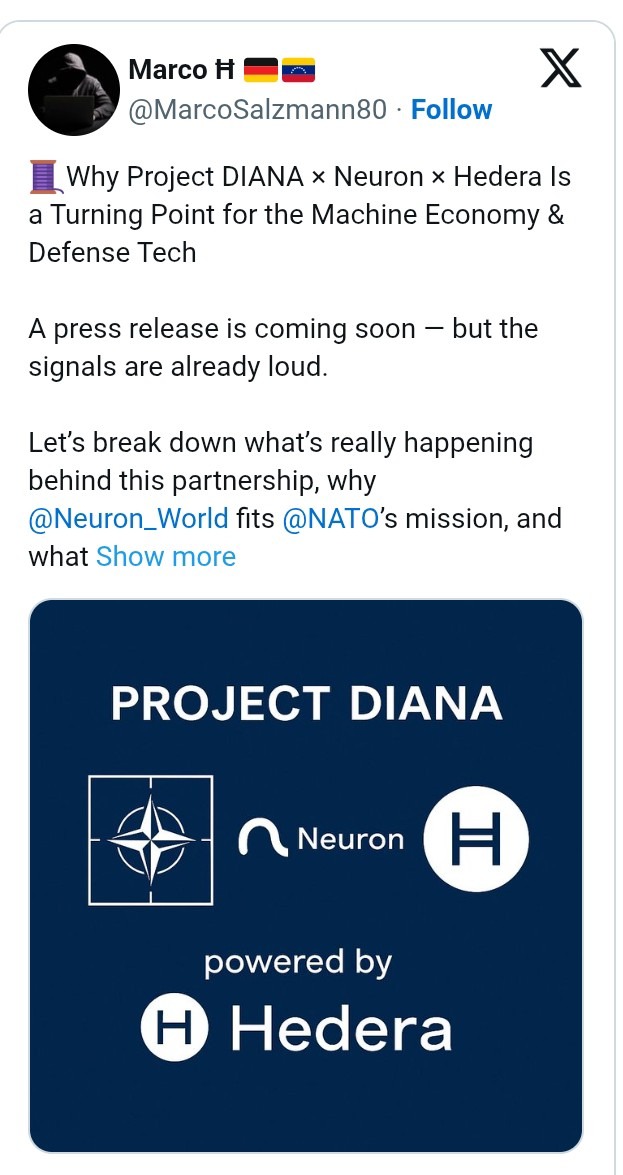
Salzmann believes that Neuron is a good fit since it is already used for geospatial intelligence, real-time flight tracking, edge compute telemetry, and autonomous machine coordination. Also, Neuron has an edge since it is built on Hedera.
Explaining this point, he disclosed that defense systems need high throughput, deterministic finality, energy efficiency, and others. According to him, Hedera ticks all of these boxes.
Technically, Hedera’s aBFT is reported to be the highest level of security in distributed systems. Also, it is built for verifiable trust, which is one of the key requirements for defense technology.
Adding to this, Salzmann highlighted that Neuron could be used by DIANA for real-time location data, cross-border defense operations, drone and Unmanned Aerial Vehicle (UAV) coordination networks, as well as secure battlefield communication systems. In a nutshell, the researcher believes that Hedera’s timestamp and Neuron’s data index could be a perfect combination for this initiative.
According to Salzmann, an official confirmation of this could validate Hedera as a trust layer for critical infrastructure and a backend for autonomous systems.
Amidst the backdrop of this, Hashgraph Ventures has secured the first close of $100 million fund, as detailed in our earlier discussion. Also, Georgia has partnered with Hedera to explore blockchain-based upgrades, as noted in our previous post.