The plan had been in the pipeline since 2022, but due to multiple previous proposals, rejections, and delays, it has stayed there, frustrating $UNI holders to no end.
The $UNI token has been doing well since the proposal was revealed, trading above $7 for the first time in weeks. $UNI is currently priced at $9.25 per token, having recovered from a low of $4.95 less than a week ago.
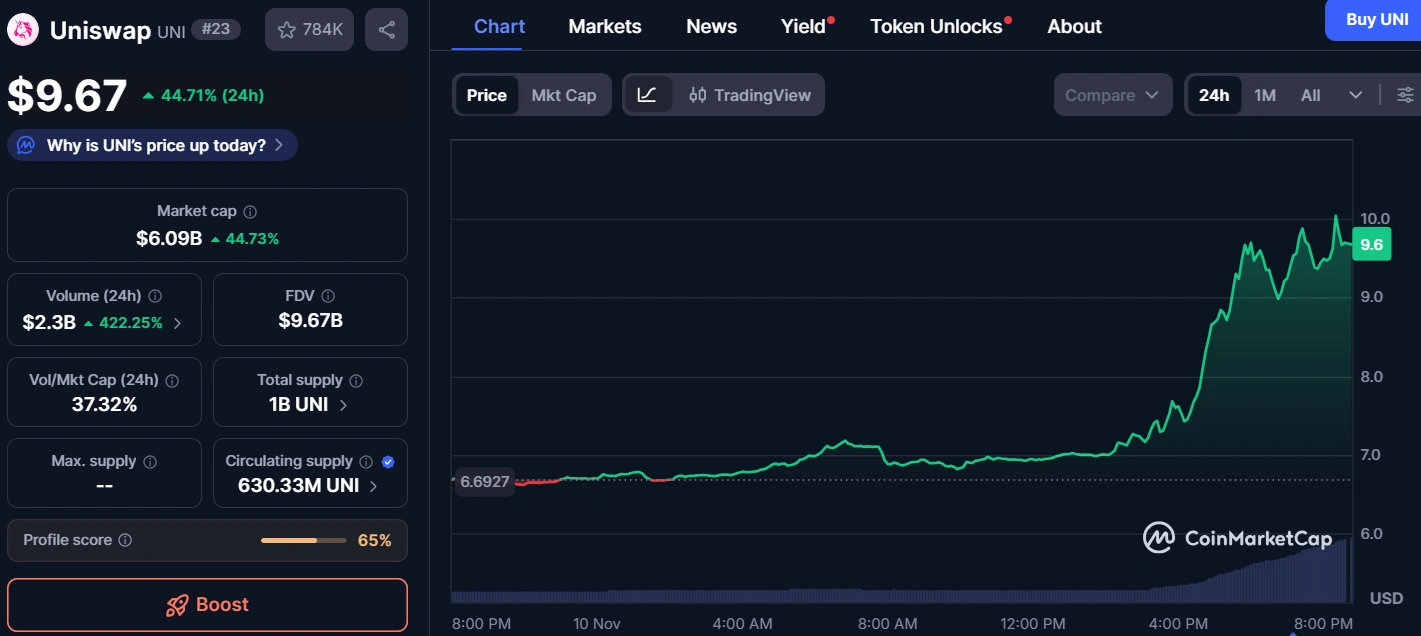
Uniswap’s $UNI token got a jolt from the latest talks of a ‘UNIfication.’ Source: CoinMarketCap
Uniswap Foundation co-founders Devin Walsh and Ken Ng published the UNIfication blog post today, expressing excitement for the opportunity to turn on protocol fees and align incentives across the Uniswap ecosystem.
“We believe this proposal positions the Uniswap Protocol to win as the default decentralized exchange for tokenized value,” they wrote. “Together with Uniswap Labs, we’re proposing a long-term model for the Uniswap ecosystem: one where protocol usage drives $UNI burn and one aligned team focuses on protocol development and growth.”
It remains to be seen exactly what percentage of fees will be allocated to the $UNI burn and incentives, but the community is simply excited; it looks like progress is finally being made after years of sluggish steps forward.
The proposal has gotten hopes up again
The UNIfication proposal addresses the “fee switch” mechanism, which has been in debate for years and was rejected in prior votes.
Aside from the rejection, there were also delays that came from regulatory fears due to the oppressive regime of the SEC under Gary Gensler, as well as governance apathy, which resulted in low voter turnout.
Now that there is a new proposal coming up under the new, more friendly SEC administration, hopes are up once more.
Also, the community does not seem to mind such occasional injections of hope; after all, each time the talk comes up, $UNI’s price reacts with a pump. This may be because of the mechanism’s potential to redirect the billions of protocol fees Uniswap toward $UNI burns and holder rewards, thereby creating deflationary pressure and utility.
Current factors, especially the friendly regulatory environment, make it very likely that the waiting is coming to an end, but it would not be completely surprising to see talk of implementing the mechanism get postponed again.

 cryptopolitan.com