After the incident, Paxos quickly addressed the confusion on X by clarifying that the event was caused by an internal mistake rather than a hack or security breach. “This was an internal technical error,” the company said. “There is no security breach. Customer funds are safe. We have addressed the root cause.” The firm later confirmed that the minting occurred during an internal transfer process and was promptly corrected.
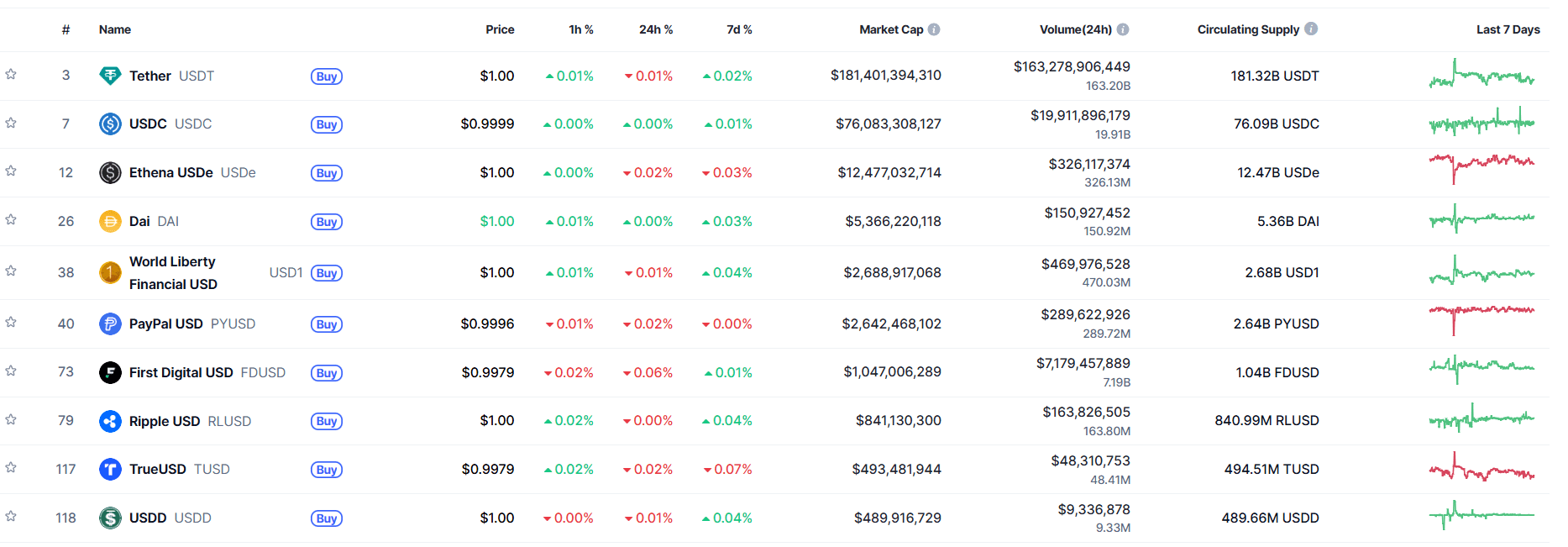
Despite the eye-popping scale of the transaction , $PYUSD’s price remained stable, and briefly dipped only about 0.5% before returning to its dollar peg. At the time of the incident, $PYUSD had a market cap of approximately $2.3 billion, which ranked it as the sixth-largest stablecoin behind industry giants like Tether’s USDT, Circle’s USDC, Ethena’s USDe, MakerDAO’s DAI, and World Liberty Financial’s USD1.
Top stablecoins by market cap (Source: CoinMarketCap)
The episode is now one of the largest token burns in crypto history, though few have come close to such an astronomical figure.
$PYUSD Glitch Shows Blockchain’s Strength
Although it was alarming at first, Paxos’ accidental minting and burning episode became a real-world demonstration of just how blockchain’s transparency can actually strengthen trust in digital finance. The incident occurred at 7:12 pm UTC and was corrected just 22 minutes later. While the scale of the mistake was staggering, the blockchain’s open ledger made it immediately visible, traceable, and easy to correct —which is something rarely achievable in traditional finance.
Kate Cooper, CEO of OKX Australia and a former banking executive, said the incident sheds some light on blockchain’s potential to improve oversight and accountability. “Mistakes happen in every financial system — the difference with blockchain is that they’re visible, traceable, and quickly correctable.” Cooper believes that the same transparency that exposed Paxos’ error is what could strengthen governance and modernize financial operations, adding that this level of openness is virtually “unheard of” in legacy banking systems.
Ryne Saxe, CEO of cross-chain liquidity platform Eco called the Paxos event a “case study” in the benefits of real-time accountability. He said the public nature of blockchain data allows for instant detection and resolution of errors, which is in stark contrast to the more opaque and delayed response mechanisms that is typical in the traditional banking sector.
History is filled with examples of massive financial blunders that stayed hidden for months. Citigroup once accidentally credited $81 trillion to a client’s account in 2024, while Deutsche Bank mistakenly transferred €28 billion to a partner in 2015. These mistakes took hours or even months to correct and disclose.
Still, experts warn that the Paxos event also proves that there is a need for stricter operational controls in stablecoin management. Fireblocks vice president Shahar Madar said that “minting $300 trillion is a preventable mistake,” and that stablecoin issuers should enforce stronger security policies to govern every step of token creation and destruction. Even though blockchain’s transparency proved its worth, the incident still serves as a reminder that human and technical safeguards must evolve alongside the technology itself.

 coinpaper.com