
 beincrypto.com

Meteora is stirring the Solana community with a controversial proposal: to allocate 3% of the TGE fund to $JUP stakers, not in regular tokens but in Liquidity Position NFTs.
This novel approach promises to bootstrap deep liquidity for $MET from day one, yet it raises questions about fairness and concentration risk. Will this be a savvy move to bridge the two communities, or will it ignite a prolonged debate?
3% Allocation for $JUP Staker
As BeInCrypto reported, Meteora is preparing for a TGE in October. The platform floated one of the community’s most notable proposals ahead of $MET’s TGE.
Under the plan, the project intends to allocate 3% of the TGE fund to Jupiter’s $JUP stakers as Liquidity Position NFTs. Specifically, Meteora would use the 3% to seed $MET liquidity in a Single-Sided DAMM V2 pool, then allocate positions to Jupiter stakers based on time-weighted staking, amount, and voting activity.
The objective is to create $MET/$USDC liquidity at listing without immediately adding more $MET to the circulating supply. The proposal also emphasizes that “no additional tokens circulating will be added due to this proposal.” This is a “liquidity-first” approach rather than a direct token payout.
Meteora’s Co-Lead, Soju, published a public calculation to visualize scale. According to Soju, roughly 600 million $JUP are currently staked. A 3% allocation would equal 30 million $MET tokens. That works out to about 0.05 $MET per staked $JUP.
“I think its reasonable,” Soju shared.
A user on X ran some napkin math and produced a similar figure of ~0.05035 $MET/$JUP depending on FDV assumptions. The per-$JUP reward is small but aggregated at scale, so it can serve as a meaningful incentive to convert users into $MET liquidity providers.
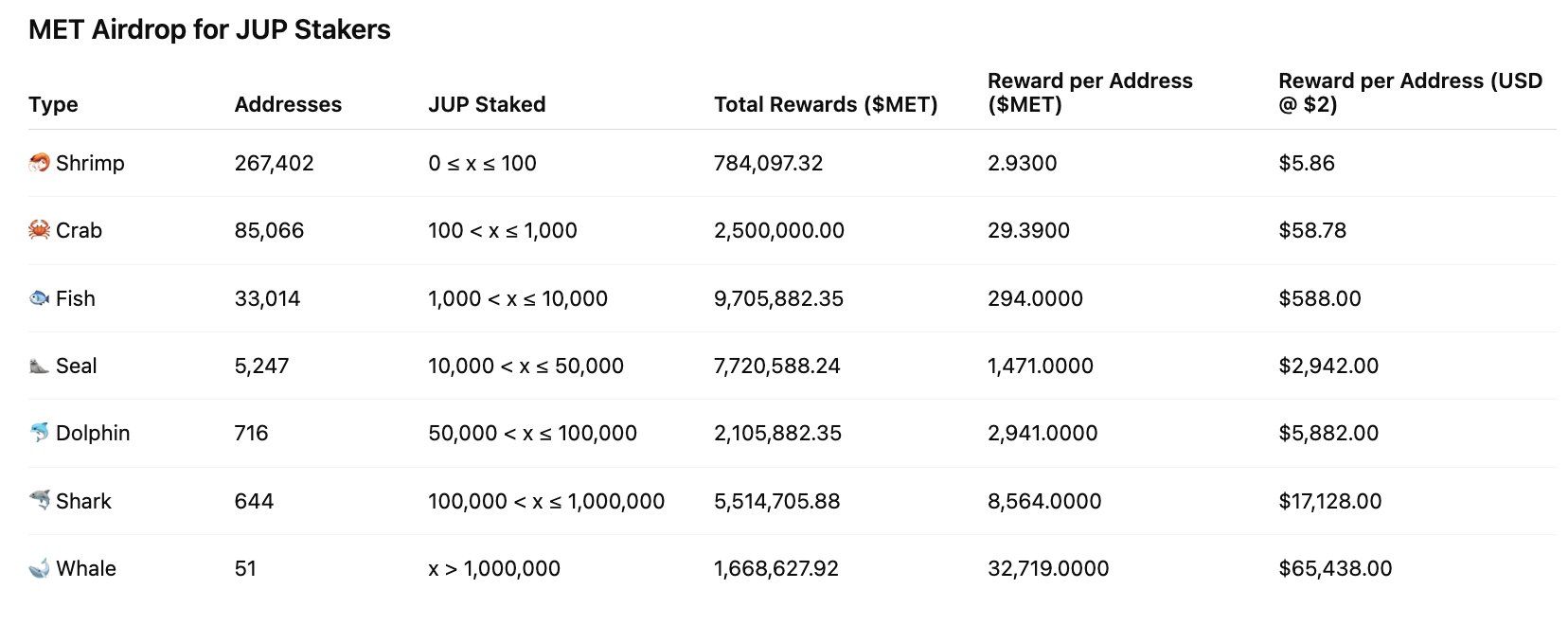 $MET airdrop for $JUP stakers. Source: fabiano">
Pros & Cons
Meteora’s proposal has clear upsides compared to other projects that reward users via airdrops. It explicitly recognizes Jupiter’s role in the Solana ecosystem, helps bootstrap $MET/$USDC liquidity at TGE, and reduces the immediate sell pressure because the initial reward is a liquidity position rather than freely tradable tokens. With careful engineering (time-weighted distribution, vesting attached to NFTs, withdrawal restrictions), this could be an effective bridge between the two communities.
However, significant risks remain. The community has raised fairness concerns: why should $JUP stakers receive a large share? Could an “LP Army” or large wallets capture a disproportionate share of the rewards? What will the circulating supply be at TGE immediately? Earlier allocation drafts mentioned up to 25% reserved for liquidity/TGE reserve, so the total initial circulating supply remains a material transparency question.
“Difficult to debate on ‘fairness’ when $JUP gave up 5% for Meteora (via mercurial stakeholders). LP army deserves more -> LP Army will capture a significant chunk of all future emissions (ongoing LM rewards), and still possess 20% (8% + 5% + 2% + 3% + 2%) of total supply at TGE,” Soju noted.
From past airdrop events, Meteora’s team must be transparent about tokenomics, clearly disclose the LP $NFT redeem/vest mechanics, set per-address caps, and consider additional incentives for $MET holders. If executed poorly, concentrated distribution and subsequent sell pressure could erode TGE’s value.
The post Meteora’s 3% TGE Allocation to $JUP Stakers a Smart Liquidity Move? appeared first on BeInCrypto.