“This is a ‘40 Act, which doesn’t directly invest fully in spot,” Balchunas said. “So long as the SEC doesn’t say anything, you can let it launch 75 days after filing.”
Unless the SEC raises a last-minute objection, the funds are set to list this week, Balchunas said.
Most US ETFs are organized under the ’40 Act, functioning as open-end investment companies that can hold securities such as futures-based funds. By contrast, ’33 Act ETFs are typically used for physically backed commodities, including spot Bitcoin and gold products.
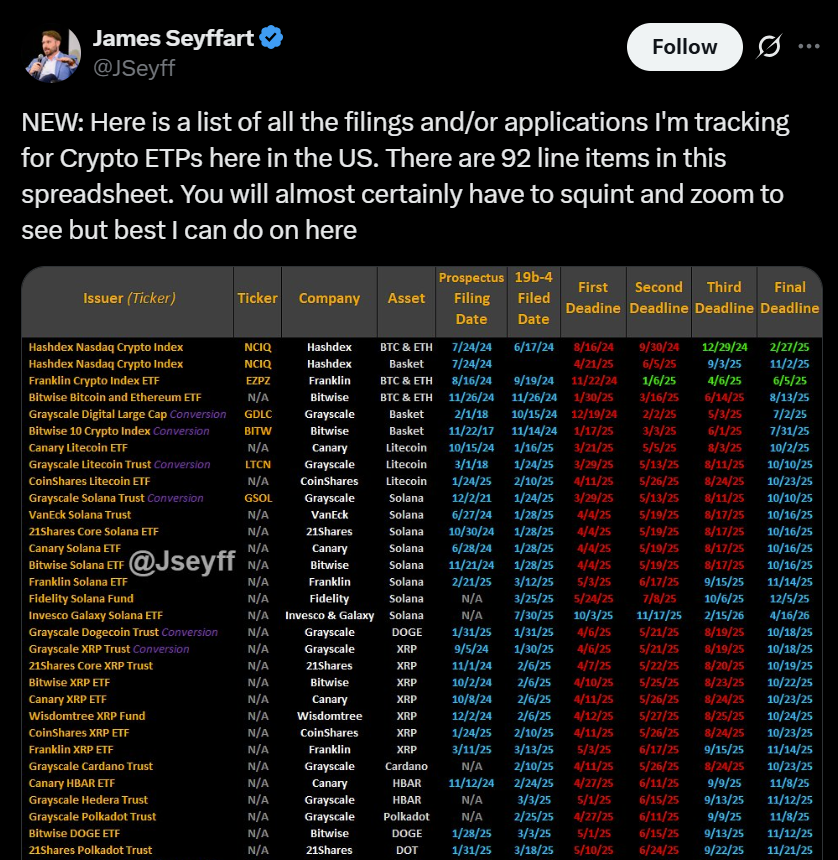
Bloomberg ETF analyst James Seyffart says 92 crypto exchange-traded products are currently in the US pipeline. Source: James Seyffart
Related: Dogecoin ETF pushes crypto industry to embrace speculation
SEC delays decision on other ETFs
While the REX-Osprey funds remain on track to launch this week, the SEC has delayed rulings on several high-profile ETF applications from Franklin Templeton, BlackRock and Fidelity.
In notices published on Wednesday, the SEC said it needs additional time to evaluate proposals that include allowing staking for Ether (ETH) within the funds. The agency also postponed decisions on applications for $XRP ($XRP) and Solana (SOL) ETFs.
Earlier this week, the SEC pushed back its decisions on Bitwise’s proposed Dogecoin ETF and Grayscale’s Hedera ETF, setting a new deadline of Nov. 12, as Cointelegraph reported.

Source: Cointelegraph
The delays come roughly a month after the SEC clarified that certain liquid staking activities fall outside securities laws and, therefore, beyond its oversight. In May, the agency also concluded that proof-of-stake blockchains, in and of themselves, do not constitute securities.
Related: How to legally stake crypto in 2025 under the SEC’s new rules

 cointelegraph.com




