$ENA holders set for cut of revenue as
$USDe locks in top-three spot ">
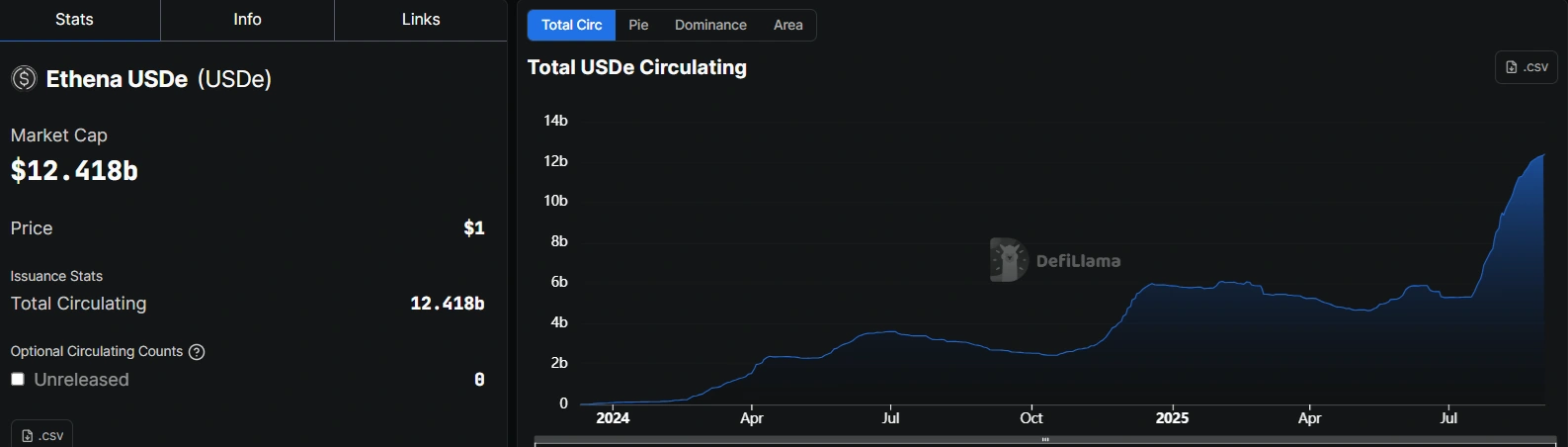
$USDe circulating supply. Source: Defillama
Ethena’s fee switch milestone is within reach
Ethena Labs’ $ENA “fee switch” proposal was approved in November 2024, which will allow it to redistribute a portion of the protocol’s revenue stream to $ENA token holders.
However, it listed three milestones that it had to achieve before the process of redistributing revenue with holders could begin. Those milestones were:
- Surpassing $6 billion in $USDe supply.
- The second is having a cumulative protocol revenue of at least $250 million
- The third milestone was to secure listings for $USDe on four of the top five centralized exchanges ranked by derivatives trading volume.
Ethena has already achieved the first two out of the three milestones. The only piece that’s still pending is the centralized exchange integrations.
Guy Young, Ethena’s founder, reportedly stated that achieving the third milestone is a top priority for them.
For $ENA holders, the move could transform the token’s role from a governance asset into one with tangible yield streams.
$USDe is a different type of stablecoin
Unlike $USDT and $USDC that rely on bank reserves, $USDe uses a delta-neutral strategy to stay pegged. Instead of parking cash or Treasuries in accounts, it hedges user deposits with short positions on centralized exchanges, aiming to build a buffer against price swings.
That unusual setup has helped it gain traction, especially as DeFi users look for fresh yield opportunities in the wake of new U.S. stablecoin rules.
However, not everyone is convinced of Ethena’s strategy as S&P Global flagged $USDe with higher risk scores because of its dependence on derivatives, while Chaos Labs has raised red flags over possible rehypothecation and liquidity strains if funding rates swing out of balance.
Much of $USDe’s rise has been powered by strategies that combine stablecoin issuance with DeFi yield loops. On-chain integrations with protocols like Aave and Pendle have enabled recursive lending structures that boost returns for large players.
In practice, this allows users to deposit $USDe, borrow against it, and redeploy the proceeds into additional yield-generating positions, compounding earnings across multiple layers.
The flywheel effect has drawn in institutional players as well as retail traders. Ethena’s design makes it attractive to entities looking for both stable on-chain dollars and exposure to derivatives funding payments.

 cryptopolitan.com