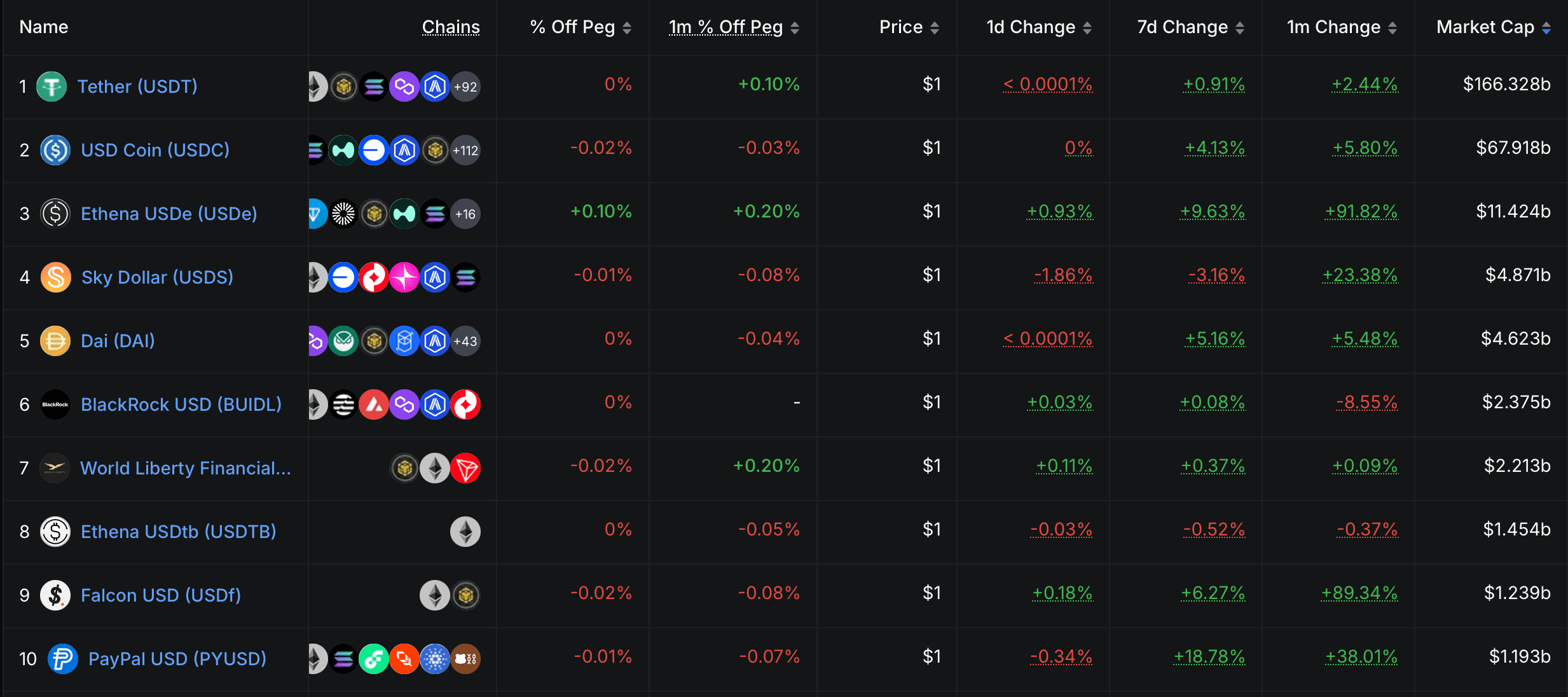
Top ten stablecoins by market cap according to defillama.com stats on Aug. 19, 2025.
$USDf minting requires overcollateralization: stablecoins are accepted at a 1:1 ratio, while volatile tokens demand higher deposits (for example, $150 in $ETH to create 100 $USDf) to absorb market price swings.
To maintain its $1 peg, falcon usd ($USDf) also deploys arbitrage and delta-neutral trading. When the token dips below $1, buyers are incentivized; when it climbs above, users are motivated to mint and sell—automated mechanisms that restore balance.
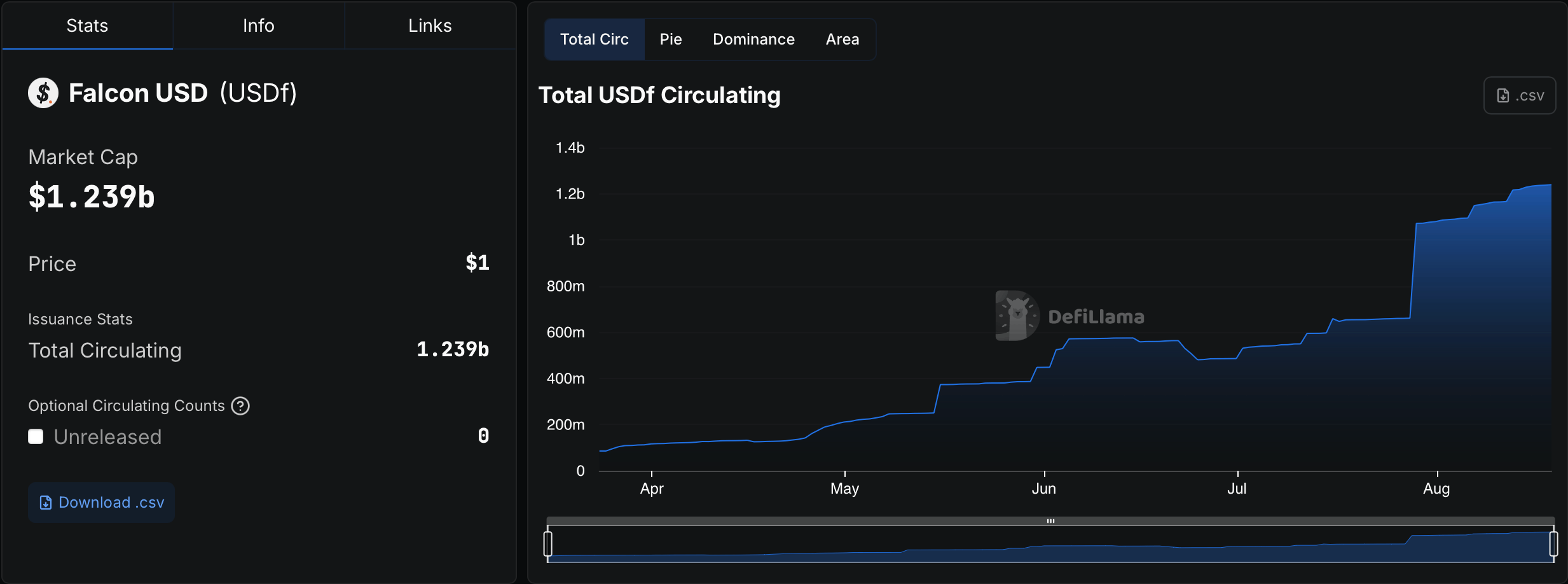
At the close of March, $USDf’s market capitalization was $85 million. Over the past 146 days, its supply has expanded by 1,355.29%. Roughly 91% of $USDf circulates on the Ethereum blockchain, with the remaining share issued on Binance Smart Chain.
Documentation explains that holders can stake $USDf to receive sUSDf, an appreciating ERC-4626 token. Yields are generated from market-neutral strategies such as funding-rate arbitrage (44% of returns) and cross-exchange arbitrage (34%), offering up to 11.8% APY.
Locking sUSDf for three to twelve months can raise returns to 15%. The protocol enforces a collateral ratio between 115% and 116%, with reserves audited quarterly and monitored in real time using Chainlink Proof of Reserve. As of Aug. 18, 2025, $USDf’s market capitalization stood at $1.24 billion.
Growth drivers include partnerships such as Bitgo, integration with tokenized treasuries, and deployment on trading platforms like Uniswap and Curve. Supply exceeded $1 billion just three months after its April 2025 debut. $USDf sits among a wave of fresh contenders climbing into the top ten stablecoin ranks, alongside Sky’s USDS, Blackrock’s BUIDL, World Liberty Financial’s USD1, and Ethena’s USDtb.

 news.bitcoin.com