Speculation runs wild when it comes to $XRP’s supposed connections to governments and banks. One often-quoted example is a years-old U.S. Department of Homeland Security (DHS) report, which claims, “It is more likely that in the near future, a currency-agnostic P2P payment transfer mechanism like Ripple will be used to access U.S. dollars instead of a cryptocurrency like Bitcoin.”
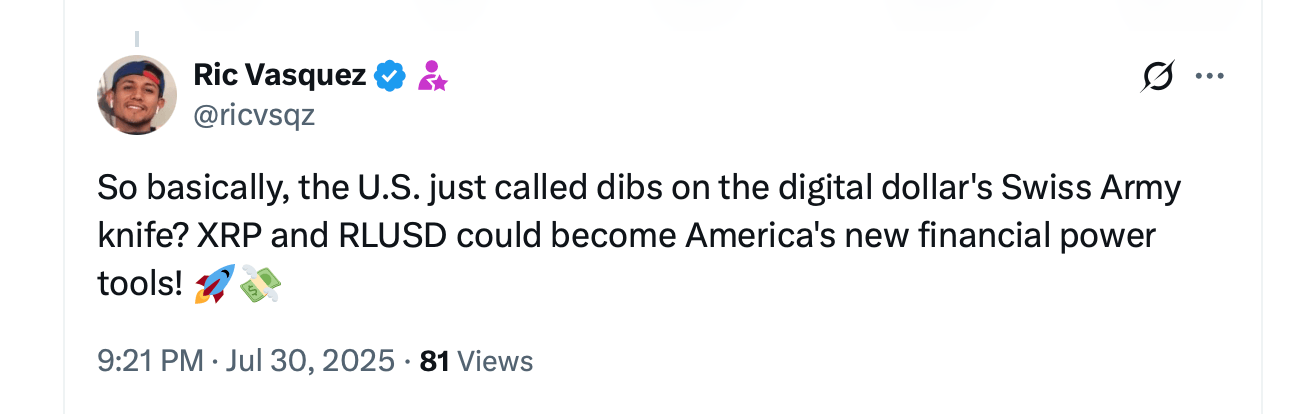
Still, official channels push back on the idea of a U.S. CBDC running on $XRP. The Federal Reserve hasn’t made any decision on launching a CBDC and hasn’t mentioned Ripple or $XRP in any of its research efforts. $RLUSD, meanwhile, is a privately issued stablecoin—not a sanctioned digital dollar. That hasn’t stopped echo chambers on X from keeping the theory alive through endless threads and recycled posts.
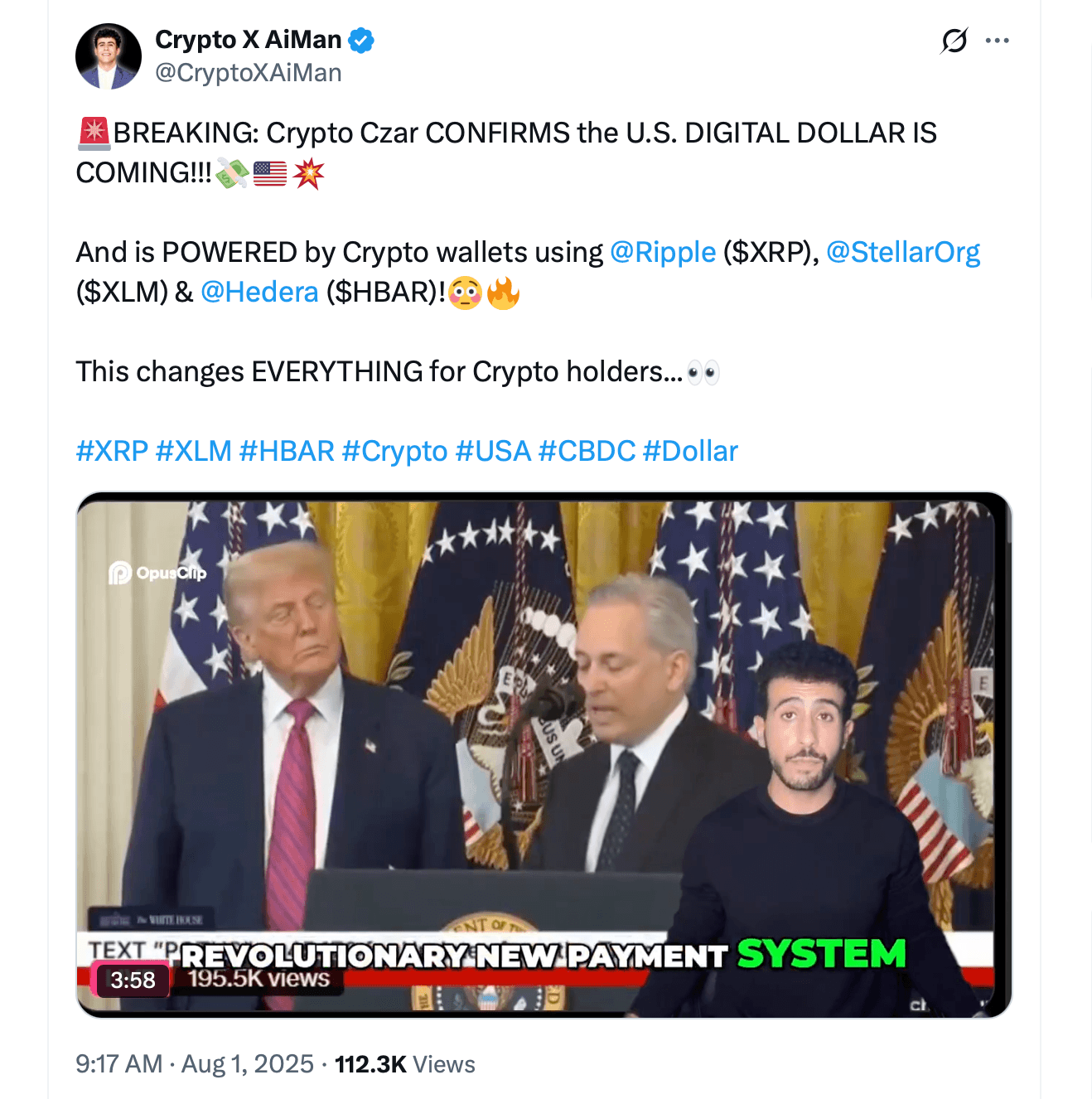
Reddit discussions emphasize utility and adoption as drivers of value, with users believing $XRP will become a reserve currency in a new financial system. Influencers and Youtube videos amplify this, like claims that $XRP is “digital gold” or will bridge trillions. In the end, the belief sticks around thanks to a cocktail of optimism, selective facts, and the power of community echo—despite the absence of confirmation from any official U.S. source.
Threads and theories may trend, but fantasy doesn’t turn stablecoins into sovereign currency—no matter how loud the $XRP army gets. The fact is, right now, the digital dollar isn’t waiting in Ripple’s inbox. Without federal backing or regulatory clarity, to many onlookers, $RLUSD remains just another stablecoin chasing relevance. If $XRP becomes the backbone of global finance, it won’t be because influencers on X, Youtube, or Reddit declared it destiny.

 news.bitcoin.com