
 crypto-news-flash.com

- Schiener praised the comparison and hinted at possible collaboration between the $IOTA and $XRP communities.
- $IOTA pushes modular decentralization and real-world utility while $XRP sticks to fast financial transfers.
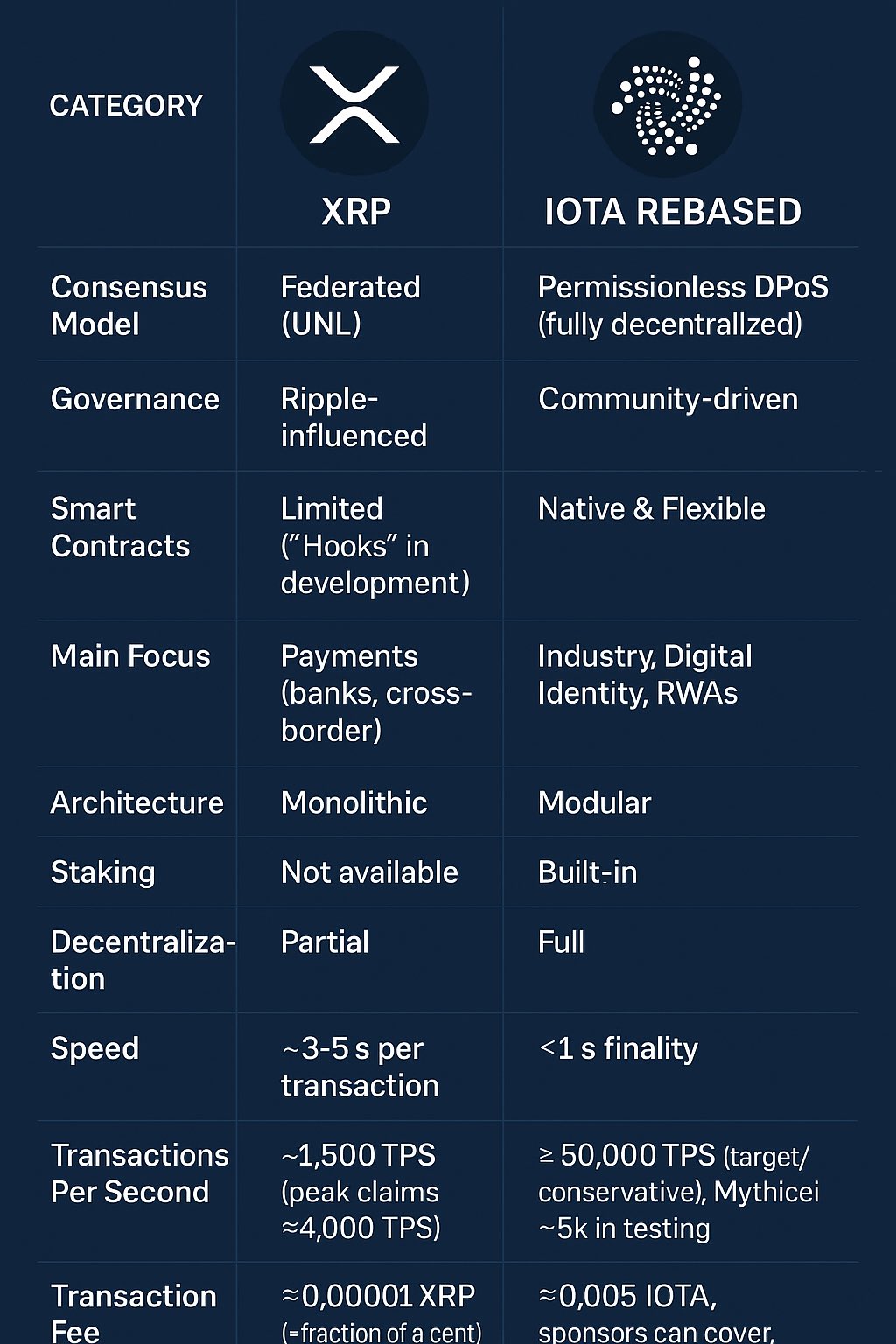
Dominik Schiener, co-founder of $IOTA, has responded positively to a public comparison between $IOTA Rebased and $XRP, suggesting future cooperation could benefit both sides. The comment came after X user Cigamatoi posted a detailed comparison, highlighting the different directions taken by these two decade-old blockchain networks.
Schiener stated, “Really nice comparison of $IOTA and $XRP!” He emphasized that both are “OG projects” with over ten years in development. He described $XRP as a US-based network expanding into Europe, while $IOTA, rooted in Europe, is now entering the US market.
“Lots of great lessons from the $XRP community and would love to see more collaborations with them,” Schiener added.
Cigamatoi drew a line between the networks’ visions. $XRP was built primarily to speed up cross-border payments. In contrast, $IOTA aims to handle real-world assets, decentralized applications, and digital identity, creating broader infrastructure beyond finance.
Decentralization, Speed, and Governance Show a Clear Split
Consensus mechanisms show philosophical divergence. $XRP uses a federated approach with validators that are often tied to Ripple. $IOTA’s permissionless DPoS approach offers a decentralized model with open access. According to Cigamatoi, that means $IOTA is founded more on trustless consensus, but $XRP is based on pre-defined validators
Transaction speed shows a major technical distinction. $XRP requires approximately 3 to 5 seconds per transaction, and under ideal conditions, can handle 1,500 to 4,000 transactions per second. Meanwhile, $IOTA Rebased is designed for over 50,000 TPS and has already reached around 5,000 under internal tests. Finality is under one second.
Smart contract capabilities are also on different timelines. $XRP is still developing “Hooks,” which have limited use cases. $IOTA Rebased already has native-integrated, flexible smart contracts that can exhibit numerous use cases across industries.
$IOTA Rebased Pitches Broader Industrial Utility
$IOTA is being applied across supply chains, IoT devices, tokenized physical assets, ESG reporting, and digital identity systems. $XRP remains tied to its original goal: cross-border bank payments and liquidity handling. $IOTA is targeting full industrial environments, not just finance-related transactions.
Transaction costs and token use also differ. $XRP’s fee per transfer is extremely low, under 0.00001 $XRP. $IOTA Rebased averages around 0.0005 $IOTA and allows users to avoid direct charges through sponsor arrangements. $XRP does not include staking, and its token distribution was more top-heavy early on. $IOTA has built-in staking and claims that its user base guides decisions.
The technical structure further separates the two. $XRP follows a single-layer design—quick but rigid. $IOTA’s framework uses separate modules, which allows adjustments and additions more easily over time.
Cigamatoi concluded that $XRP fits the earlier stage of crypto due to its specific target and simplicity. But as interest grows in open governance, adaptability, and clearer mechanisms, platforms like $IOTA may be a better fit for what comes next.