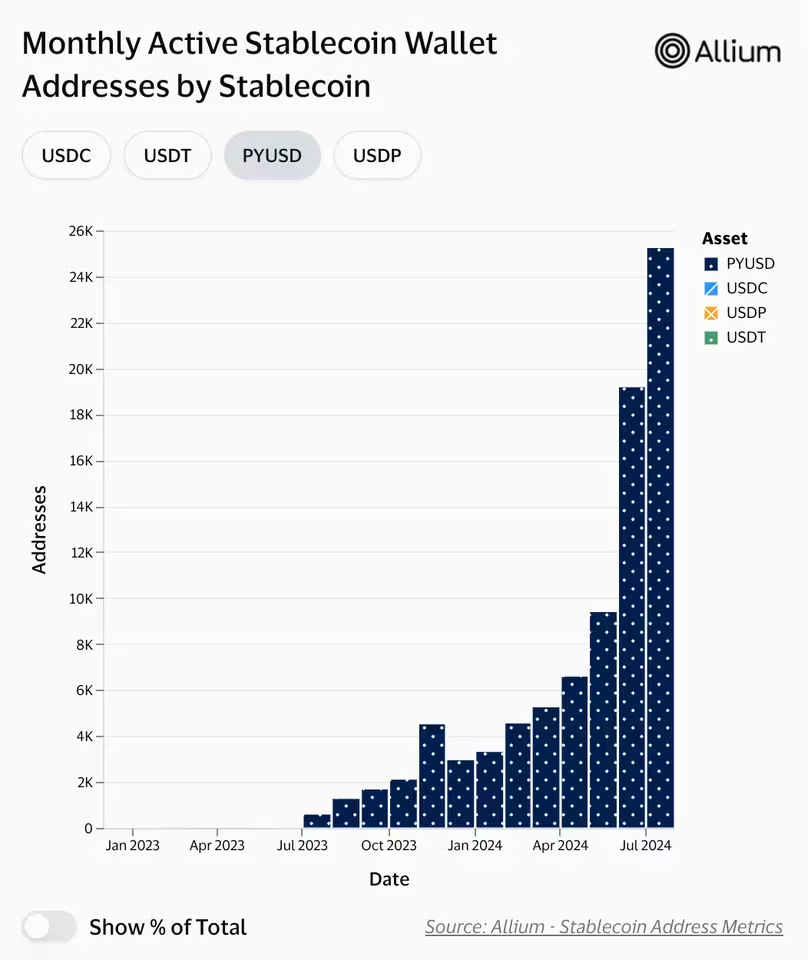
PayPal’s entry into the stablecoin market was initially seen as a significant moment for the industry, with expectations it would compete with top stablecoins like USDC and $USDT. However, early excitement faded as $PYUSD struggled to gain traction on the Ethereum network. This changed when $PYUSD expanded to the Solana network in May, where its supply skyrocketed to $650 million in just three months, surpassing its supply on Ethereum.
Over the past month, $PYUSD supply on Solana grew by 171%, and it is quickly approaching Tether’s $USDT in scale on the network, according to DefiLlama.
Tom Wan, a business development associate at 21.co, credited $PYUSD’s growth to incentives and integration with decentralised finance (DeFi) protocols. Solana-based platforms like Kamino, Drift, and Marginfi offered high yields for $PYUSD deposits, and Anchorage Digital introduced similar incentives for institutional investors last week.
Still, concerns remain about the sustainability of $PYUSD’s growth once these incentives are removed. David Shuttleworth, a partner at Anagram, noted that while these incentives aren’t meant to last, they aim to increase $PYUSD circulation and drive new users to the Solana ecosystem.

 coinculture.com