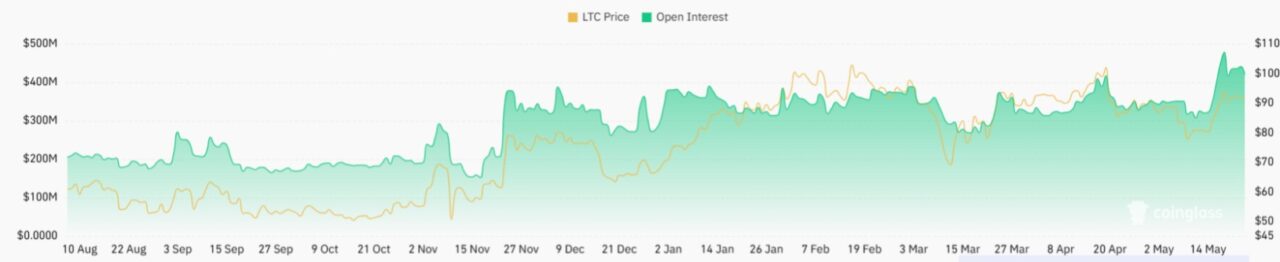
A multitude of factors might have fueled this burgeoning open interest in Litecoin futures, including the recent surge of tokens being minted on the network after Bitcoin’s network started suffering from a flurry of activity over BRC-20 tokens being minted. A notable driving force is the impending halving event scheduled for August 5, where Litecoin’s new coin issuance rate will be slashed by 50%.
The Litecoin block reward for miners will be slashed by 50% from 12.5 $LTC to 6.25 $LTC after the halving. Historical $LTC price data suggests that the price of Litecoin could surge months after its halving event to the point it hits a new all-time high next year. The cryptocurrency could, however, endure a correction right after the halving.
According to data analyzed by popular cryptocurrency analyst Rekt Capital, Litecoin “trends to rally quite strongly before its halving,” with the cryptocurrency rising 820% after bottoming out 122 days ahead of its first-ever halving, and rising 550% after bottoming 243 ahead of its second halving.
Historically, the cryptocurrency rallied more after its halving event. After its first halving, $LTC surged 12,400%, while after its second halving it rose 1,573%.
Over the past month, Litecoin, a cryptocurrency that’s often referred to as the silver to Bitcoin’s gold, has been on a steady ascent, exhibiting nearly 7% growth and nudging its value from $86 to $92.
As CryptoGlobe reported its creator Charlie Lee has revealed h believes $LTC has potential to see significant gains against the flagship cryptocurrency ahead of its highly-anticipated August halving event.
The cryptocurrency has already surged 85% since reaching a record low against Bitcoin in June 2022, and Lee believes that $LTC/$BTC could rally to 0.025 $BTC, translating to an increase of over 700% during the next bull cycle.
It’s important to point out that the effect of halving events on the price of a cryptocurrency is not certain, and opinions on the matter vary among analysts. The past performance of a cryptocurrency does not guarantee future performance.
Image Credit
Featured image via Pexels

 cryptoglobe.com