
 beincrypto.com

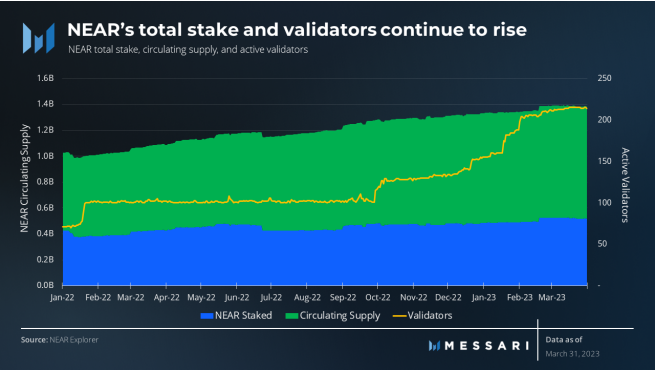
A new Messari report on the Layer 2 $NEAR Protocol has revealed that the network progressed toward greater decentralization as the number of daily active accounts reached an all-time high of roughly 64,000 in Q, 2023.
According to the report, new accounts decreased for the third consecutive quarter. Transaction volumes slowed to 393,000, down 13% from Q4 2022.
USN Stablecoin Volumes Healthy Amid Wind Down
$NEAR is a so-called thresholded proof-of-stake blockchain that can run decentralized applications. Originally conceived as a community-driven cloud, it is secured by a group of validators who stake the chain’s native $NEAR token for a chance to validate transactions. The network determines transaction fees by computing requirements and network bandwidth.
At press time, the network had 200 validators.
Last year, the $NEAR Foundation contributed $40 million to aid in the winding down a $NEAR-native stablecoin, USN, issued by Decentral Bank.
Before that, Circle announced it would launch its stablecoin on $NEAR to enable $USDC fund flows on $NEAR’s decentralized applications. Stablecoins are cryptocurrencies pegged to the value of a government-issued currency through on-chain or off-chain assets.
Circle’s $USDC briefly lost its peg across several exchanges during mid-March as investor panic resulted in a flurry of withdrawals from Silicon Valley Bank. The company held $3.3 billion in cash reserves supporting $USDC’s peg to the U.S. dollar at the failed institution. Circle competitor Tether started issuing its $USDT stablecoin on $NEAR in September 2022.
USN, $USDC, and $USDT are the top three stablecoins on the network, with market caps of $37.99 million, $29.99 million, and $19.54 million.
$NEAR and Arbitrum Decentralization Shifts Power Away From Foundations
As of Q1 2023, $NEAR holds about $316 million in its treasury. The $NEAR Foundation will allocate funds toward several internal decentralized autonomous organizations, including Marketing DAO, Developer Governance DAO, Creatives DAO, and the $NEAR Digital Collective.
The $NEAR Digital Collective is a new governance body using a House of Merit to represent voters proposing network changes. A council of advisers will guide the direction of the House of Merit.
The recently-launched Arbitrum DAO has spotlighted the challenges of DAO governance.
Community members opposed the Arbitrum Foundation’s decision to earmark 750 million ARB tokens for grants to the Foundation. A later proposal suggested greater transparency for the tokens granted to the Foundation’s “Administrative Budget Wallet.”
Another proposal, AIP-1.2, lowered the barrier to entry for those wishing to participate in the governance of the Arbitrum DAO.