
 news.bitcoin.com
A Rare Signal From the Mining Trenches
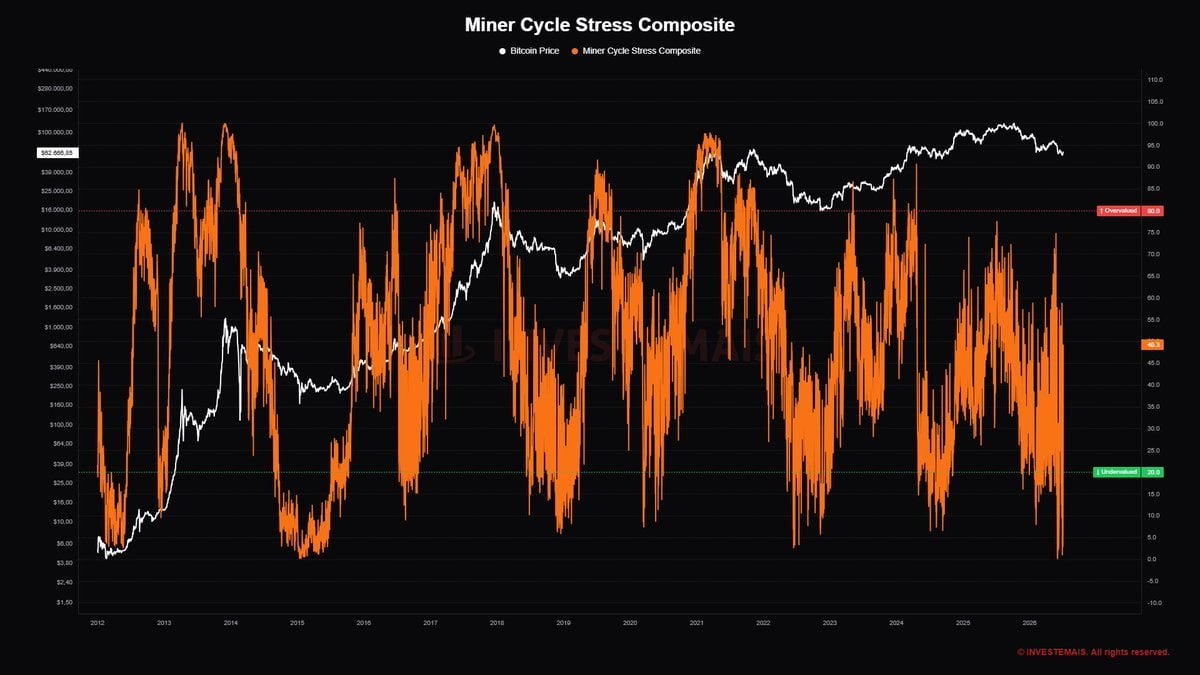
The latest reading blends several miner-health indicators, including profitability and revenue gauges, into a single measure of how much pressure the network’s block producers are under. On the subject, prominent crypto analyst Wu Blockchain noted:
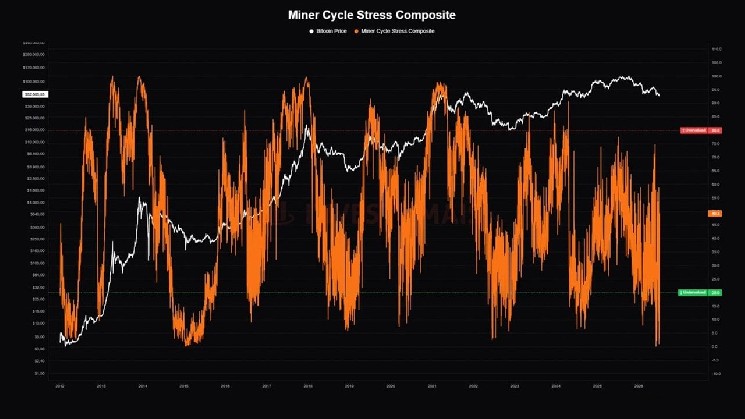
“The Miner Cycle Stress Composite has fallen to a new 2026 low and entered its ‘undervalued’ range. Similar synchronized declines previously appeared near major Bitcoin bottoms in 2015, 2018, 2020.”
The individual components tell the same story. The Puell Multiple, a metric that compares daily miner revenue to its yearly average, has dropped to 0.74, meaning miners are earning roughly a quarter less than their 12-month norm. Miner revenue has fallen 11% over the past 10 days, while Bitcoin’s hashrate has declined more than 25% since October 2025, one of the longest sustained drawdowns on record.
One in Five Miners Is Underwater
The stress is not merely statistical, as JPMorgan analysts estimate bitcoin has traded below its average production cost of roughly $78,000 for five consecutive months, leaving about 20% of miners operating at a loss.
The network seems to be adjusting to the exodus, given bitcoin’s mining difficulty, the measure of how hard it is to find a new block, was cut 10.09% to 124.93 trillion in the latest major adjustment, the second-largest downward move of 2026 after February’s 11.16% drop.
Moreover, Bitcoin.com News reported earlier this year that miners absorbed an 18% hashprice crash even as difficulty jumped 7.15%, with hashprice, the expected daily revenue per petahash of computing power, sliding to $28.68.
The pressure is claiming casualties. Japan’s SBI Crypto said last week it will close its bitcoin mining pool after five years, sending 20,412 PH/s, just over 2% of the global hashrate, hunting for a new home before the pool stops accepting shares on July 30.
Asset manager Coinshares, meanwhile, has described mining margins as tightening across the industry, estimating that 15–20% of miners are unprofitable and noting that many operators are accelerating a pivot toward artificial intelligence (AI) and high-performance computing workloads to survive.
The demand side has offered little relief. U.S. spot bitcoin exchange-traded funds (ETFs) recorded their worst month since launch in June, bleeding $4.5 billion as bitcoin slipped below $60,000 during the month’s weakest stretch.
What Past Capitulations Suggest Comes Next
Periods of extreme miner stress have historically clustered near cycle lows rather than tops. Vaneck’s research on previous hashrate contractions found that, excluding the network’s early history, bitcoin delivered a median forward return in the high-40% range over the 90 days that followed such episodes.
The firm’s analysts sketched three 90-day scenarios at the time: a constructive path of 10% to 35% upside, a “capitulation-lite” range of -5% to +20%, and a bearish case of losses up to 30%.
Onchain analysts see the same tension. Cryptoquant’s Miner Capitulation Index has climbed above 65, a level analyst Axel Adler Jr. described as evidence of building stress, though he emphasized it remains below the extremes of the 2022 bear market, when miner capitulation moved hand in hand with a 65% drawdown in bitcoin’s price.

That said, undervalued miner readings alone do not guarantee a reversal, and with bitcoin down nearly 50% from its October 2025 high near $126,200, sellers have repeatedly overwhelmed hopeful technical signals this year. The next test comes at the upcoming difficulty adjustment, where another deep cut would confirm that unprofitable hashrate is still leaving the network.