10% to 56%: USDC’s remarkable rise in euro-paired stablecoin trading
ambcrypto.com
20 h
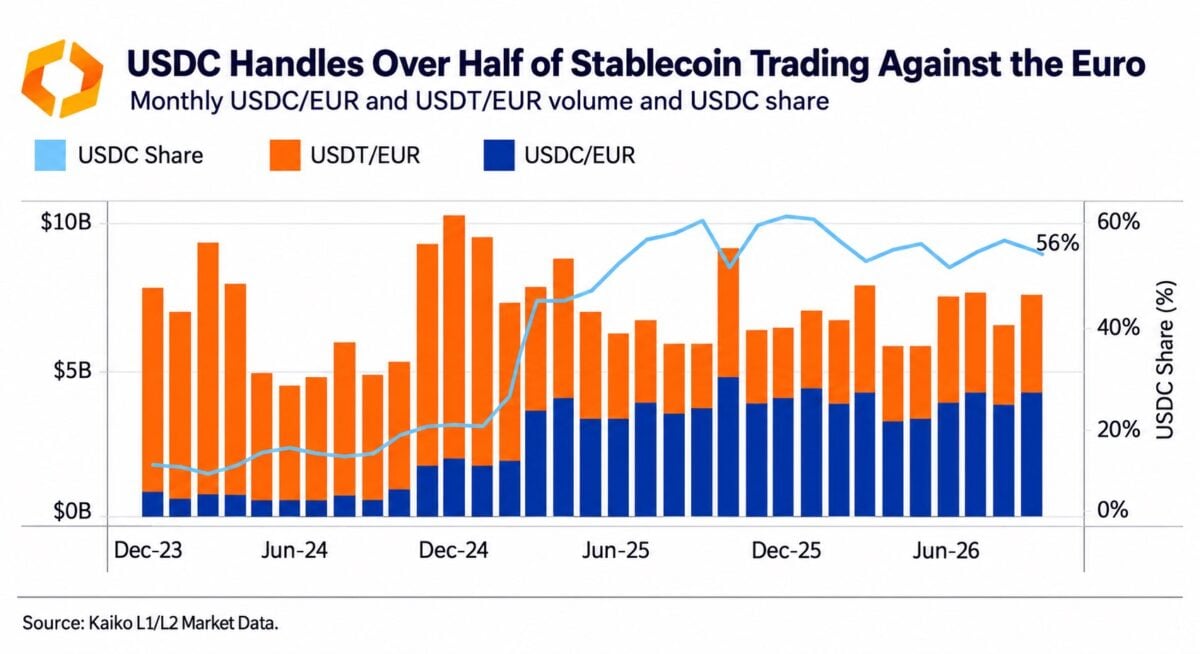
Since December 2023, USD Coin [$USDC] has increased its market share of euro-paired stablecoin trade from 10% to 56% as of October.
While at the end of 2024, euro-paired stablecoin trade volume reached levels near $10 billion per month before declining in subsequent months.
As a result of MiCA restrictions on Tether [$USDT], the number of transactions using $USDC increased.This gave$USDC an advantage as it pushed more trading activity toward $USDC.
Know when your coins move
Alerts, real-time prices, and market news — all in one app
Point your phone camera to install
4.8 based on 40K reviews in the App Store and Google Play
Julia Kovalchuk, Head of B2B Product at Paybis, a MiCA-licensed crypto and fiat infrastructure provider, told AMBCrypto in an exclusive interview,
After MiCA, $USDC grew from about 21% to 75% of stablecoin volume among our payment-firm clients in a year. The US leans toward $USDC too, while $USDT still dominates trading and emerging markets. Winners are regional and split by use case – $USDC is the default choice for enterprise payment companies, traditional-finance on-ramps, and regulated custody in both the EU and the US.
Specifically, since Tether had been denied access to euro markets, euro-paired $USDC order books now have 40% more depth than those of $USDT/EUR orderbooks.
Therefore, larger euro-paired stablecoin trades were able to be executedwithout causing as much price movement.
Source: Kaiko
This gives $USDC an advantage for traders converting euros into dollar-backed stablecoins. Nevertheless, the global supply of $USDT is 2.5 times larger than that of $USDC.
The 56% level of euro-paired trading of $USDC, however, indicates how regulation may be able to move trading activity and liquid assets from one stablecoin toanother.
MiCA rules give $USDC an edge over $USDT in Europe
The shift in market leadership demonstrates a much broader trend of changesoccurring in the European regulatory environment.
MiCA established a July 2026 deadline for all stablecoin issuers to obtain EU authorization and demonstrate they comply with reserve and supervision requirements.
Still, Tether’s $USDT remains unauthorized. However, Circlereceived authorization via a French electronic-money license. In response to the regulations, Coinbase began restricting$USDT trading for its European customers.
AMBCrypto asked Kovalchuk what compliance means in a world governed by MiCA-style regulations. She responded,
In Europe, liquidity is easy to find. A license takes years and costly legal work, so many smaller firms plug into licensed infrastructure like ours. The US GENIUS Act, Hong Kong’s Stablecoins Ordinance, and the UAE’s payment token rules point the same way.
Coinbase is also converting any outstanding amounts of non-compliant $USDT for its European customers around the 30th of October. Meanwhile, the European Banking Authority designated $USDC a significant e-money token in mid-October, bringing it under direct supervision.
Therefore, these regulations are also establishing a framework for how exchangescan service European users.
Ethereum stablecoin addresses surpass 300M
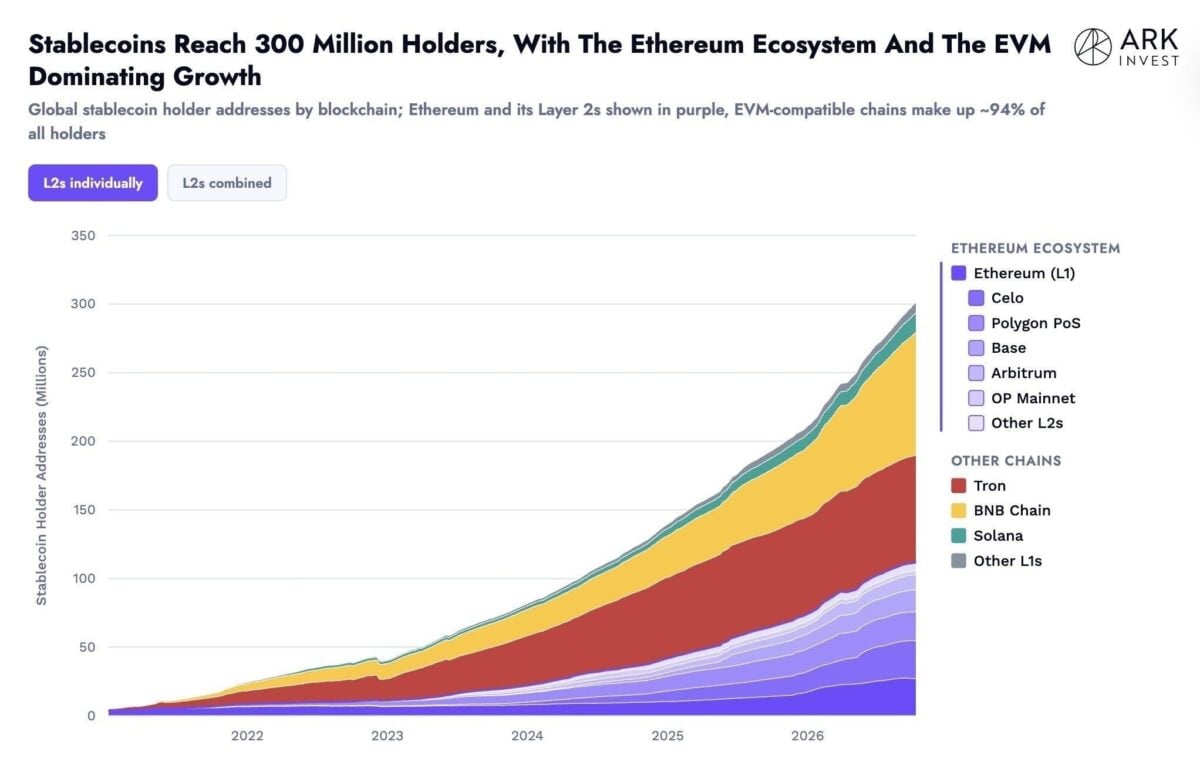
The Ethereum [ETH] stablecoin ecosystem has continued expanding, reaching over 300 million holder addresses. However, the fact that thereare over 300 million holder addresses does not automatically mean that there areas many unique and active users.
Approximately three-quarters of these holdersreside on layer two networks. This highlights the role that Layer 2 networkshave played in increasing access to stablecoins.
When asked if stablecoin gains on Layer 2s translate to real adoption or just balances that flow back to L1, Kovalchuk noted,
Some of both. Part of L2 volume is still trading balances moving back to exchanges. The growth to watch is repeat use: payouts, merchant settlement, and payroll. Once the same businesses settle on L2 every week, that L2 has become a payment rail.
Source: Ark Invest
Lower fees associated with layer two networks make it cheaper for individuals to transfer funds usingstablecoins. Increased levels of network usage may indicate that individualsare more likely to utilize the same stablecoin multiple times.
But if a few regulated issuers hold most of the market, who carries the risk when one fails? According to Julia,
Holders carry the risk, which is why MiCA’s reserve and redemption rules matter. Europe has moved from one dominant stablecoin to another, so concentration is worth watching. Businesses should ask their platform how many stablecoins it supports and how quickly it can switch if one is restricted.
Together, these trends could shape future competition between $USDC and $USDT. Ultimately, lasting leadership will depend on regulatory access, deep liquidity, and sustained user activity.
Final Summary
$USDC reached 56% of euro-paired stablecoin trading as MiCA rules restricted $USDT.
Ethereum surpassed 300 million stablecoin holder addresses, with Layer 2s accounting for 75%.

 ambcrypto.com