
 coindesk.com

In the often-fractured world of decentralized finance, crises tend to expose fault lines. This time, they’re also revealing an unusual level of coordination.
Aave, one of DeFi’s largest lending protocols, is at the center of a broad recovery effort following losses tied to the Kelp DAO exploit, drawing in capital and credit commitments from across the industry. The effort, informally dubbed “DeFi United,” has raised about $303 million in commitments as of Monday, according to its website, with much of the capital still pending governance approval.
The exploit, which rippled into rsETH markets and created risk across lending positions on Aave, has prompted what is shaping up to be one of the most coordinated industry responses to a DeFi incident.
“There’s a shared priority around supporting users and restoring normal market conditions,” an Aave Labs spokesperson told CoinDesk. “Many of these participants are deeply connected to DeFi, whether through infrastructure, capital, or user access, and have a direct interest in ensuring markets function as expected.”
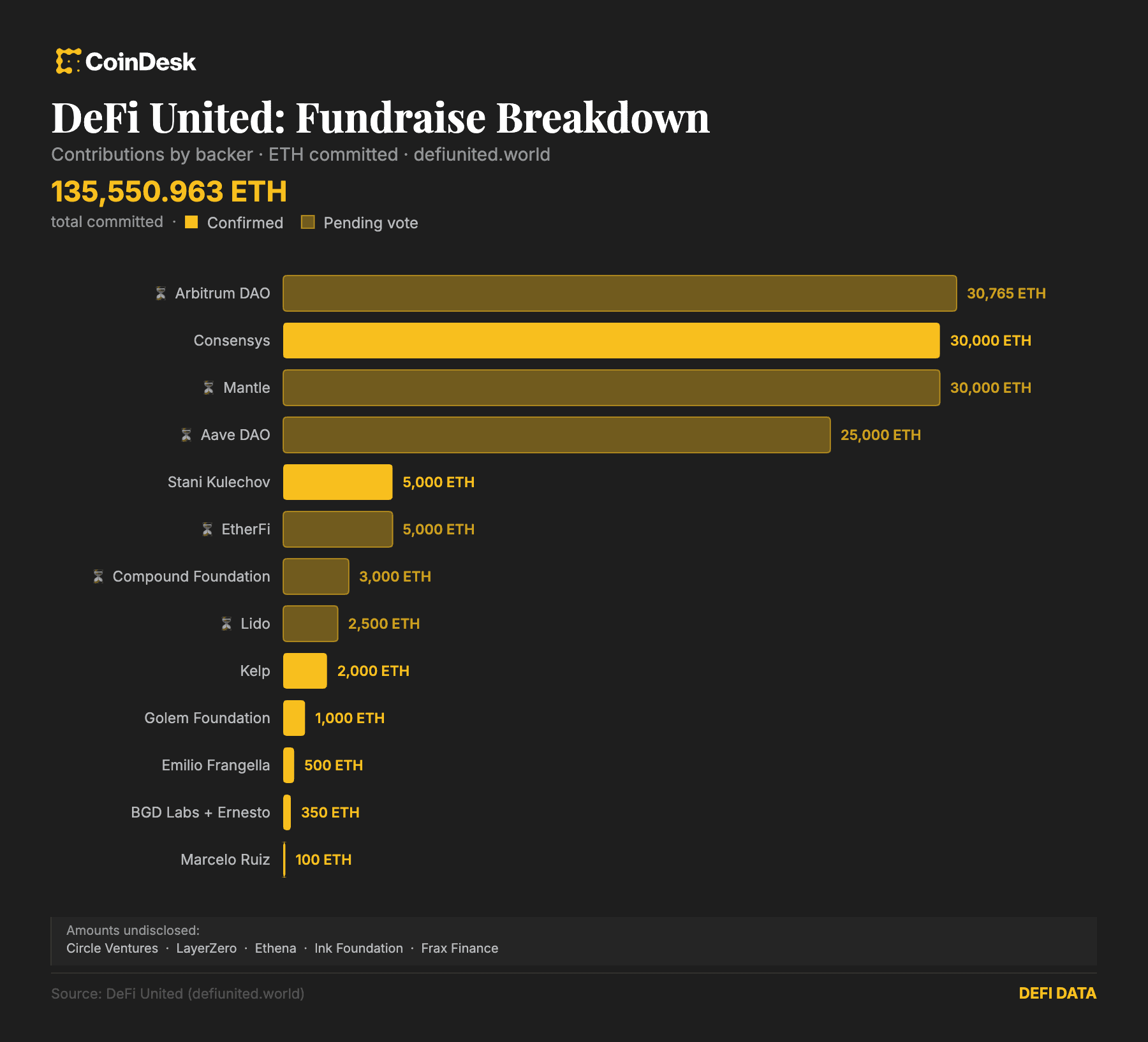
At the core of the effort is Aave itself. A governance proposal outlines a plan for the DAO to allocate up to 250,000 $ETH as part of the recovery. Founder Stani Kulechov has separately indicated he would donate 5,000 $ETH personally. Other contributors within Aave’s orbit are also stepping in, including Aave’s Emilio Frangella (500 $ETH), BGD Labs’ Ernesto Boado (100 $ETH), BGD Labs (250 $ETH), and KPK’s Marcelo Ruiz de Orlano (100 $ETH).
'Long-standing' relationships
But the response has quickly extended beyond Aave, and in some cases began with direct outreach.
Following the April 18 bridge hack that impacted rsETH, Kulechov reached out to Consensys and other ecosystem participants early to help coordinate a response, according to a Consensys spokesperson.
The firm, alongside its founder Joseph Lubin, agreed to commit up to 30,000 $ETH in financial support to help advance the recovery and protect users. Sharplink played a strategic advisory role in those discussions, the spokesperson said.
“The Ethereum ecosystem has always been at its best when it moves together,” Lubin said in a statement. “DeFi United is exactly that, a broad, coordinated response to protect users and strengthen the infrastructure we’ve all helped build. Consensys is proud to contribute alongside other stewards in the ecosystem.”
The effort has also drawn smaller contributions from across the community.
Lido has put forward a proposal to allocate up to 2,500 stETH, while EtherFi is discussing a 5,000 $ETH plan aimed at supporting users and limiting bad debt across DeFi. Mantle has proposed a 30,000 $ETH credit facility loan, adding to a growing pool of backstop liquidity. Compound also put forward a proposal to give up to 3000 $ETH to the fund.
Other contributions are taking the form of deposits into Aave itself. Babylon Foundation plans to deposit $3 million in USDT, while Renzo has supplied more than $10 million from its treasury. Circle Ventures is purchasing AAVE tokens, and additional deposits have come from entities including Avalanche Foundation, Solana Foundation, and Justin Sun, according to Aave Labs.
The list of participants continues to grow. Entities that have not publicly specified the size of their commitments include Ethena, LayerZero, Frax Finance, and Ink Foundation, alongside Tyro.
“These are long-standing Aave relationships across the ecosystem,” the Aave Labs spokesperson added. “Teams like Consensys, Sharplink, and others have been in close contact throughout.”
Not all contributions are structured the same way. Some participants are offering grants, others deposits, and several are extending credit lines, highlighting different approaches to balancing support with risk management.
In parallel, Aave Labs has put forward a proposal asking Arbitrum governance to approve the release of roughly 30,765.67 $ETH immobilized by the network’s Security Council into the coordinated remediation effort, with the goal of “making affected rsETH holders whole” and restoring rsETH’s backing.
Much of the capital remains subject to governance approval, and several proposals are still under discussion. Even so, the breadth of participation underscores how widely the exploit's impact has been felt across DeFi.
“The Ethereum ecosystem has always been at its best when it moves together,” Lubin said. “DeFi United is exactly that: a broad, coordinated response to protect users and strengthen the infrastructure we’ve all helped build.”
Ian Allison contributed reporting.
Read more: Why DeFi is not dead after the KelpDAO exploit