CryptoSlate’s $XRP page displayed $0.97 when retrieved at 13:15 UTC on Nov. 15, with market data marked as updated eight minutes earlier.
More depth, different inventory needs
An automated market maker, or AMM, lets users trade against a pool whose prices follow a formula. XRPL’s current design uses a constant-product-style curve. Liquidity supports trading across a broad price range, even when the assets usually trade close to one another.
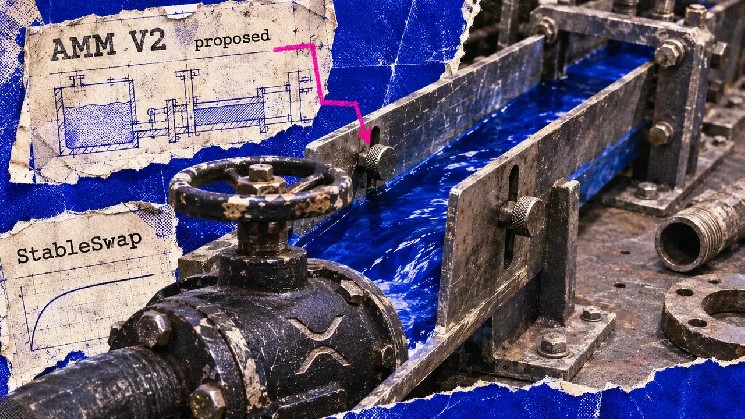
The AMM Swappable Curves draft proposes alternatives. StableSwap would concentrate effective depth near the expected relationship between correlated assets, such as two dollar stablecoins. Concentrated liquidity would let providers allocate capital within chosen price ranges. Binned liquidity would place assets at discrete fixed prices, with execution moving to another price when a funded bin is exhausted.
The economic aim is more executable depth per unit of capital. A stablecoin pool could serve trades near parity with less money spread across distant prices. A provider choosing a narrower range could make the same deposit more useful while that range remains active.
The size of any trading improvement would depend on funding, price ranges, fees, trade size and whether correlated assets remain close in value.
Routing matters as much as the curve. XRPL already combines AMMs and order books. The draft would compare curve offers at each routing step using their actual output after fees at the offer’s size, rather than choosing solely by the displayed marginal price. Any execution comparison must therefore include order-book liquidity and alternative routes, not just these two pools.
A more efficient direct $RLUSD/$USDC pool could improve stablecoin execution without holding $XRP as either trading asset. Users still face $XRP transaction costs and applicable account or trust-line reserve requirements. Those requirements are separate from funding $XRP inventory in a trading pair; current AMM ledger entries themselves have reserve exemptions, which do not automatically extend to new position entries proposed for AMM V2.
An $XRP pair creates a different opportunity because its inventory includes $XRP. Even there, capital efficiency cuts both ways. Less $XRP could support a given amount of executable depth, while a larger, more active market could attract enough providers to raise aggregate deposits.
Higher turnover alone would not distinguish those outcomes. The same inventory can support repeated trades. A stronger holding-demand case would require persistent additional $XRP balances across relevant pools and routes, with deposits, withdrawals and swaps separated so reserve changes are not mistaken for fresh buying.
Fee income also belongs to liquidity providers rather than all $XRP holders. XRPL’s documentation describes relative-price and arbitrage risks. Concentrated liquidity adds range management: Uniswap’s explanation shows how a position can become entirely one asset and stop earning fees outside its range. More efficient capital is not automatically more profitable capital.
The tests before a demand claim
AMM V2 remains proposed work. The discussion opened in May, and the Foundation’s feasibility page was updated Nov. 4. Its roadmap lists rebasing and reopening the implementation pull request, then review and audit, as next steps. Activation requires validator approval. The current specification gives binned pools a separate amendment gate from concentrated liquidity and StableSwap.
The Foundation’s Nov. 4 assessment said no issuer, wallet, exchange or DEX front end had publicly committed to using the pools.
For $XRP holders, persistent inventory tied to additional funded use would strengthen the demand case, but larger pool balances alone could reflect capital moved from elsewhere. Better execution could arrive before any additional holding demand is demonstrated.

 cryptoslate.com