
 thecryptobasic.com
The $XRP Ledger recorded over 222 million transactions in Q2 2026, marking the second-highest quarterly transaction total in its history.
This impressive record came as $XRP remained under pressure from the downtrend that began in Q4 2025. Although activity slipped from the previous quarter, it stayed close to the record level set in Q1.
$XRP Total Transactions Spike in Q2 2026
According to Blockwork’s latest “State of $XRP” quarterly report, Q2’s transaction count stood at 222.4 million, representing only a 6.5% drop from Q1’s record 238.0 million. Further data confirmed that the network processed an average of 2.44 million transactions each day.
However, failed transactions rose to 54.6 million, accounting for 24.5% of total transactions, compared with 19.0% in Q1. Meanwhile, average daily active addresses fell to about 16,800, down 10.7% QoQ and 24.5% YoY.
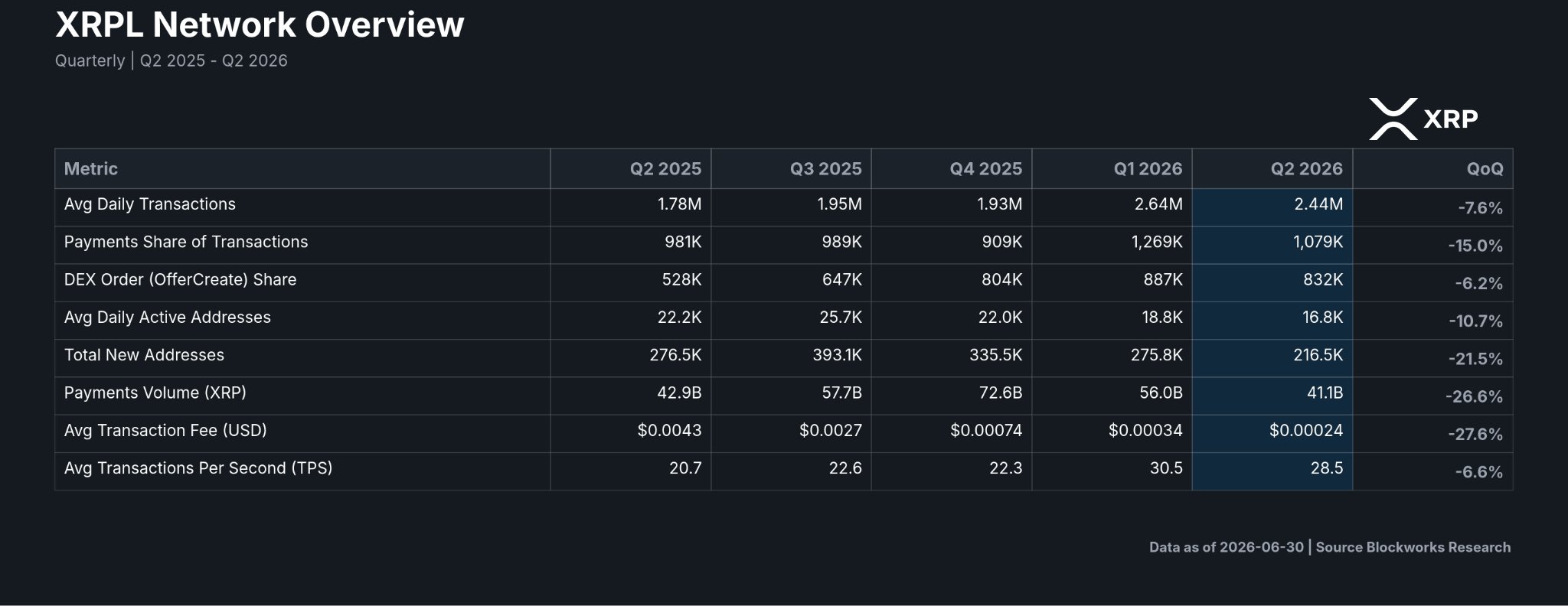
The decline in user activity was more noticeable among new addresses. XRPL recorded an average of about 2,380 new addresses per day, down 22% QoQ. Returning addresses averaged about 14,380 per day, a smaller 8.4% QoQ decline. This suggests that existing users remained more active than new users during the quarter.
The network also maintained a notable pattern in address activity. Notably, active receiver addresses exceeded active sender addresses for seven straight quarters through Q1.
Native DEX Trading Drops as Issued Assets Grow
Trading on XRPL’s native decentralized exchange weakened during the quarter. Specifically, DEX volume dropped 35.9% QoQ to $482.9 million. Of that total, the central limit order book (CLOB) handled $419.1 million, while automated market maker (AMM) pools recorded $63.8 million.
CLOB trading continued to take a larger share of the market, reaching 86.8% for the quarter. This marked the fourth straight quarter in which its share increased. By comparison, the AMM share fell from 29.5% one year earlier to 13.2%.
However, the market value of issued currencies on XRPL increased during Q2. This metric rose 21.0% QoQ and 67.9% YoY, reaching $980.4 million at the end of the quarter. The figure covered approximately 1,100 tokens on the network.
$RLUSD made up 69.0% of the issued-currency value at quarter-end, a sharp increase from 23.4% at the end of Q1. The growth in $RLUSD supply helped make up for declines among smaller non-stablecoin assets. As a result, $RLUSD took a much larger share of the issued-asset market during Q2.
$NFT Market Recovers Amid Stablecoin Market Growth
Also, $NFT activity on XRPL improved from its weak Q1 performance. Trading volume reached $3.69 million in Q2, more than twice the $1.56 million recorded in Q1. Average daily traders rose 7.4% to 529, while daily sales increased 9.4% to about 1,750.
However, the $NFT market remained below its level from a year earlier. Q2 volume was 36% lower than the prior-year quarter and stood at roughly 1/130 of DEX volume. $NFT mints rose to about 153,000 from 129,000 in Q1, but remained way below the 3.5 million recorded a year earlier.
Impressively, stablecoins recorded one of the biggest gains on XRPL during Q2. Native stablecoin supply climbed 195.4% QoQ to $825.5 million at the end of the quarter, up from $279.5 million in Q1. The figure also marked an increase of more than 1,100% from the $66.1 million recorded a year earlier.
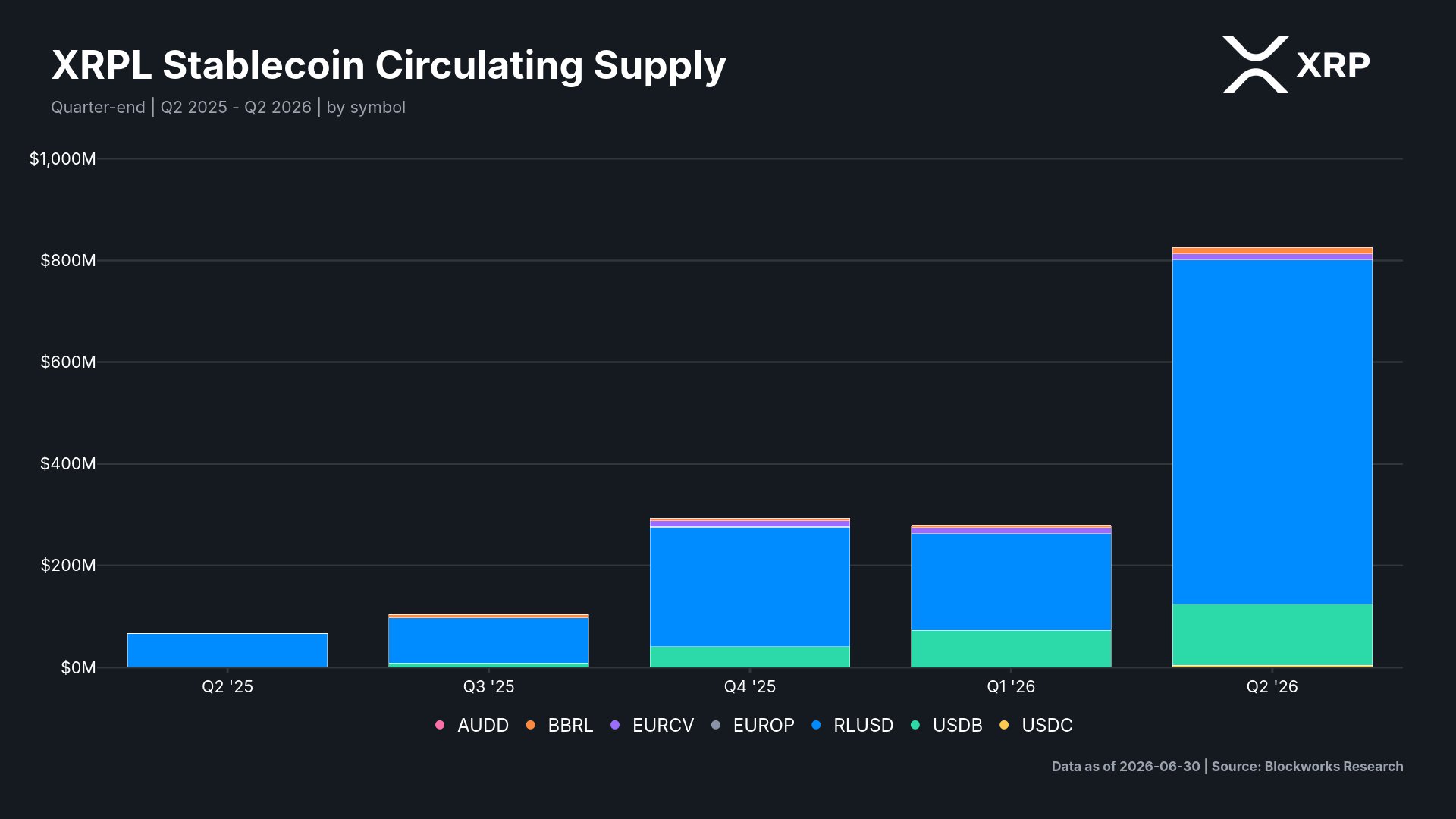
$RLUSD accounted for $676.9 million, or 82.0% of total stablecoin supply at the end of Q2. USDB followed with $119.8 million, representing 14.5% of the total. Meanwhile, Braza’s BBRL and Société Générale’s EURCV had shares of $12.5 million and $11.4 million.
$XRP Price Remains Under Pressure
The growth in network activity came as $XRP continued to struggle in the market. Notably, $XRP began Q2 with a price of around $1.31, surged to a peak of $1.48 by May 14, but then corrected to close the quarter at around $1.04.
The Q2 closing price marked a 19.9% decline from Q1 and stood 53.5% below the $2.23 close recorded a year earlier. $XRP’s market cap ended the quarter at $65.80 billion, down 18.9% QoQ and 49.5% YoY.
Market capitalization fell less than $XRP’s price because growth in circulating supply from escrow releases partly offset the impact of the lower token price.