Lite Strategy reported 929,548 $LTC at Dec. 31, after the buyback had begun. Adding the rounded 4.9 million repurchases to the July count produces an implied starting share count of about 36.78 million, assuming no offsetting changes in common shares.
That proxy rises from roughly 0.02527 $LTC to 0.02569 $LTC per outstanding common share, an increase of about 0.00042 $LTC, or 1.66%. The estimate combines a Dec. 31 treasury snapshot with a reconstructed share count based on a rounded repurchase total.
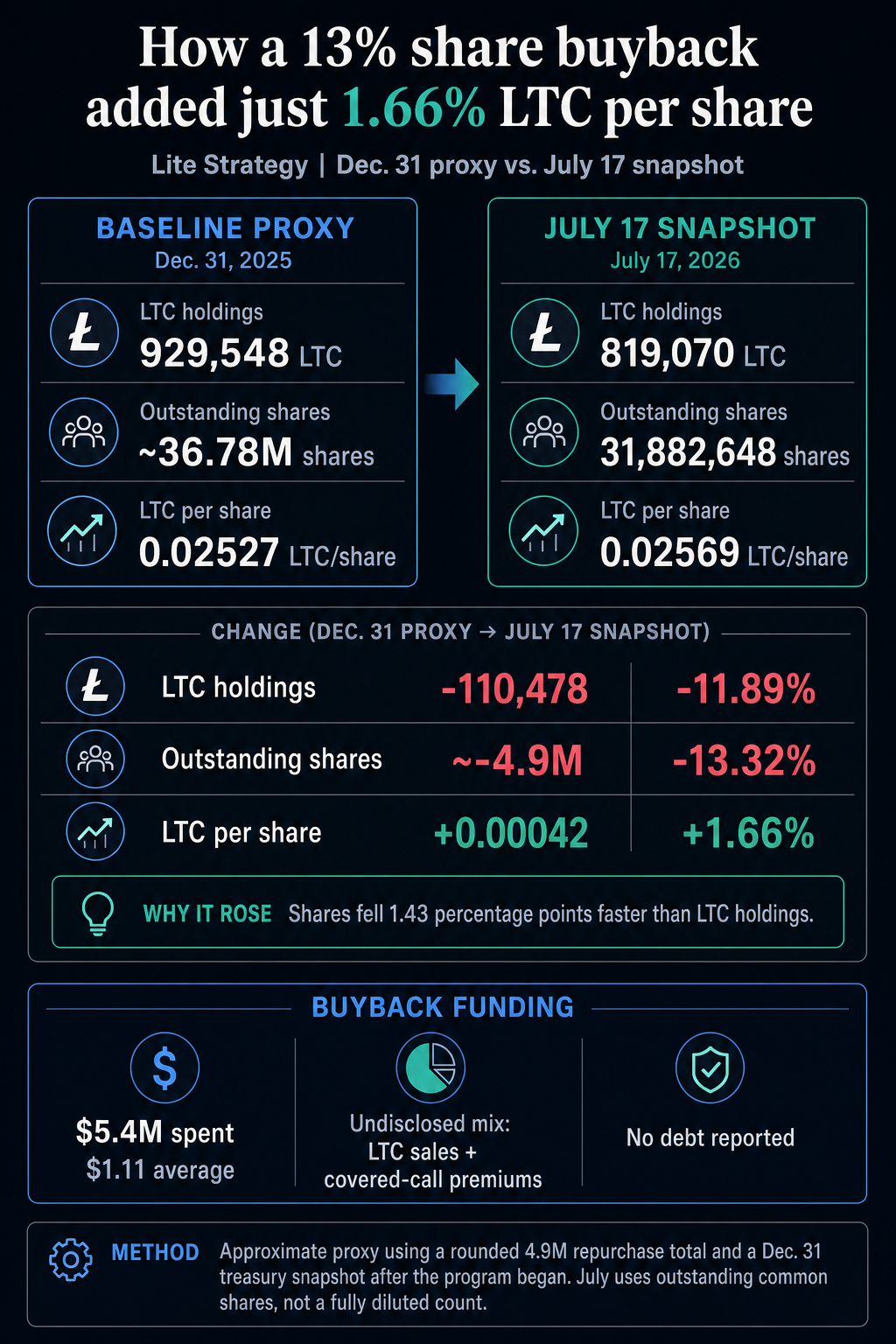
The arithmetic hinges on a small gap between two declines. Reported $LTC holdings fell 11.89% from Dec. 31 to July 17, while the reconstructed share count fell about 13.32%. The July ratio is not fully diluted: Lite Strategy's March quarterly filing separately listed about 3.95 million warrants without providing an updated July count.
Through March 31, Lite Strategy reported $1.925 million in digital-asset sale proceeds and $742,000 in covered-call premiums while spending $1.995 million to repurchase 1,629,136 shares. The combined inflows exceeded the buyback spend, leaving the exact funding mix unresolved.
Accretion still depends on execution
Lite Strategy said its issuer-defined discount to Litecoin net asset value reached the low-40% range during the repurchase period and later narrowed below 25%. The company did not publish a reproducible NAV formula or exact observation dates, so the narrowing cannot be assigned to the buyback alone.
A renewed discount could make repurchases below treasury value attractive again, but per-share accretion still depends on retiring shares faster than $LTC leaves the treasury after accounting for execution and costs. Every $LTC-funded purchase reduces the company's absolute holdings.
The July release reported no debt and gave preliminary, unaudited June 30 estimates of $5.7 million in cash and $1.1 million in liabilities. That eliminates disclosed debt-funded pressure from this transaction while leaving Litecoin price, liquidity, and execution risks intact.
Covered calls can reduce the upside retained by shareholders. The March filing said the contracts could require delivery of the underlying $LTC at expiry if exercised, limiting further appreciation on that portion of the treasury. Transferred $LTC collateral also created GSR counterparty exposure, although Lite Strategy assessed expected credit losses as immaterial at March 31.
The proxy estimate suggests the first round added $LTC per outstanding share, but only modestly. If the discount widens again, the decisive comparison will be how much Litecoin leaves the treasury against how many shares disappear.

 cryptoslate.com