
 en.coinotag.com

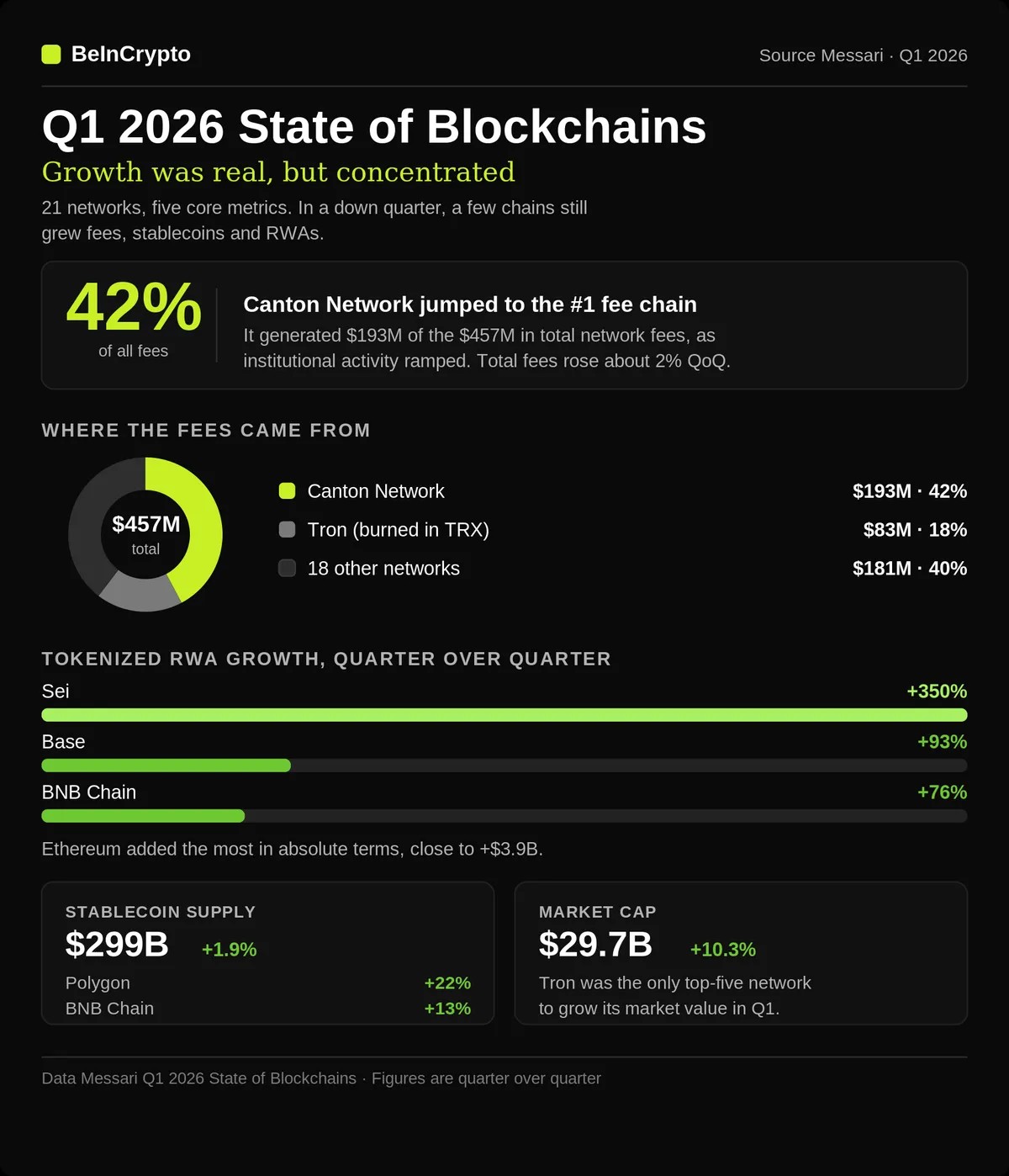
Canton Network captured roughly 42% of all blockchain fees in the first quarter of 2026, climbing to the top of Messari’s fee rankings as institutional activity on the network grew.
The chain generated about $193 million of the $457 million in total fees across 21 blockchains that Messari tracked, according to its Q1 2026 State of Blockchains report.
Why Canton Leapt to the Top of the Fee Table
Canton Network ranked first among the 21 networks for fees in Q1 2026. Its $193 million share represented about 42% of the group total. Aggregate fees rose roughly 2% over the prior quarter.
That gain stood out in a weak market. Most networks saw key metrics fall as prices sold off through the quarter. Canton moved the other way, lifted by growing institutional crypto adoption rather than retail trading.
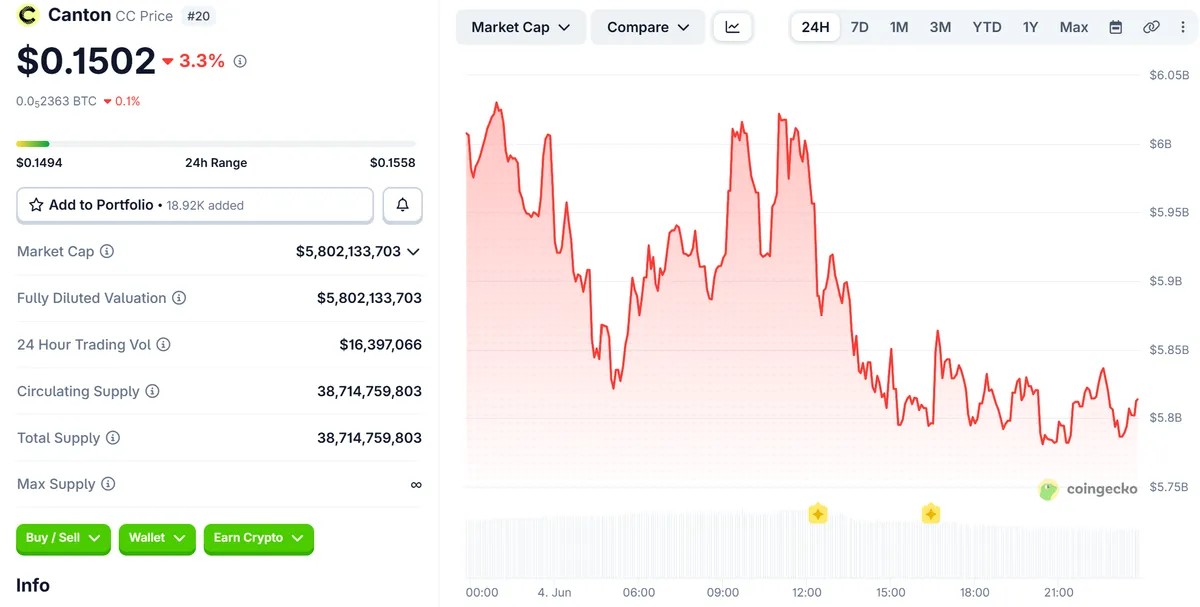
Despite the news, however, the native token, Canton Coin (CC), traded near $0.15 at the time of writing. It had slipped about 3% over the prior 24 hours, leaving CC ranked around 20th by market value despite its earlier bullish chart setup.
What Drove the Fee Growth
Canton runs as a Layer-1 built for regulated institutions. Digital Asset launched the network in May 2023 alongside more than 30 financial firms.
It uses privacy features and a Global Synchronizer, now governed by the Canton Foundation under the Linux Foundation, that lets separate institutional systems settle transactions together.
Founding participants include Goldman Sachs, BNP Paribas, and Deutsche Börse. JPMorgan’s Kinexys unit moved to issue its JPMD deposit token on Canton in January, and DTCC is working to tokenize US Treasuries it custodies. HSBC completed a tokenized deposit pilot on the network in April.
— Messari (@MessariCrypto) June 4, 2026Most blockchains weren't built for regulated markets. @CantonNetwork is building one that is.
Their infrastructure has even pulled in the likes of DTCC, J.P. Morgan, Visa, and other major institutions.
If you haven't read up about Canton yet, make sure to check out our report… https://t.co/ODhV6b7TQ0
Follow us on X to get the latest news as it happens
Fees climbed as tokenized real-world assets, repo markets, and banks settling bonds on-chain scaled up.
Messari noted that real-world assets kept rising even as other metrics declined across the sector.
Q1 2026 State of Blockchains is live. 21 networks, five core metrics, one clear theme: even in a down quarter, a few networks grew fees, stablecoins, and RWAs,” the researchers indicated.
Messari framed the quarter around selective strength.
A Concentrated Picture
Growth was narrow rather than broad. A handful of chains carried the gains while many others declined. Tron was the only top-five network to grow market value, rising about 10% to $29.7 billion.
“TronDAO was the only top 5 network to grow market cap (+10.3% QoQ to $29.7B). With ~$83M in Q1 fees all burned in TRX, fee accrual helped insulate it from the broader bear market. Total fees actually rose ~2% QoQ to $457M – driven by Canton Network. Canton Network jumped to the #1 fee chain, capturing 42% of all fees ($193M) as institutional activity ramped. Tokenized RWAs kept climbing while other metrics declined,” indicated Luis Rincon, Head of Research Operations at Messari.
Real-world asset growth clustered too. Sei led with a 350% quarterly jump, ahead of Base at 93% and $BNB Chain at 76%. Ethereum added the most in absolute dollar terms, close to $3.9 billion.
Stablecoin supply rose modestly to $299 billion, with Polygon and $BNB Chain growing fastest.
The pattern echoes Canton’s earlier token price pullback and points to value consolidating on networks tuned for specific uses.
Whether Canton holds the top fee spot may depend on how quickly institutions keep moving assets on-chain.