
 99bitcoins.com

In $XRP news today, the company has launched its USD-backed stablecoin $RLUSD in Turkey through partnerships with three local platforms, BiLira, Bitexen, and Bitlo, giving Turkish users direct access to a regulated, dollar-denominated digital asset for the first time via the $RLUSD product specifically.
$RLUSD has reached $1.7Bn in market capitalization since its late 2024 launch, and Turkey processes nearly $200Bn in annual crypto transaction volume, making it one of the most consequential emerging markets Ripple has entered.
Ripple's $RLUSD Expands Into Turkey
Ripple announced that $RLUSD is now available in Türkiye through BiLira, Bitexen and Bitlo.
The expansion marks another milestone for the stablecoin, which has grown to a market capitalization exceeding $1.7 billion in less than a year.… pic.twitter.com/WPsTV5NPYQ
— BSCN (@BSCNews) June 2, 2026
Here is the central tension this article unpacks: persistent lira inflation has already pushed millions of Turkish users toward stablecoins as a matter of financial survival, but access to dollar-pegged assets is not the same as protection.
Whether $RLUSD’s regulated structure and transparent reserves make it meaningfully better than what Turkish users already hold is a question worth answering honestly before you move a single lira.
$XRP News: What a Ripple USD-Backed Stablecoin Actually Means for Turkish Users
Think of $RLUSD like a digital safety deposit box denominated in US dollars. Every token you hold represents one real dollar sitting in reserve, held in US dollar deposits, short-term US Treasury bills, and cash equivalents, and a New York-regulated trust company is responsible for keeping that ratio intact, with monthly third-party attestations confirming the reserves are actually there.
That is meaningfully different from keeping your savings in Turkish lira, which has lost a substantial portion of its value against the dollar over recent years as lira inflation eroded purchasing power. It is also different from buying USDT on an exchange – Tether’s reserves have historically faced scrutiny and lacked the same regulatory oversight.
$RLUSD is issued under a charter from the New York Department of Financial Services (NYDFS), runs on both the $XRP Ledger and Ethereum, and is not algorithmic – there is no complex mechanism propping up its dollar peg that could collapse under pressure, the way Terra’s UST did in 2022.
What this is not: it is not a Turkish bank account, it is not insured by any Turkish deposit guarantee scheme, and holding it does not mean Ripple is managing your money. You are holding a token that represents a claim on dollars held by a US trust company, which is a genuinely useful thing, but comes with its own layer of counterparty exposure.
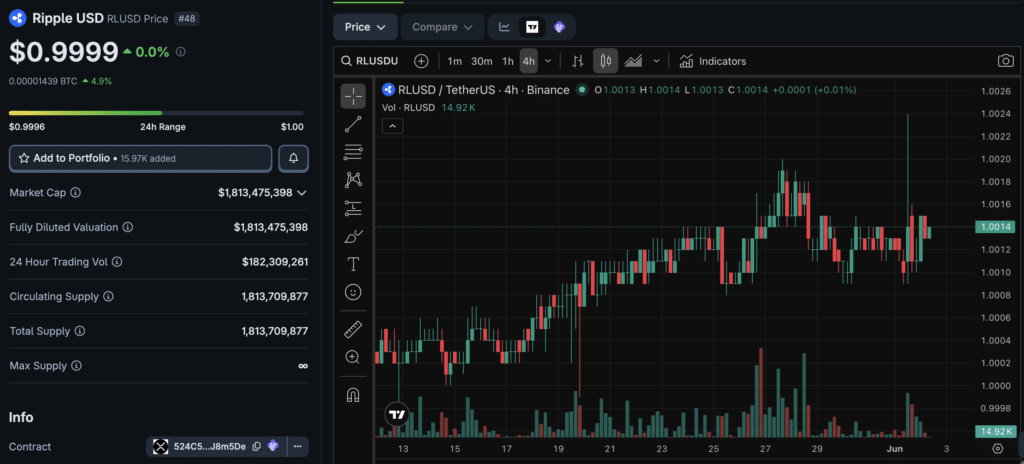
(SOURCE: CoinGecko)
What $RLUSD in Turley Actually Means for Users and What It Doesn’t Solve
The benefits of $RLUSD start with inflation protection; it allows Turkish users to preserve purchasing power in a regulated, transparent manner through local exchanges recognized by Turkey’s Capital Markets Board.
Additionally, it improves remittance efficiency: using $RLUSD on the $XRP Ledger can significantly reduce costs and enable settlement in seconds compared to traditional SWIFT methods.
However, $RLUSD does not address all issues. It is not legal tender in Turkey, meaning you can’t use it for rent or taxes. Turkish exchanges must meet anti-money laundering requirements, so transactions are not anonymous and require KYC compliance.
There are also risks associated with smart contracts and platform stability; if the exchange is hacked or goes insolvent, legal recourse is limited. Lastly, regulated status ensures transparency about reserves but does not inherently guarantee the safety of the underlying assets.
DISCOVER: The Next 1000x Crypto Gem Before It Lists on Binance
The Partnerships Behind the Launch and What Ripple’s Broader Strategy Signals
Ripple
J.P Morgan
Ripple
Ripple
Ripple3 out of the 4 big banks highlighted utilize Ripple Custody to safely store, trade and manage digital assets like $XRP and $RLUSD https://t.co/oc3cxB0pRt pic.twitter.com/S8lKmfrGKY
—
ChartNerd
(@ChartNerdTA) June 2, 2026
In other $XRP news, the three chosen partners for this rollout each offer unique advantages. BiLira operates Turkey’s largest OTC desk, handling about $300M in monthly volume and issuing TRYB, a stablecoin pegged to the Turkish lira.
Bitexen provides a multi-jurisdiction platform across Turkey, the Middle East, South Africa, and Europe, facilitating cross-border flows that $RLUSD supports. Bitlo, with a retail focus and multiple customer experience awards, addresses the trust issues faced in the market.
This launch is part of a broader strategy, as $RLUSD has been integrated into Ripple Payments for cross-border transactions, rolled out to African institutional partners for remittances, and listed on major exchanges like Binance and Kraken.
Ripple views $RLUSD as essential to making its payments infrastructure viable at scale, as demonstrated by its partnership with Istanbul Technical University to establish an $XRP Ledger validator funded via $RLUSD, indicating a focus on building a local ecosystem.
EXPLORE: Best Meme Coin ICOs to Invest in 2026
The post $XRP News: Ripple’s $RLUSD Arrives in Turkey in a Hedge Against Inflation appeared first on 99Bitcoins.