
 coindesk.com
Solana-based token issuance launchpad Pump.fun has, to date, run a simple model: every dollar of revenue has gone toward buying and burning its own token. In theory, the constant supply reduction was supposed to steadily prop up $PUMP's price and align the token's value with the platform's success.
But that model is now history after a review of the previous 100% buyback showed it wasn't fully working in the company's favor.
The firm said in an X post that it would shift to a 50/50 split, in which half of all future net revenue from the Pump.fun bonding curve, PumpSwap, and Terminal, the company's three core products, flows into an irreversible smart contract that automatically buys $PUMP on the open market and burns it for the next year.
The other half stays with the company for product investment, hiring, marketing, and potential acquisitions. The previous policy was to allocate 100% of revenue to buybacks.
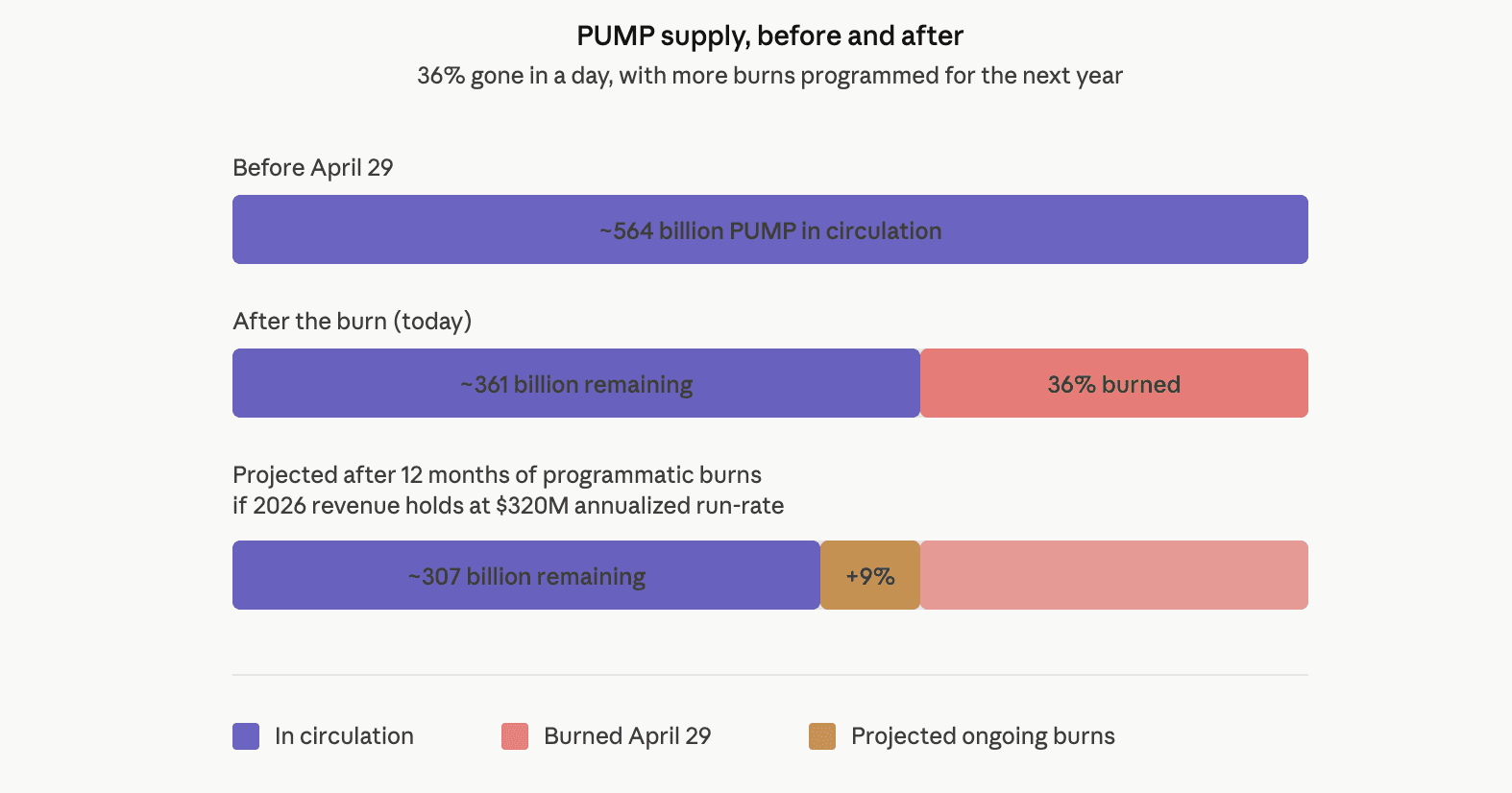
Pump said it had burned all $PUMP tokens it had bought back from the open market over the past nine months, or roughly 36% of that token's circulating supply, in two transactions on Solana.
Burn refers to the permanent removal of tokens from circulation, usually by sending them to a crypto wallet address not controlled or held by anyone. $PUMP's burn announcement is one of the largest single-event supply reductions in crypto history by share of circulating tokens.
Co-founder Alon Cohen explained the change in a follow-up post on X, arguing the business needs the other half of revenue for product investment, hiring, marketing, and potential acquisitions, to keep Pump.fun alive for "decades to come."
Part of the reason the move was necessary is the price chart.
$PUMP has spent most of 2026 trading sideways below its launch valuation despite using 100% of revenue for token buybacks for nine months and generating over $1 billion in lifetime revenue.
"Despite being one of the biggest revenue generating platforms in crypto and allocating 100% of revenue to buybacks, we believe there was a lack of trust in the longevity of the business, the certainty of buybacks, and what the bought-back tokens would be used for," the team said on X.
today is a turning point for $PUMP and pump fun
— alon (@a1lon9) April 28, 2026
I want to give more context on the bigger picture and where we're actually going.
over the past ~9 months, 100% of revenue went into buybacks. basically no other platform in crypto has done that at this scale.
however, we… https://t.co/3WTAHH1fUX
There is a bear case, however. Memecoin launchpad volume is cyclical and mean-reverting. Pump.fun's gross protocol revenue totaled $971.37 million in 2025 but is annualizing to roughly $320 million so far in 2026, DefiLlama data shows.
The 50% of declining revenue produces smaller burns than 100% of peak revenue did.
The bull case is the math on remaining tokens. Burning 36% of the $PUMP that was in circulation removes a large block of supply that could have hit the market.
Locking 50% of future revenue into more burns means more tokens get permanently destroyed every week, regardless of what the team decides later.
If Pump.fun keeps generating even half the revenue it did in 2025, the ongoing burns would retire a meaningful chunk of what remains over the next 12 months. Less supply against steady demand would form a bullish setup that the token may not have had since launch.
$PUMP rose 6.9% in the 24 hours after the Wednesday announcement. Its annualized fees run at $802 million and revenue at $416 million per DefiLlama, putting Pump.fun in the rare category of crypto projects generating real cash flows at scale.