
 thecryptobasic.com

Market analyst Bodhi Karma is pushing back against a growing belief among $XRP holders that the upcoming XLS-66 feature will offer simple, passive income.
In a detailed breakdown, the analyst explains that while the system does create opportunities to earn yield, it works very differently from traditional “interest-paying” products.
Key Points
- XLS-66 may offer yield for $XRP holders, but it’s not simple passive income as many expect.
- Users receive MPTs, not payouts, with profits only realized when redeeming their vault share.
- Interest stays in the pool, boosting token value rather than sending regular wallet payments.
- $XRP holders need active strategies and risk management, as returns depend on lending performance.
No Automatic Interest Payments
According to the analyst, many users assume that depositing $XRP into vaults will generate regular payouts directly into their wallets. However, that is not the case.
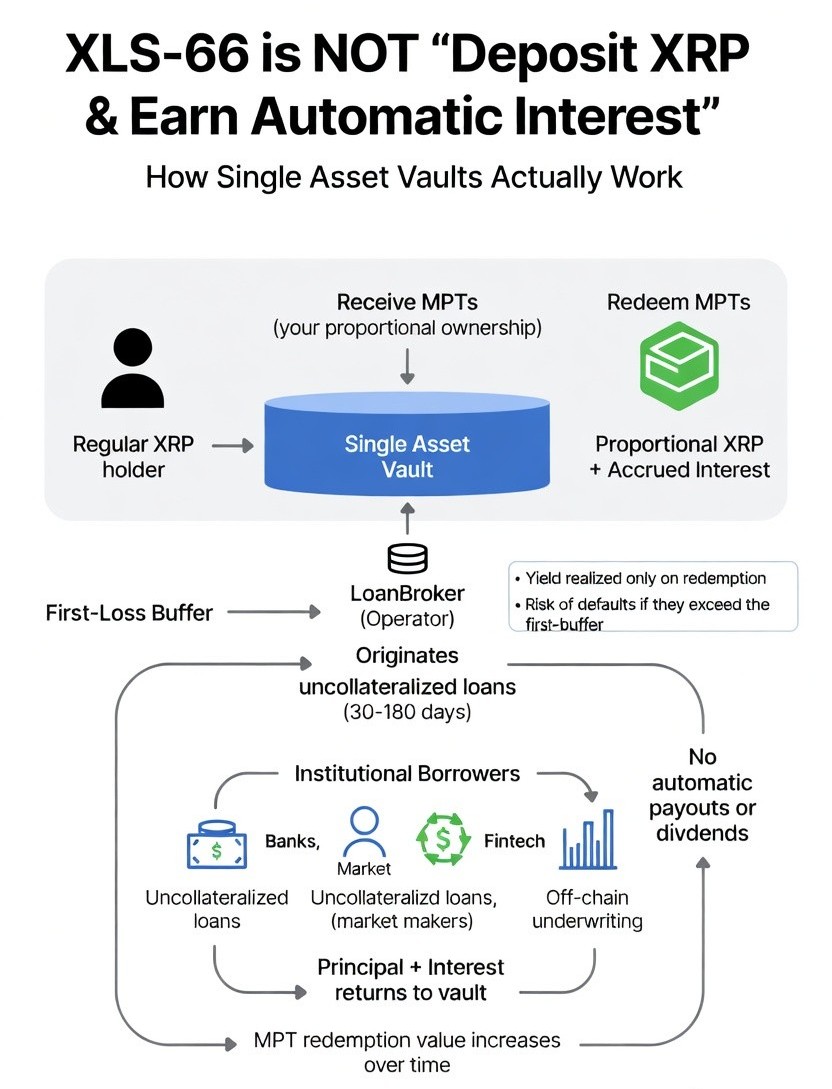
Instead of earning periodic interest, users receive Multi-Purpose Tokens (MPTs) when they deposit $XRP into a Single Asset Vault. These tokens represent their share of the pooled $XRP.
Any interest generated from lending activity stays inside the vault, increasing the overall value of the pool rather than being distributed as direct payments.
Profits are only realized when users redeem their MPTs. At that point, they receive their share of the $XRP in the vault, including any accumulated gains.
How the Lending System Works
Notably, the XLS-66 model introduces a structured lending system within the $XRP Ledger ecosystem. Deposited $XRP is pooled and made available for lending through a LoanBroker, typically an institution or specialized operator.
Loans issued through the system are:
- Fixed-term, usually between 30 and 180 days
- Uncollateralized, meaning no on-chain collateral is posted
- Approved using off-chain credit assessments
Borrowers repay both principal and interest, which is then added back into the vault. Over time, this increases the redemption value of the MPTs held by depositors.
To reduce risk, LoanBrokers provide a “first-loss buffer,” a capital reserve to absorb initial losses if borrowers default. Only when losses exceed this buffer would depositors begin to take a hit.
Institutional Players Dominate Borrowing
The system is not designed for everyday consumer loans. Instead, the main borrowers are expected to be institutions such as:
- Market makers
- Payment providers
- Fintech firms
- Exchanges
- Large $XRP holders managing liquidity
This institutional focus explains the short loan durations and reliance on traditional credit underwriting processes.
Multiple Vaults, Different Strategies
Another key feature of XLS-66 is the ability for different institutions to operate their own vaults. Each LoanBroker can specialize in different borrower types or risk levels.
Some vaults may be open to all $XRP holders, while others could be restricted for regulatory reasons. As more participants enter the ecosystem, users may see a wide range of vault options with varying risk and return profiles.
This structure allows $XRP holders to diversify by spreading funds across multiple vaults rather than relying on a single provider.
Active Strategy Required
Despite the appeal of earning yield, the analyst stresses that XLS-66 is not a “set it and forget it” system.
To manage risk and optimize returns, users may need to adopt strategies like staggered redemptions. One example shared involves splitting $XRP across multiple vaults and periodically redeeming portions on a rotating schedule.
This “redeem-and-redeploy” approach allows users to:
- Realize profits regularly
- Monitor vault performance
- Shift funds away from underperforming operators
- Keep most capital continuously deployed
Over time, this can create a balance between earning yield and maintaining flexibility.
Risks Still Exist
While the structure introduces safeguards, risks remain. Because the loans are uncollateralized, significant borrower defaults could reduce returns or even impact deposited capital if losses exceed the first-loss buffer.
Liquidity is another factor, as access to funds depends on how much of the vault’s assets are currently lent out.
New Opportunity for $XRP Holders
In summary, XLS-66 offers a more advanced way for $XRP holders to put idle assets to work, but it requires a clear understanding of how the system operates.
Rather than automatic income, it introduces a model where returns build over time within pooled vaults and are only realized upon redemption.
With the proposal still under voting and not yet live, $XRP holders have time to study the system and decide whether this more hands-on approach to earning yield fits their strategy.