
 coindesk.com

Blockchain ecosystems are losing developers across the board while artificial intelligence projects dominate growth on GitHub, the world’s largest platform for hosting and collaborating on software code.
Weekly crypto commits (publishing new code) to repositories have fallen roughly 75% since early 2025, dropping from about 850,000 to 210,000, while active developers declined 56% to around 4,600, according to data from analytics platform Artemis.
Repositories track where developers are writing code, building tools and launching new projects, they offer one of the clearest signals of where software innovation is happening.
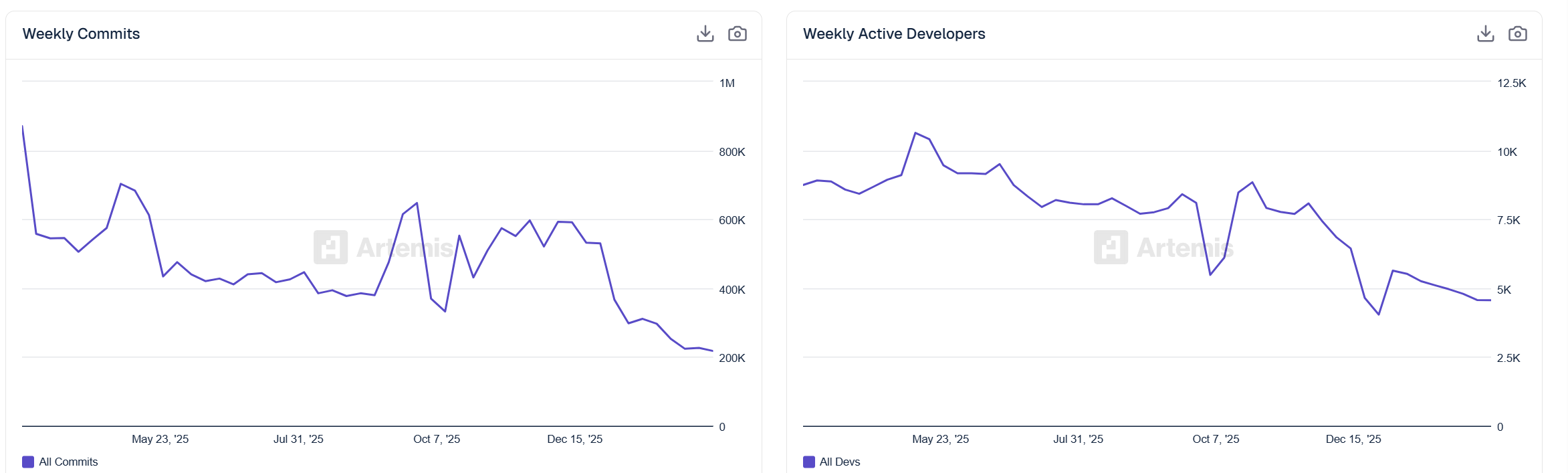
The contraction stands in stark contrast to the broader software ecosystem. GitHub added about 36 million developers in 2025 alone, bringing its global base to more than 180 million, with platform-wide commits rising roughly 25% year over year, according to GitHub's Octoverse report.
Much of that growth is flowing into artificial intelligence. GitHub now hosts more than 4.3 million AI-related repositories.
The number of repos importing large language model software development kits surged about 178% to more than 1.1 million over the past year, while generative AI projects now attract more than 1 million monthly contributors.
The numbers suggest developers are reallocating time toward AI infrastructure rather than blockchain.
Repositories using Jupyter Notebooks, commonly used for machine learning experimentation, grew about 75%. Dockerfile repositories used to deploy AI applications jumped roughly 120%. TypeScript, the programming language underpinning much of the modern web and many AI tools, overtook Python and JavaScript to become GitHub's most-used language after gaining more than 1 million contributors in a single year.
Within crypto, the decline is broad but uneven.
Ethereum's weekly active developer count fell 34% over three months to 2,811, according to Artemis. Solana shed 40% to 942 developers. Base, the Coinbase-incubated Layer 2 that was among 2024's fastest-growing ecosystems, dropped 52% to 378 developers.
Newer chains that attracted speculative interest during last year's bull market are faring worst. Aptos lost about 60% of its developers, BNB Chain commits plunged 85%, and Celo fell 52%.
The only category of meaningful size still growing is wallet infrastructure, which rose about 6% to 308 weekly active developers.
Still, the data suggests crypto may be consolidating rather than collapsing.
Electric Capital's annual developer report shows the sector peaked at roughly 31,000 monthly active developers in 2022 before falling to about 23,600 in 2024, with estimates suggesting further declines to around 18,000 by mid-2025.
The composition of the remaining workforce is also changing. Developers with more than two years of tenure grew about 27% year over year and now produce roughly 70% of commits. The exodus is concentrated among part-time contributors and newcomers with less than 12 months of experience, a group that declined 58% in one tracking period.
Crypto development has historically followed market cycles, and activity could rebound if another bull market draws builders back.
But previous downturns offered fewer alternatives for displaced developers. In 2025, generative AI represents a rapidly expanding frontier with deep venture funding and immediate commercial demand, raising the question of whether this cycle's talent drain proves harder to reverse.