Some Monero proponents attribute $XMR’s recovery to the emerging narrative that Qubic had deliberately overstated the hashrate it controlled. One crypto trader going by the name Smart Degen on X stated that Qubic’s actual control of Monero stood at 38% and not the 51% claimed. The Qubic mining pool has also been accused of falsely claiming success in its 51% attack “to pressure miners into defecting to their pool out of fear of losing profitability.”
Still, some observers said the whole controversy proved that Monero can be destabilized even with Qubic’s 35% hashing power.
Meanwhile, Smart Degen claimed that the Qubic mining pool has faced community backlash, which has ranged from “mass miner boycott of its pool to DDoS attacks on Qubic infrastructure.”
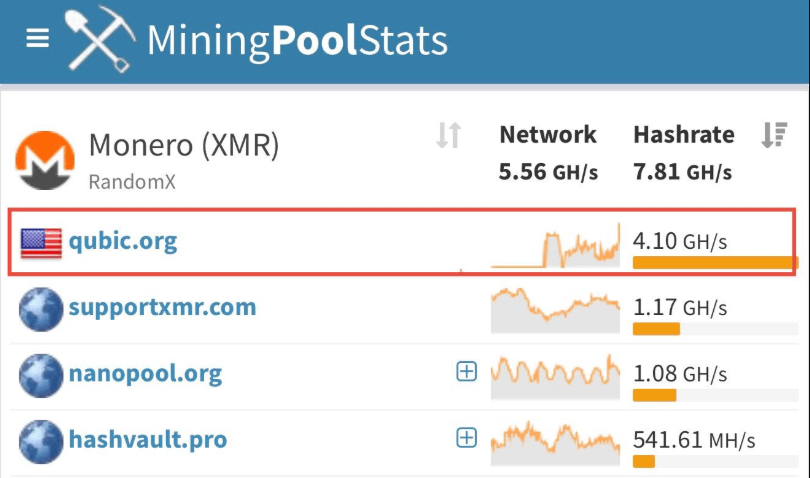
These counterattack measures, as well as surging P2Ppool adoption and solo mining, contributed to the drop in Qubic’s hashrate share from the claimed 51% to 30%, Smart Degen said in an Aug. 17 post. At the time of writing, Qubic’s token was 3% down, possibly hinting at investor dissatisfaction with the 51% attack claim.
Despite this, some Qubic supporters insisted that the attack had been successful and that as much as 73% was now controlled by the Qubic mining pool. Remarking on Qubic’s claimed 51% attack success, one crypto trader said:
“This is a tremendous breakthrough in technology! $QUBIC has reached 4.1Gh/s, dominating 73% of Monero’s hashpower. That means we have successfully reached 51% of $XMR’s power, so all blocks will now be mined entirely by $QUBIC. This shows the power of human innovation. It’s the first time we are witnessing this kind of new technology, the first UPoW capable of leveraging its mining power to solve real-world problems.”

 news.bitcoin.com