“In February, $USDC accounted for 31% of the stablecoin market, while $USDT represented 52%, but $USDC’s market share has since dropped to 20% as $USDT’s has grown to 70%.”
– Unchained
2 alternative stablecoins to consider for the next year
Given $USDC’s importance in challenging $USDT’s dominance and bringing balance to a highly dominated market, alternative stablecoins may see an increase in demand in 2025.
The alternatives can vary from similarly centralized solutions like PayPal’s $PYUSD or decentralized experiments like Ethena’s $USDe, which uses a totally new system based on a drafted model by the known crypto executive Arthur Hayes.
Nevertheless, users, traders, and investors must understand these alternatives are still mostly experimental, bringing considerable risks.
Maker’s $DAI: Leading decentralized stablecoin
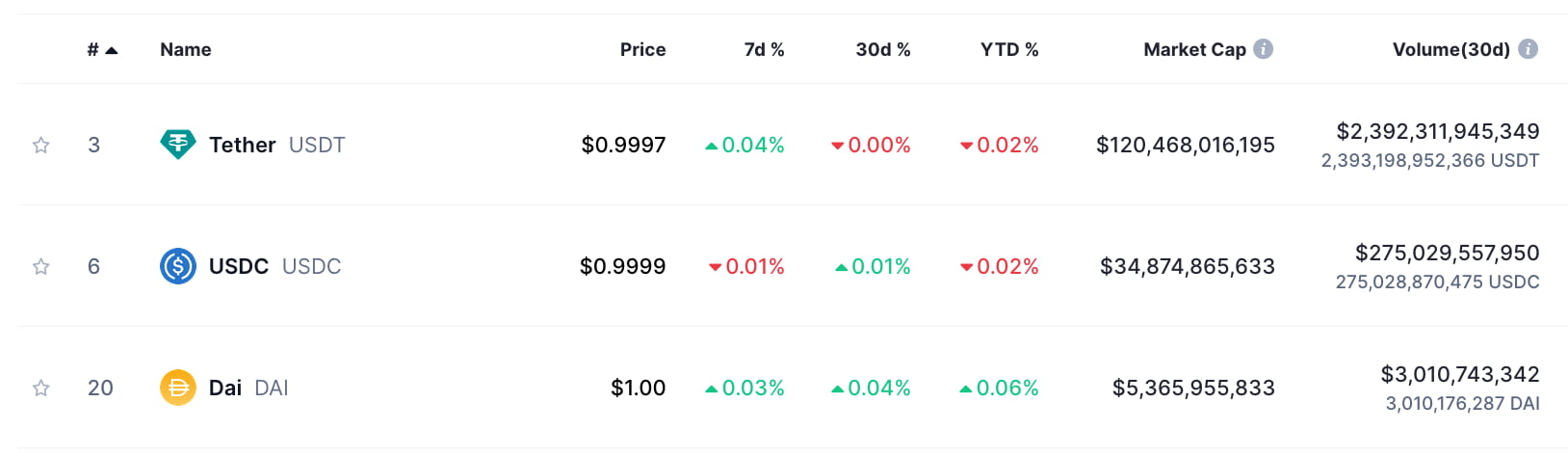
First, Maker’s (MKR) $DAI is the third largest stablecoin by market cap, with over $5.36 billion minted. It has 15% of $USDC’s $34.87 billion capitalization and 4.5% of $USDT’s $120.47 billion market value.
$DAI is an overcollateralized stablecoin, which means that investors must deposit far more nominal value in different cryptocurrencies to Maker’s vaults in order to mint a smaller amount of $DAI in a decentralized manner.
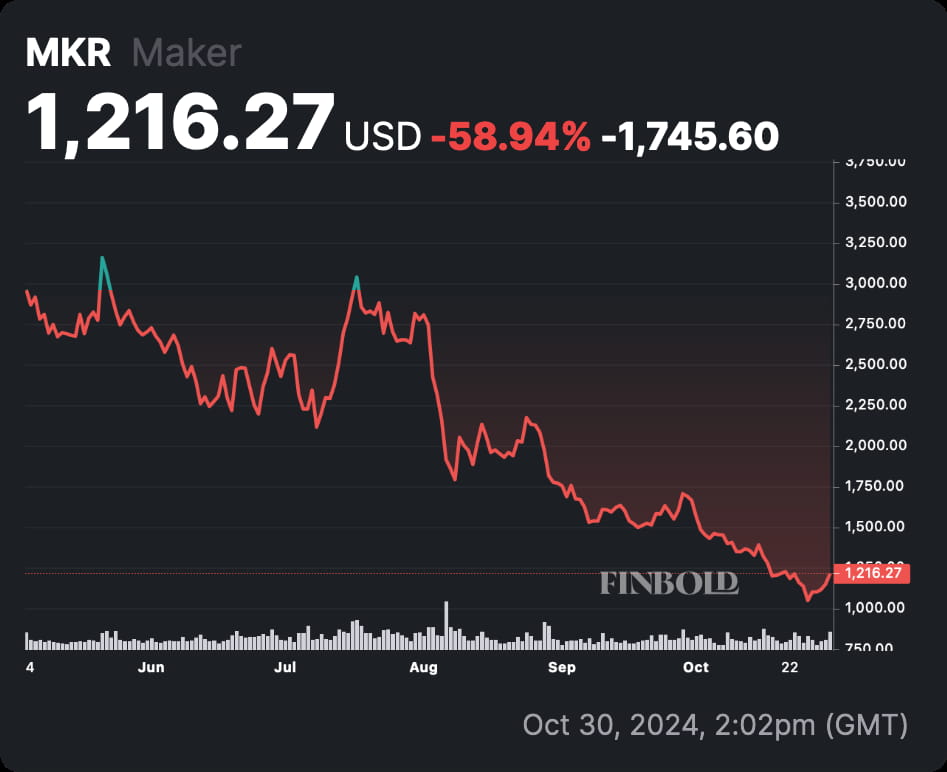
However, recent governance moves from the MakerDAO, in an apparently failed rebranding attempt, raised market concerns and negative price consequences. MKR lost over 50% of its value since the rebranding announcement to Sky with the launch of a new token.
MKR holders offloaded their positions as the token would be rendered useless after the rebranding, now halted, was completed. Finbold reported how a MakerDAO’s investor capitulated for less than $2 million from a position previously worth $3 million.
Hatom’s USH: Promising alternative stablecoin for 2025
Similar to Maker’s $DAI, Hatom (HTM) is in the final stages of launching USH after years of development and tests. Hatom’s USH uses the $DAI’s battle-tested overcollateralized model to keep its peg to the U.S. dollar.
As of this writing, USH is going through public testing on an open testnet running on MultiversX’s ($EGLD) Devnet. The decentralized alternative stablecoin can be minted by the supply of cryptocurrencies like $EGLD, Bittensor (TAO), wBTC, wETH, $USDC, and $USDT, as announced on October 28.
The wait is finally over! We're excited to announce the introduction of both USH and Booster V2 on the Public Devnet for the community to start rigorous stress-testing.
We invite you all to explore all the features and put them to the test by accessing any of the links below:… pic.twitter.com/HhsEwb7Cx7
— Hatom Labs (@HatomProtocol) October 28, 2024
Moreover, Hatom Labs will offer different incentives for investors who provide liquidity and stake the minted USH in other protocols. At Finbold, we previously featured the protocol as a promising platform for yield farming and earning passive income through lending.
The MultiversX blockchain, despite having a proportionally low capitalization, is on the radar of significant market players. Namely, Uphold’s Head of Research Dr. Martin Hiesboeck mentioned MultiversX as a promising Ethereum rival in an article on X. Uphold also featured the chain in a closed webinar for institutional investors on October 15.
Additionally, the founder and CIO of Europe’s oldest crypto fund, Justin Bons, deemed $EGLD the “technological Holy Grail of crypto.”
In this rapidly evolving ecosystem, solutions like Maker’s $DAI and Hatom’s USH appear as decentralized alternatives to stablecoins.
As 2024 comes to an end and 2025 approaches, $USDT, $USDC, $PYUSD, $USDe, and other solutions will compete for users’ and investors’ attention and liquidity – requiring deep research and understanding of the inherent risks and trade-offs of each alternative.

 finbold.com