
 news.bitcoin.com
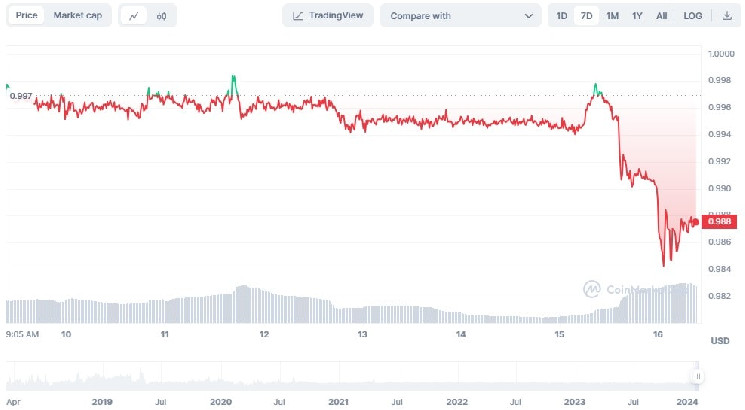
Market insights reveal that on January 15, 2024, the stablecoin $TUSD deviated from its usual $1 parity, dipping to $0.979 per coin the next day. By 10:00 a.m. Eastern Time (ET) on Tuesday, it managed to recover slightly, climbing above the $0.99 mark.
$TUSD Faces Unsteady Ground, Drops Under $1
Recently, $TUSD experienced fluctuations, slipping below its $1 benchmark on Monday. That evening, its value lingered around $0.98, amid challenges linked to the company’s real-time attestations. As of January 16, 2024, $TUSD’s circulating supply, as displayed on their website, stands at 1.92 billion tokens.
A significant portion of $TUSD’s supply is in the hands of Binance, which owns the top five ERC20 wallets. Of the total supply, only 391.99 million $TUSD tokens are issued on the Ethereum blockchain, while 1.48 billion are on the Tron network. Binance’s cold wallet holds approximately 1.4 billion of these tokens.
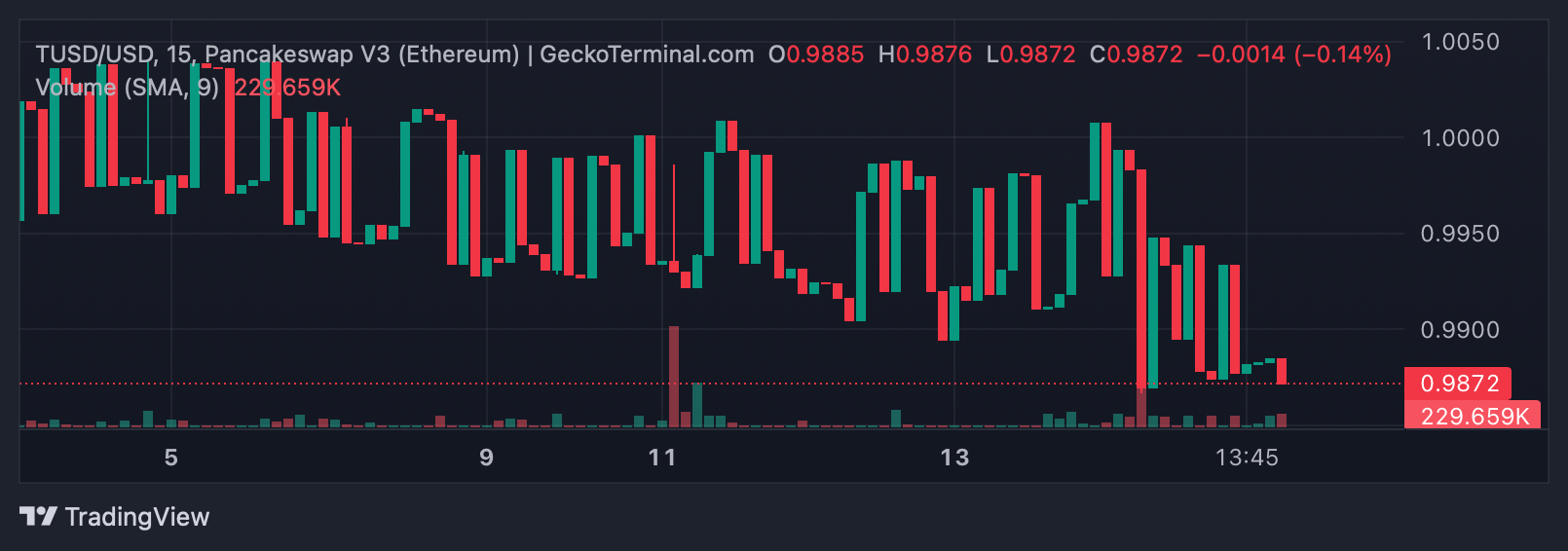
At 10:00 a.m. ET on Tuesday, $TUSD temporarily reached $0.996 per coin. Yet, by 10:20 a.m., it fell to about $0.987. This instability has sparked considerable debate on social media, with many questioning the reasons behind $TUSD’s fluctuating peg. Most of the trading activity for the coin is concentrated on Binance, with a significant portion of its volume originating from this exchange.
In the last 24 hours, $TUSD’s global trade volume hit $425 million. Despite a hefty supply of 1.92 billion $TUSD, its market valuation on Tuesday was slightly lower, at $1.89 billion. $TUSD is now among several stablecoins that have dealt with parity issues, a trend that began with the Terra blockchain ecosystem’s collapse in May 2022.
What do you think about the issues $TUSD has been facing dealing with holding its $1 peg? Share your thoughts and opinions about this subject in the comments section below.