
 coindesk.com
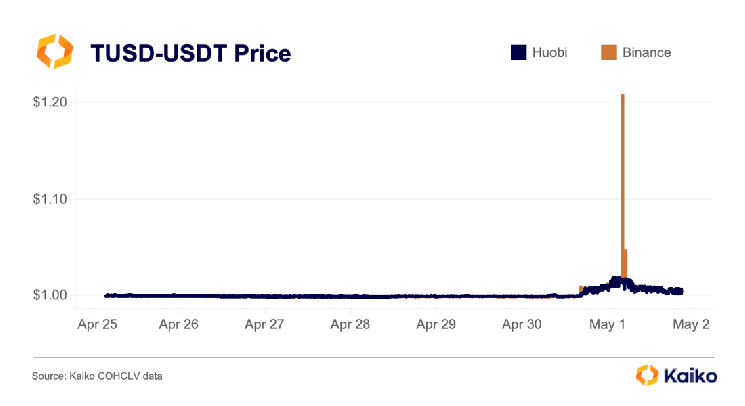
Traders quickly jumped in to take advantage of TrueUSD’s ($TUSD) depegging event earlier to capture a potential 20% gain – paying an outrageously large amount in fees to be able to do so.
Crypto analytics firm Kaiko said in a Wednesday newsletter that onchain traders utilized Aave and Compound, two popular lending protocols, to borrow large amounts of $TUSD and quickly swapped these holdings for USD Coin (USDC), another dollar-pegged token.
Such a move was to effectively short, or bet against, $TUSD from its elevated price. However, neither Aave nor Compound had a large supply of $TUSD, which caused borrowing rates to hit over 100% annualized on both protocols.
Kaiko said these token conversions appeared to be organic instead of driven by automated bots. The firm added $TUSD’s depegging likely occurred due to the lack of liquidity backing its intended $1 peg.
“Binance has recently been promoting $TUSD, making $BTC-$TUSD the only zero-fee pair on the exchange,” Kaiko wrote. “This quickly made Binance $BTC-$TUSD one of the highest-volume pairs in all of crypto despite $TUSD being relatively unknown amongst stablecoins.”
“Additionally, $TUSD liquidity has not kept pace with its volumes, making a depegging like this more likely,” it added.
Binance has shied away from binance USD ($BUSD), which it offered in association with crypto firm Paxos since regulatory troubles earlier this year. Paxos said at the time it would stop minting new $BUSD tokens at the direction of the New York Department of Financial Services (NYDFS).
Traders have quickly adopted $TUSD on Binance. Bitcoin trading volumes paired with the token clocked over $1 billion over the past 24 hours, second only to tether-denominated trading at $1.5 billion.