
Non-Custodial vs Custodial Crypto Payment Gateways: Key Differences Explained
Source: https://bcon.global/custodial-vs-non-custodial-gateway/
When searching for a payment gateway, you need to decide on the interaction model. Are you willing to delegate responsibility for the safety of your funds to a payment gateway while dealing with the restrictions and rules of the banking sector? Or do you want to be your own master and use technology to its full potential?
At Bcon Global, as a non-custodial crypto payment gateway, we believe that innovations are created to be used as intended, not adapted to fit an outdated system. Many merchants focus on payment processing features while overlooking how funds are actually received and stored. Understanding the difference between custodial and non-custodial systems helps businesses reduce operational risks and maintain full control over their cryptocurrency assets.

Know when your
coins move
Alerts, real-time prices, and market news — all in one app
 Point your phone camera to install
 4.8 based on 40K reviews in the App Store and Google Play


What Is a Custodial Crypto Payment Gateway?
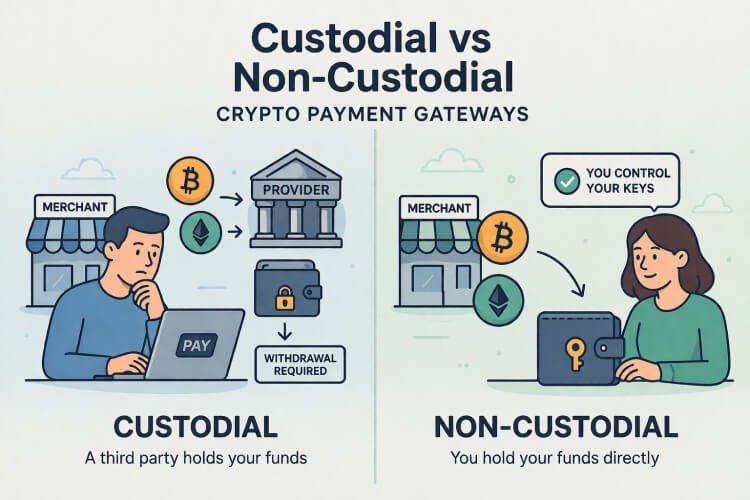
Custody means that your funds are held by a third party that provides services to you. In the case of a custodial payment gateway, the provider uses its own wallet addresses, and your customers send payments to wallets controlled by the payment gateway.
You then have to request withdrawals, pay additional fees, and undergo identity verification procedures. In many ways, the process is similar to using a traditional bank.
What Is a Non-Custodial Crypto Payment Gateway?
A non-custodial gateway works completely differently. Blockchain technology and cryptocurrency wallets allow you to create your own wallets and store funds without the involvement of third parties. Non-custodial gateways automate payment acceptance between you and your customer without requiring access to your wallets.
In other words, by using only your wallet address, the payment gateway can include it in invoices for your customers and track the status of transactions sent to that wallet. This is possible thanks to blockchain technology and the transparency of transactions.
In other words, anyone can track the destination of a payment, which is exactly what the Bcon non-custodial payment gateway does.
How Direct-to-Wallet Payments Work
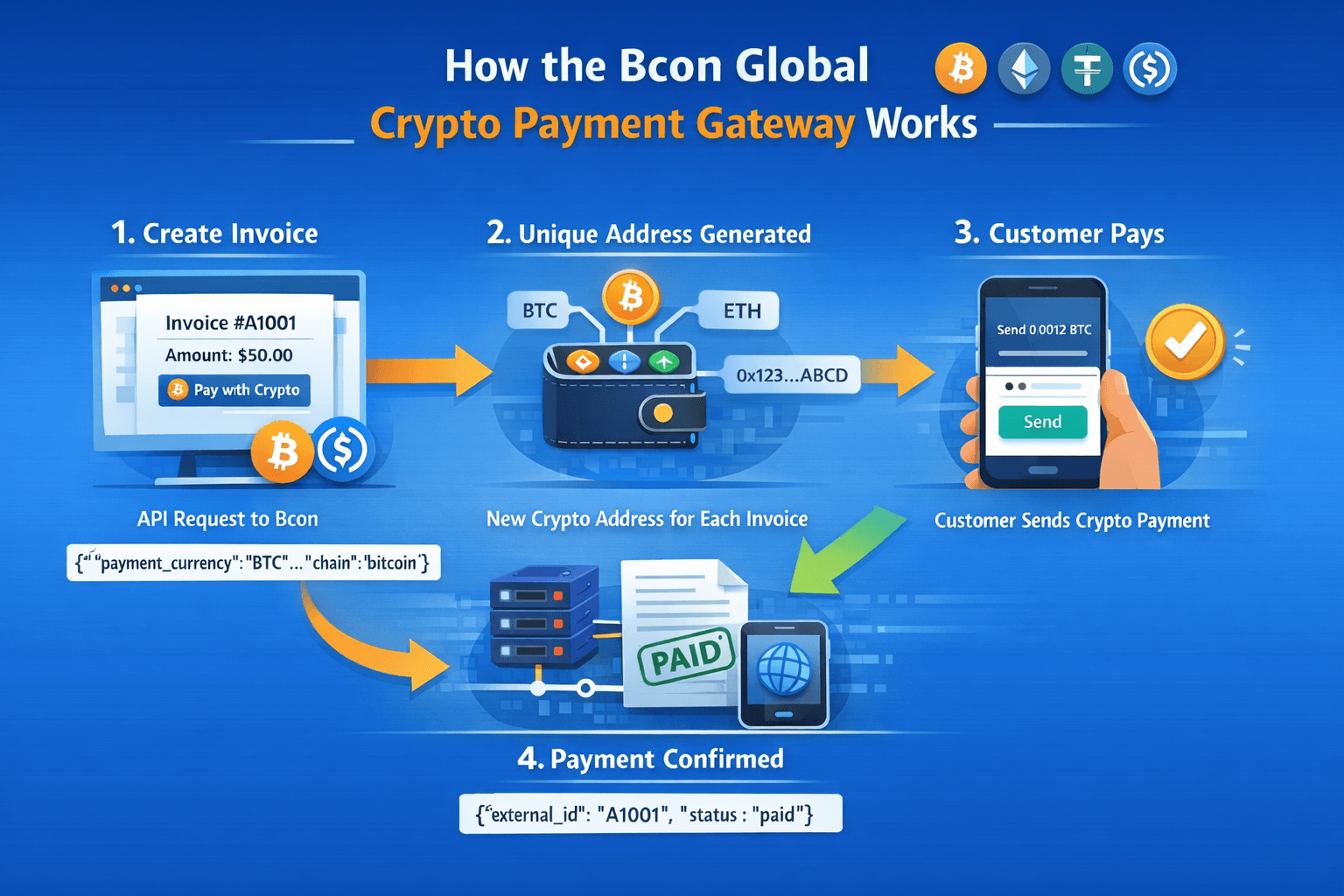
As a merchant, you specify the wallet addresses in the Bcon dashboard that you want to use to receive payments on your website. When your customer places an order, a request is sent to Bcon to monitor the payment status for your wallet.
The payment is tracked by the payment gateway, which then notifies your website’s CRM system whether the payment was successful or not, as well as how much money was received.
Source: https://bcon.global/how-to-start-accepting-crypto-payments-with-the-bcon-new-address-api-function/
No Private Keys, No Third-Party Control
The main advantage is that Bcon Global does not require any access keys or credentials—only your wallet address. As a result, the service cannot influence your business operations or your finances in any way.
Custodial vs Non-Custodial: Comparison Table
|
Feature |
Custodial Gateway |
Bcon Global Non-Custodial Gateway |
|
Merchant controls funds |
No |
Yes |
|
Direct wallet payments |
No |
Yes |
|
Provider holds assets |
Yes |
No |
|
Private keys controlled by merchant |
No |
Yes |
|
Risk of frozen funds |
Possible |
Eliminated |
|
Immediate access to funds |
Not always |
Yes |
|
Third-party custody risk |
Yes |
No |
Security and Compliance Considerations
Security is often the primary reason businesses choose a non-custodial payment solution. If a provider controls the wallet, merchants depend on that provider’s infrastructure, policies, and operational decisions.
With Bcon Global, payments are delivered directly to the merchant’s wallet. This significantly reduces risks associated with third-party custody while increasing transparency.
No KYC Requirements
Since Bcon cannot control your business activities, freeze your accounts, or block your transactions, KYC or KYB procedures are not required.
Reducing Counterparty Risk
Custodial services are subject to extensive regulatory requirements that directly affect you as a merchant. These requirements may include reporting obligations, verification of fund sources, compliance checks related to regional policies, customer identification procedures, and other regulatory controls.
A non-custodial approach eliminates these risks because your funds are already in your own wallet. No third party can freeze them, block access to them, or control them. Only you have access to your funds.
Which Model Is Right for Your Business?
Bcon Global was designed for merchants who value independence, transparency, and security. For businesses accepting cryptocurrency as a long-term payment method, direct wallet ownership often provides greater flexibility and lower operational risk than custodial alternatives.
FAQ
What is the main difference between custodial and non-custodial gateways?
A custodial gateway holds merchant funds, while a non-custodial gateway sends payments directly to the merchant’s wallet.
Does Bcon Global store merchant funds?
No. Bcon Global never stores, manages, or controls merchant funds.
Can Bcon Global freeze my cryptocurrency?
No. Since payments are sent directly to your wallet, only you control access to your funds.
How does Bcon Global earn revenue?
Bcon cannot automatically deduct fees from your transactions. Therefore, payment for our services is made separately by topping up your account balance on the platform.
Is a non-custodial gateway more secure?
For many businesses, yes. Eliminating third-party custody reduces the risk associated with relying on another company to hold and manage funds.