
How to Swap BTC for XMR Without Giving Up Your Privacy
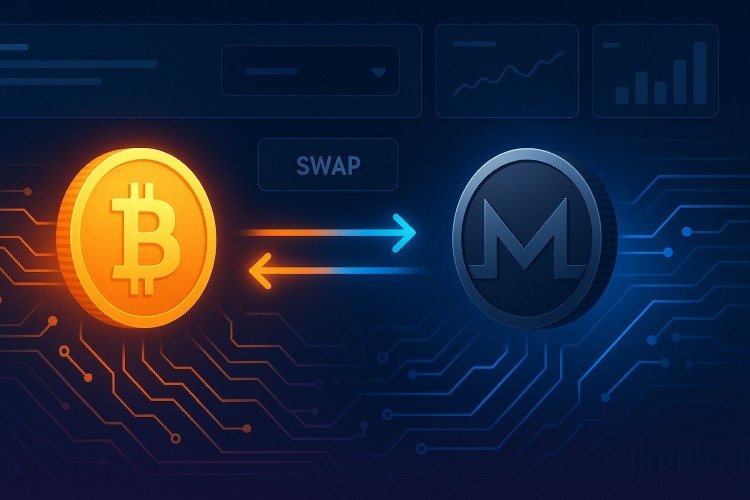
If you are wondering how to swap BTC for XMR, the mechanics are easier than most people expect. The harder part is doing it without leaking the very information you are trying to protect, because the obvious route, a big-name exchange, usually asks for your ID before it lets you near a privacy coin. This is a step-by-step walkthrough of how the swap actually works, what to watch for, and how to finish it in a few minutes without handing over a passport photo.
First, a quick word on why anyone bothers, because it shapes how you should do it.
Why swap BTC for XMR in the first place
Bitcoin was never private. Addresses look like random strings, but chain analysis firms are good at clustering them and tying them to real identities. If you bought BTC on a regulated platform, that platform knows who you are, and anything you send afterward can, in principle, be followed.
Monero is built the opposite way. It hides the sender, the receiver, and the amount by default, using ring signatures, stealth addresses, and confidential transactions. There is no public ledger to scroll through. Swapping BTC for XMR is the standard way to step from a transparent chain onto a private one, so it is worth doing the swap itself in a way that does not undo that.
Before you start: what you need
Three things, and that is it:
-
Some BTC in a wallet you control.
-
A Monero wallet with a receiving address ready to paste. Use one whose keys you hold, not another custodial account.
-
A non-custodial swap service that supports XMR and does not require an account.
That last point matters more than it sounds. If you swap through a service that forces an ID upload and a selfie, you have created a permanent record linking your real name to the moment you acquired a privacy coin, which defeats the purpose. Many large platforms have also delisted Monero entirely, so a service that still supports it clears a bar that a lot of well-known names fail.
How to swap BTC for XMR, step by step
A non-custodial swap service does not ask you to deposit, hold a balance, or log in. The flow is short:
- Open the swap page and enter the amount of BTC you want to swap.
- Paste your Monero receiving address into the destination field.
- The service shows you the rate you will receive and generates a one-time Bitcoin deposit address.
- Send your BTC to that deposit address from your own wallet.
- Wait for the Bitcoin network to confirm the transaction.
- Once confirmed, the service sends XMR straight to the address you gave.
That is the whole thing. No registration, no KYC review, no funds parked in someone’s account for days. It usually wraps up within minutes of your Bitcoin transaction confirming, and because there is no account, there is no profile being built around your swaps.
A note on timing: the wait depends mostly on Bitcoin confirmation speed rather than the service itself. If the network is busy and you are in a hurry, sending a slightly higher BTC fee speeds things along.
Doing it through Xgram
For a no-account swap, BTC to XMR exchange is the one I usually point people to, because it covers the three things that matter for this trade: it keeps Monero listed, it does not make you register, and the swap runs start to finish without an account.
In practice the steps above map directly onto it. You land on the page, type how much BTC you are sending, drop in your XMR address, and get a deposit address back along with the rate you will receive. Send your Bitcoin, wait for confirmation, and the Monero arrives at your wallet. Nothing to sign up for, no verification step gating the swap.
If you want to see the wider set of supported pairs or other coins before settling on Bitcoin to Monero specifically, the main Xgram site lists what else is available.
Things to get right so you do not lose funds
The swap is simple, but crypto is unforgiving. A few habits:
-
Double-check your Monero address before sending. Transactions do not reverse, and a single wrong character means lost funds.
-
Use wallets you control on both ends rather than custodial accounts, or you reintroduce the identity link you were trying to avoid.
-
Read the quoted rate as the real number you will receive; it already includes the service’s margin.
-
Bookmark the real URL so you are not relying on search results that scammers sometimes hijack with phishing clones.
Is it legal and safe to swap BTC for XMR
Yes, swapping one cryptocurrency for another is legal in most places, and wanting privacy is not suspicious on its own. That said, you are responsible for the rules where you live, including any tax reporting that applies to crypto disposals. Privacy from chain surveillance and compliance with your local law are separate things, and the first does not excuse you from the second.
On safety, the real risks are the ones you control: sending to the wrong address, falling for a phishing copy of a real site, or using a wallet whose keys you do not hold. Verify the address field every single time.
A few honest caveats
Instant swaps are convenient, not free. The rate already includes the service’s cut, so you receive slightly less XMR than a raw market price suggests. For most people, the convenience and the no-account aspect are worth that small premium, but if you are swapping a very large amount, it is worth comparing a couple of quotes first.
And privacy is a chain, not a single link. Knowing how to swap BTC for XMR privately does nothing if you then send the XMR somewhere that immediately ties it back to you, reuse an address, or log in over a connection that identifies you. The swap is one good step, not a complete strategy.
Bottom line
Swapping BTC for XMR comes down to six steps: enter an amount, paste your XMR address, get a deposit address, send your Bitcoin, wait for confirmation, and receive your Monero. The only real decision is choosing a service that does not require you to verify your identity to get a privacy coin. Xgram keeps Monero supported and skips the account requirement, so the whole swap stays a five-minute, no-signup job. Check your address, mind the rate, and you are done.
Note: Under Xgram’s terms of use, the service is not provided to users from the United States. US residents are not eligible to use the exchange.