
How Smart Contracts Are Used in Modern Video Games
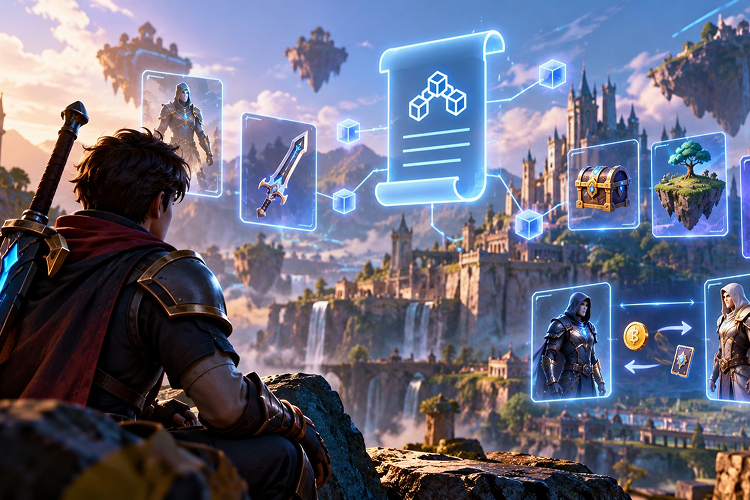
Blockchain technology introduces another approach: smart contracts that execute certain game-related transactions automatically.
Smart contracts are increasingly used in blockchain games to manage digital assets, distribute rewards, and support player-driven economies. They do not replace traditional game engines or servers, but they can change how ownership, transactions, and economic systems work.
What Are Smart Contracts in Gaming?
A smart contract is a program deployed on a blockchain that executes predefined instructions when specific conditions are met. Once deployed, its behavior is determined by its code, although some contracts include administrative controls or upgrade mechanisms.

Know when your
coins move
Alerts, real-time prices, and market news — all in one app
 Point your phone camera to install
 4.8 based on 40K reviews in the App Store and Google Play


In gaming, smart contracts can handle activities such as transferring virtual assets, distributing tournament prizes, or recording ownership of collectible items.
For example, imagine a multiplayer game where players compete in tournaments with cryptocurrency prizes. Instead of relying entirely on the developer to distribute winnings, a smart contract can hold the prize pool and release payments according to the tournament rules.
However, the contract still needs reliable information about who won. This information may come from a game server, an authorized administrator, or another verification system.
Common applications include:
-
Digital asset ownership: Recording ownership of weapons, characters, skins, and collectibles.
-
In-game marketplaces: Facilitating transactions between players.
-
Reward distribution: Paying tokens or other blockchain-based rewards.
-
Tournament management: Holding entry fees and distributing prize pools.
-
Game governance: Allowing eligible token holders to vote on selected decisions.
These functions are particularly relevant to games that feature tradable assets or financial transactions.
How Smart Contracts Work Inside a Video Game
Smart contracts operate differently from conventional game logic. Most modern games require rapid calculations, real-time interactions, and frequent updates. Running every action on a blockchain would introduce unnecessary costs and delays.
Developers therefore use hybrid architectures that combine conventional gaming infrastructure with blockchain-based systems. In Crypto Game Development, one of the key architectural decisions is determining which operations should run on-chain and which are better handled by traditional servers. Asset ownership and token transfers may benefit from blockchain execution, while combat calculations, character movement, and matchmaking generally require faster off-chain processing.
A typical implementation involves several components:
- Game client: The application where players interact with the game.
- Game server: The system responsible for gameplay calculations, matchmaking, and player progression.
- Blockchain network: The infrastructure that records transactions and executes smart contracts.
- Smart contracts: Programs that manage asset transfers, token transactions, or other predefined operations.
- Digital wallet: A tool that allows players to authorize blockchain transactions.
Consider a role-playing game where a player earns a rare sword after defeating a boss.
The game server determines whether the player completed the challenge. If the sword is represented as an NFT, the game can initiate a transaction that mints or transfers the corresponding token to the player’s wallet.
The blockchain records the token’s ownership, while the game server continues handling combat, movement, and other real-time activities.
This division allows developers to introduce blockchain functionality without moving the entire game onto a decentralized network.
Digital Ownership and NFT-Based Game Assets
One of the most recognizable applications of smart contracts is the management of digital game assets.
In traditional games, items are usually associated with accounts maintained by the publisher. Players may be able to purchase, earn, or trade them, but their ability to transfer those items depends on the game’s rules.
Blockchain games can represent certain assets as tokens controlled by smart contracts.
These assets may include:
-
Character skins and cosmetic items.
-
Weapons and equipment.
-
Virtual land and buildings.
-
Collectible characters.
-
Crafting materials and limited-edition rewards.
NFTs are commonly used for unique or individually identifiable assets, while fungible tokens may represent interchangeable resources or currencies.
A smart contract can record who owns a token and define how it may be transferred. Depending on the game’s design, players may be able to trade their assets through compatible external marketplaces.
However, owning a token does not automatically guarantee permanent access to the associated game item. The game must continue supporting that asset, and its visual appearance or functionality may depend on centralized infrastructure.
For this reason, blockchain ownership and practical usability should be treated as related but separate concepts.
Player-to-Player Trading Without Traditional Marketplaces
Trading has been part of online gaming for decades. Players exchange weapons, resources, cosmetics, and other valuable items through systems maintained by game publishers.
Smart contracts introduce additional ways to organize these transactions.
For example, a blockchain marketplace contract can facilitate a trade between two players. The buyer authorizes payment, and the contract transfers the purchased token according to its programmed conditions.
Depending on the implementation, this can reduce the need for a marketplace operator to manually process individual transactions.
Smart contract marketplaces can support several features:
-
Fixed-price sales of digital assets.
-
Auctions with predefined bidding rules.
-
Automated royalty payments where supported and enforced.
-
Trading fees distributed to designated recipients.
-
Transactions involving different compatible tokens.
Nevertheless, smart contracts do not eliminate every marketplace risk. Players can still encounter fraudulent listings, malicious contracts, compromised wallets, or assets with misleading descriptions.
Developers must also consider transaction fees and network congestion, particularly when designing marketplaces for games with frequent low-value trades.
Smart Contracts in Play-to-Earn Games
Play-to-earn games use blockchain-based rewards to provide players with tokens or assets that may have value outside the game.
Smart contracts can manage the creation, distribution, and transfer of these rewards.
For instance, a game might reward players for completing competitive seasons, participating in tournaments, or contributing resources to an in-game economy.
A contract can distribute rewards once the required conditions have been verified.
However, the existence of a smart contract does not make a reward system economically sustainable.
Games that continuously issue tokens without sufficient demand or meaningful ways to use them may experience inflation and declining token prices.
Sustainable economic design requires attention to several factors:
- Token supply: How many tokens can enter circulation?
- Reward emissions: How quickly are new tokens distributed?
- Token utility: Why would players use or hold the token?
- Asset sinks: What mechanisms remove resources or tokens from circulation?
- Player motivation: Would the game remain enjoyable without financial rewards?
Smart contracts can enforce economic rules, but developers still need to design those rules carefully.
Automated Tournaments and Prize Distribution
Competitive gaming is another area where smart contracts can provide practical functionality.
Online tournaments frequently involve entry fees, prize pools, and payments to winners. Traditional systems rely on tournament organizers to collect and distribute funds.
A smart contract can hold funds until the tournament is completed.
For example, consider a competition involving 100 participants who each contribute a fixed entry fee.
The contract can collect the payments and reserve the prize pool. Once verified results are submitted, it can distribute the funds according to predetermined percentages.
Potential advantages include:
-
Publicly verifiable prize distribution rules.
-
Automated payments after result confirmation.
-
Reduced manual processing of tournament payouts.
-
Transparent records of completed transactions.
The main challenge is verifying tournament outcomes.
A blockchain cannot independently determine who won a match played on a conventional game server. Developers need a trusted mechanism to submit accurate results and resolve disputes.
This makes the connection between on-chain contracts and off-chain game systems particularly important.
Challenges of Integrating Smart Contracts Into Games
Despite their potential, smart contracts introduce technical and operational challenges that developers must address.
Transaction Costs and Performance
Public blockchain transactions may require network fees and confirmation time.
This makes direct blockchain execution unsuitable for many real-time gameplay actions.
Developers often use Layer 2 networks, batching techniques, or off-chain processing to reduce costs and improve responsiveness.
Security Vulnerabilities
Smart contracts can contain programming errors that expose funds or digital assets.
Unlike conventional applications, deployed contracts may be difficult to modify without an established upgrade mechanism.
Security audits, automated testing, access controls, and careful contract design are therefore essential.
Player Experience
Many players are unfamiliar with cryptocurrency wallets, gas fees, and blockchain transactions.
Requiring users to manage these systems before playing can create unnecessary barriers.
Modern implementations may use embedded wallets, sponsored transactions, and simplified onboarding to make blockchain features less intrusive.
Regulatory Considerations
Games involving tradable tokens, cryptocurrency rewards, or paid competitions may face different legal requirements depending on the jurisdiction.
Developers need to evaluate financial regulations, consumer protection requirements, and gambling-related rules where applicable.
The Future of Smart Contracts in Video Games
Smart contracts are unlikely to replace traditional game servers. Their strongest applications involve systems where verifiable ownership, programmable transactions, or shared economic infrastructure offer a clear advantage.
Future applications may include more accessible asset marketplaces, automated competitive rewards, shared gaming economies, and improved tools for managing digital ownership.
Interoperability between games is another possibility, although technical compatibility alone is insufficient. Developers must agree on how external assets behave within their individual games.
Ultimately, successful integration depends on using blockchain technology to solve specific problems rather than treating decentralization as a feature that automatically improves gameplay.
Conclusion
Smart contracts give video game developers new ways to manage digital assets, automate transactions, and create transparent economic systems.
Their most practical applications include NFT ownership, player-to-player marketplaces, tournament payouts, and blockchain-based reward mechanisms.
At the same time, transaction costs, security risks, regulatory obligations, and player experience remain significant considerations.
The most effective approach combines conventional gaming technology with carefully selected blockchain functionality. When implemented for a clear purpose, smart contracts can expand what players and developers can do with virtual assets without compromising the core gaming experience.