
What Part of a Crypto Game Runs on the Blockchain?
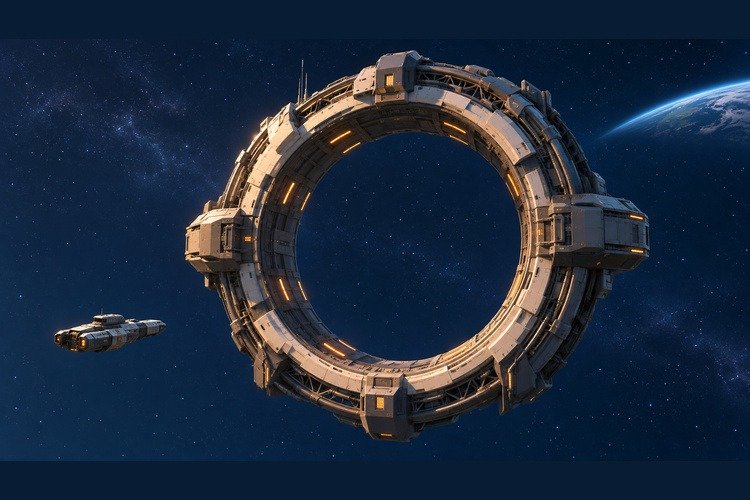
In the space survival game EVE Frontier, pilots travel through stargates that other players can build and program. In March 2026, CCP Games, the studio behind EVE Frontier, opened that part of the game to outside teams. A gate owner could set conditions for passage between two locations, allowing the code to determine which pilots could make the jump.
The Sui Foundation announced on March 13 that EVE Frontier had moved to Sui Testnet from its previous Ethereum-based test network. Builders could try their modifications in a test environment shared by everyone taking part. The code could change how a structure behaved for other players. That's where the blockchain is playing a crucial role, allowing modifications to be made by those who own the gate.
In other games, the network has a narrower job, such as carrying a payment into an account or keeping a record of who owns a digital item. Understanding these differences can make it easier to comprehend why crypto and the blockchain are so important in the gaming world currently.

Know when your
coins move
Alerts, real-time prices, and market news — all in one app
 Point your phone camera to install
 4.8 based on 40K reviews in the App Store and Google Play


When crypto funds the account
If you spend any amount of time in the crypto gaming space, you will likely come across one of the most common setups: crypto as the means of funding a user's account on a game platform. Let's take casinos as our example here.
Somebody who wants to play online crypto baccarat can fund their account using any of the coins that the casino in question accepts. The game itself remains the same as when playing with fiat currency, but the additional security, privacy, and anonymity that crypto offers makes this an attractive proposition to some gamers. It's worth keeping in mind that different cryptocurrencies will have different transfer times and different fees associated with them, and that these can change depending on network traffic, which makes it important to choose your coins with care.
Once you've made a deposit, many crypto-friendly platforms will still track the balance in a fiat currency for simplicity, but having the option to use crypto suits a variety of players. This represents one of the most straightforward ways in which crypto might be used to interact with the gaming world. However, it's far from the only option.
What an ownership record tells the game
An ownership record gives the game a reason to consult the blockchain during play. When a studio represents an item as a token, each transfer updates the record of which wallet address holds it. The game can read that record to work out which items belong in a player’s inventory. It still needs rules of its own to decide what a player can do with an item once it appears there.
Game developer Magnus Söderberg describes how studios separate ownership from gameplay. A studio can keep track of items on a blockchain while running the game itself on its servers. Someone outside the studio can look up the same ownership record the game reads. To use the item, though, the player needs software that recognizes it. Its screen appearance, the actions available to its holder, and the effect of those actions all depend on what the studio has built.
An item’s usefulness across games depends on that division of labor. Several studios can read the same ownership record, but each has to decide whether to recognize the token and what role the item has in its world. The difference becomes especially clear when a studio takes its servers offline. A player can still look up the token and establish who holds it. Using the item in the world it came from depends on that world still being available.
When a stargate can run player-written rules
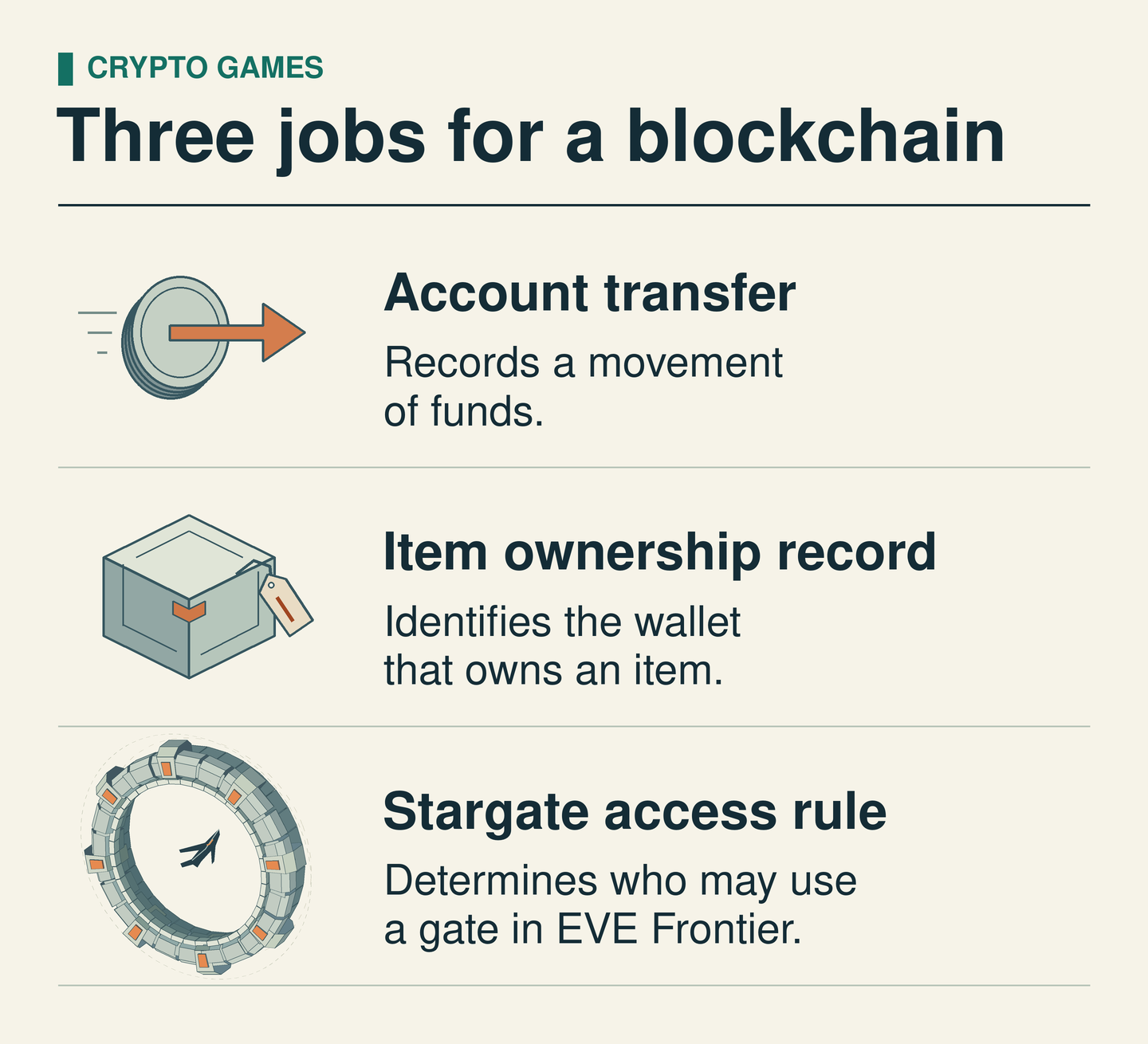
EVE Frontier calls its programmable structures Smart Assemblies. They include stargates and storage units, each an object with its own history in the shared world. The owner can attach custom code to a gate. That code governs who may pass between the two locations it connects. Because the modification belongs to an individual structure, the builder can change one route without rewriting the rules for every other gate. Other pilots encounter the change in the course of an ordinary journey.
The March migration coincided with a hackathon that also welcomed developers building tools outside the game. The game’s application programming interface, or API, gave outside software a defined way to request information about the live universe. The Sui Foundation listed maps and fleet coordination dashboards among the tools that developers could build with it.
For a map developer, a gate is a place to show on a route. The API supplies information about the world, and the developer decides how to present it to pilots. A modification installed on the gate has a different reach. Its code runs when someone uses that structure, so pilots can encounter a builder’s work during a flight without ever opening an external tool.
What “fully on-chain” adds
A fully on-chain game uses the network for both its rules and its state. State is the set of facts that describe the game at a given moment, from who owns an object to where a player is. The rules determine which actions can change those facts. Programs called smart contracts apply those rules, and the blockchain keeps the resulting state.
Söderberg cites Dark Forest, a strategy game in which players explore a hidden universe, as an example of this design. The pace of play helps explain where the approach fits. The network has to process each change of state it maintains. Turn-based play leaves time for that work between moves. Fast action gives developers much less room to wait for a network response, which helps explain why they might choose to put only certain rules on-chain.
The interface a player sees can still run locally. A developer can build a different interface to the same contracts, changing how players view the world or enter a move. Underneath, those contracts still decide which moves are valid for everyone using either interface. EVE Frontier’s March announcement showed what the network could do for a particular stargate. Calling an entire game fully on-chain makes a broader claim. The network must apply the rules that determine which moves take effect across the shared world and keep the record from which play continues.
Image Source: Created with AI