
How to Choose a Crypto Payment Gateway API
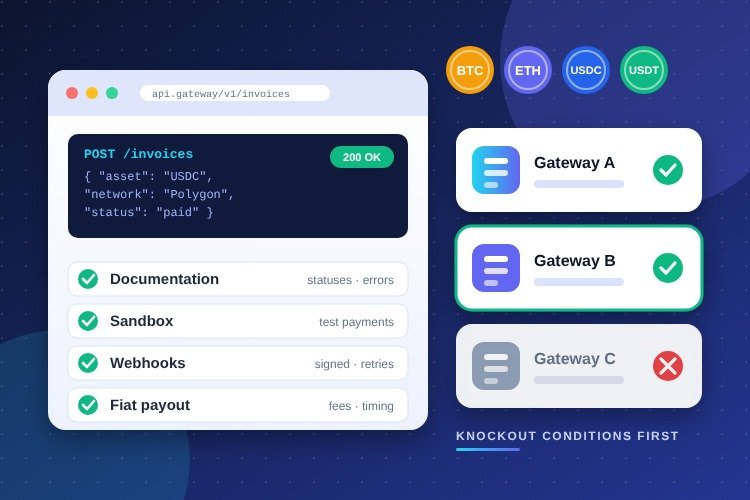
Choosing a crypto payment gateway API comes down to eight criteria: documentation, sandbox, webhooks and retries, coins and networks, auto-conversion, fiat payout, compliance and support. Their order is not fixed. First drop providers that fail your knockout conditions, such as the asset and network you need, the payout currency or the ability to reproduce a failed webhook. Then weigh the rest by what matters to your business, run a test payment, and ask for a full fee example. Below: a criteria table, evaluation steps and common mistakes.
Crypto Payment Gateway API: Selection Criteria at a Glance
This is a guide to picking a provider, not to the payment flow itself. Use the table as a questionnaire: send it to every gateway on your shortlist and compare the answers. The last column shows which answers end the comparison.
| Criterion | What good looks like | Question to ask | Red flag | Drop or weigh |
|---|---|---|---|---|
| Documentation | Quick-start that ends in a test payment, full status list, error codes, changelog | Where is the list of every invoice status and error? | Marketing pages instead of reference docs | Weigh. Drop only if statuses and the webhook scheme are undocumented. |
| Sandbox | A test mode that reproduces confirmations and failures | Can I simulate underpayment and an expired invoice? | Testing only with real funds, and no way to replay events | Weigh. Drop only if you can neither use a sandbox nor run minimal real payments. |
| Webhooks and retries | Signed requests, event IDs, documented retry policy, replay | How do I verify a webhook and what happens when my server is down? | No signature, no event ID, no resend | Drop if you cannot reproduce a failed delivery and resend an event, or webhooks are unsigned. |
| Coins and networks | The assets and chains your customers actually use | Which assets on which networks, and who pays network fees? | A long list with no detail per network | Drop if your asset is not supported on your network. |
| Auto-conversion | Clear rate source, stated spread, optional | How is the rate set and what is the spread? | Rate or spread revealed only after signup | Weigh. Drop only if you need conversion and the spread stays undisclosed. |
| Fiat payout | Stated currencies, methods, limits, timing, fees | What do I receive in my bank account from a 1,000 USDC payment? | No worked example | Drop if your payout currency or method is unavailable. |
| Compliance | Business verification, transaction monitoring, a stated jurisdiction | What do you check, and where are you registered? | Vague answers or none | Weigh. Drop only if the jurisdiction is unstated or does not fit your requirements. |
| Support | Engineering-level answers, defined hours, incident updates | Who helps when a customer sends funds on the wrong network? | Chatbot only | Weigh. Rarely a knockout on its own. |

Know when your
coins move
Alerts, real-time prices, and market news — all in one app
 Point your phone camera to install
 4.8 based on 40K reviews in the App Store and Google Play


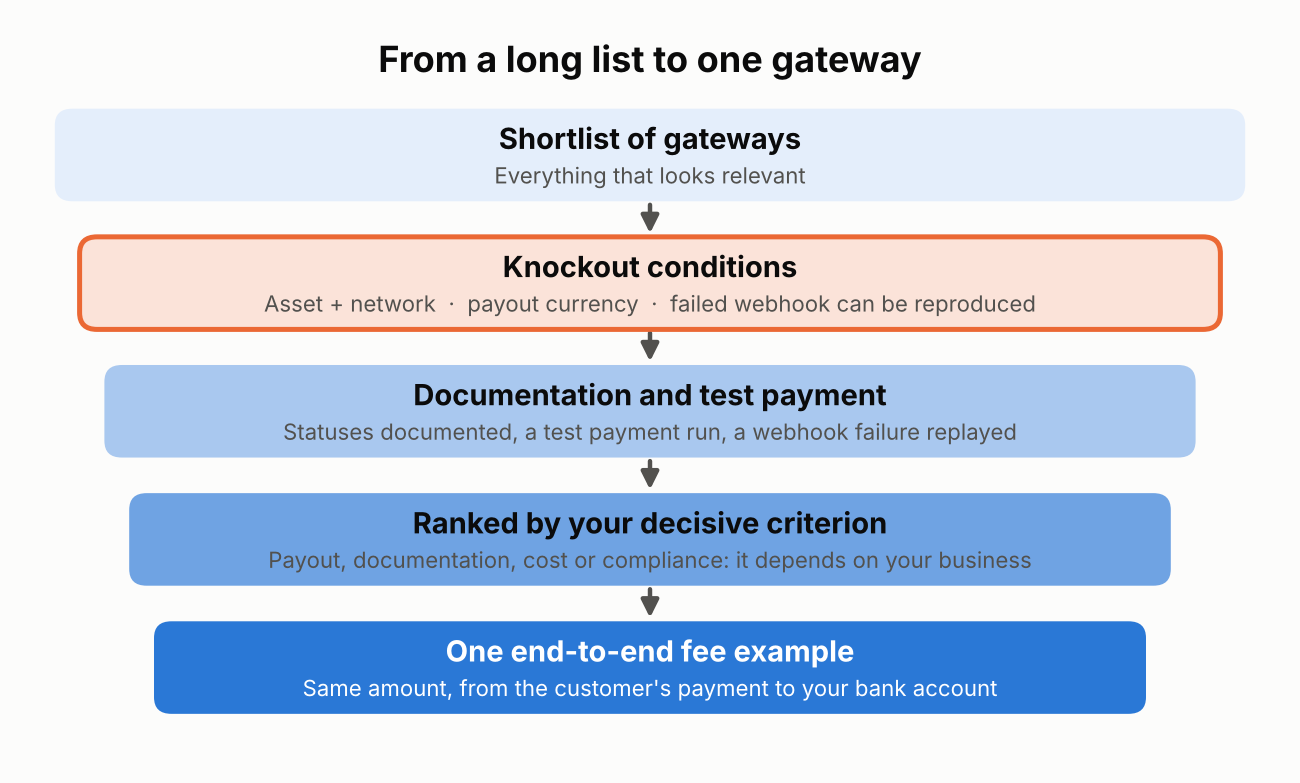
Treat the “drop” conditions as a filter and apply it before you compare anything else. Three of them fit almost every business: your asset on your network, your payout currency, and the ability to reproduce a failed webhook delivery. Add your own, such as a required jurisdiction. Compare what is left on the other criteria, and let your business decide their weight.
Hypothetical example: a SaaS company that must receive USDC on Polygon and get EUR in a bank account drops every provider that lacks either one before reading a page of documentation. A marketplace that pays many suppliers may rank payout limits and timing first, and a team with no payments engineer may rank documentation first.
How to run the evaluation
- Write your knockout conditions. Start from the table: the asset and network you need, your payout currency, and the ability to reproduce a failed webhook delivery. Add your own, such as a required jurisdiction.
- Drop providers that fail them. Ask in writing before any sales call. A gateway that does not cover them is out, however good its docs look.
- Read the documentation of the rest. Check that statuses, errors and webhooks are documented, not just promised.
- Run a test payment. Use the sandbox, or a minimal real payment if there is none, and replay a failed webhook on purpose.
- Rank the survivors by your decisive criterion. For a payout-heavy business that is the payout path, for a small team it may be documentation. Use the other rows of the table as tie-breakers.
- Ask for one fee example. The same amount, end to end, from the customer's payment to your bank account.
- Ask the compliance questions. Jurisdiction, verification process, and what gets screened.
Documentation, Sandbox and Webhooks
Payment gateway API documentation
Documentation is the best predictor of integration time. Good payment gateway api documentation gets you from zero to a test payment in one sitting, lists every status an invoice can reach, and explains what to do in each. Look for a changelog and a versioning policy, so an update does not break your integration, and for an OpenAPI spec or SDK if you prefer generated clients.
Check how the docs treat the bad cases. Underpaid, overpaid, and expired invoices should have their own statuses. If the docs only describe the happy path, you will find the rest in production.
Sandbox
A sandbox is where you break things safely. The useful kind reproduces confirmations and failures: a payment that arrives short, an invoice that expires, and a webhook that fails. Ask whether you can trigger these and replay events. If the provider has no test environment, plan to run real payments with minimal amounts, and ask how the provider helps when a test goes wrong.
Webhooks, retries, and confirmations
For a crypto gateway for developers, webhooks carry the payment status, so check three things. First, signatures. Webhooks arrive as plain HTTP requests to a public endpoint, and the usual defense is HMAC, which RFC 2104 describes as a mechanism for message authentication using cryptographic hash functions in combination with a shared secret key. The provider should document the header and the exact scheme.
Second, retries and replays. Ask what the retry schedule is, whether events carry a unique ID so you can deduplicate them, and whether you can resend an event from a dashboard or an endpoint. For many teams this is a knockout condition: if you cannot reproduce a failed delivery, you cannot test your handler.
Third, idempotency on the calls you make. A POST is not idempotent by default, so a timeout followed by a retry can create two invoices. The IETF Idempotency-Key draft describes a header for making such requests fault-tolerant. It is still an Internet-Draft, a work in progress, and providers differ in what they support, so ask.
Also ask how many confirmations the provider waits for on each network before it reports a payment as final. The Bitcoin developer documentation warns that a payment with zero confirmations is unsafe to trust without a risk analysis and advises waiting for at least six confirmations for high-value payments. A provider's policy should be written down and be adjustable to your risk.
To see how one provider presents these points, Inqud has a dedicated page for its crypto payment gateway api. Use a page like it as a sample when you compare what each provider documents and what it leaves out.
Coins, Conversion, Payout, Compliance, and Support
Coins and networks
Match the gateway to the assets and chains your customers already use. The same token exists on several networks, each with its own fees and confirmation times, so ask for the supported assets per network, not one long list of tickers. More assets also means more to reconcile and support, so a short list that covers your customers is often the better choice. BTC and ETH can move sharply in price between invoice and payment. Stablecoins such as USDT and USDC reduce that swing but not the dependence on the issuer.
Auto-conversion and fiat payout
If you do not want to hold crypto, you need conversion and a way out to a bank. Ask how the rate is set, whether there is a spread, and what the payout costs. Then test the path with a small amount before the first large payment, because bank payouts depend on banks and their hours.
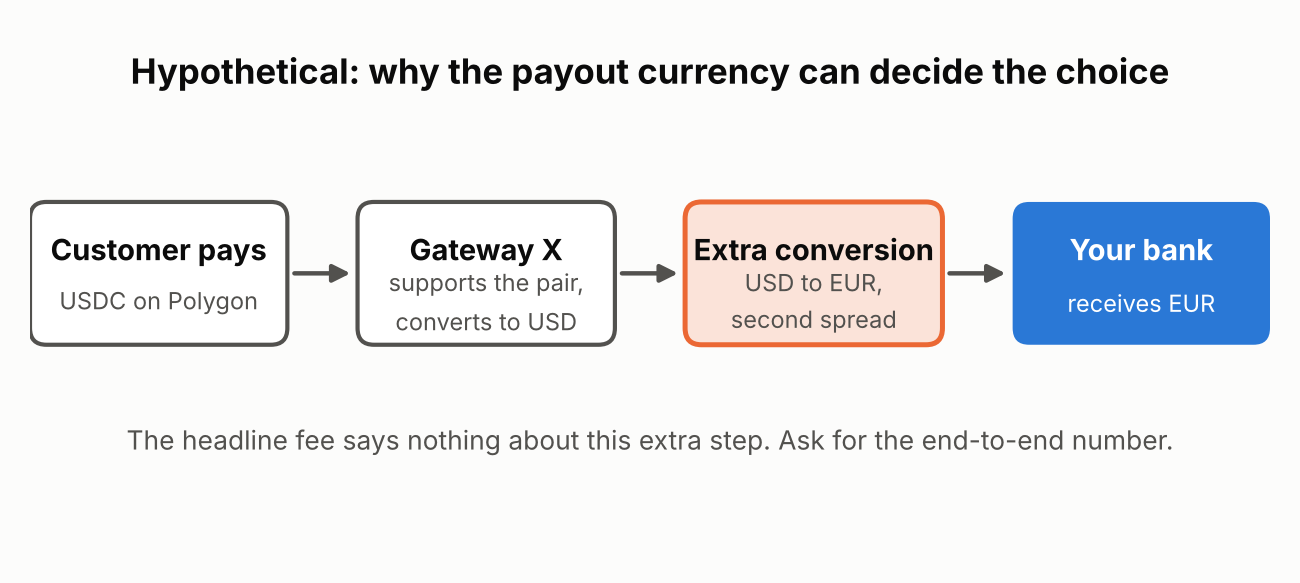
Hypothetical example: your customers pay in USDC on Polygon, and you need EUR in a bank account. Gateway X supports that asset and network but pays out only in USD. You would add a second conversion at a second spread, and the headline fee tells you nothing about that. Ask for the end-to-end number.
Compliance
Three terms matter here. KYB (know your business) is the provider verifying your company, its owners, and its activity before activating an account. KYT (know your transaction) is monitoring incoming and outgoing transfers for risky sources. AML (anti-money laundering) is the wider program of policies and reporting around both.
A gateway that screens nothing puts you at risk of frozen payments, so strict checks are a good sign. Ask where the provider is registered, what it verifies, and how it handles a flagged transfer. Obligations depend on the jurisdiction, and so do taxes and reporting. This is general information, not legal or tax advice.
Support
Support is part of the API. Look for engineering-level answers, defined response times, and incident communication. Crypto payments have no chargebacks, and a confirmed transaction cannot be reversed, so when a customer sends funds on the wrong network, what the provider does decides what you can promise.
Common Mistakes When Choosing a Gateway API
- Choosing by the headline fee. Spread, payout fees, and network fees can outweigh a low rate. Ask for one end-to-end example.
- Reading the marketing page instead of the docs. Missing statuses and error codes surface only after you start building.
- Skipping the failure tests. A gateway that handles the happy path may still mishandle underpayment, expiry, or duplicate webhooks. Test them in the first week.
- Ignoring the payout path. Receiving crypto is the easy part. Check currencies, limits, timing, and fees on the way out. For some businesses this is the deciding criterion.
- Collecting assets "just in case." Every extra asset and network adds reconciliation and support work. Start with what your customers use.
How an Accelerator Evaluates a Payment Partner's API
This is a model of cooperation, not a description of any signed agreement. Early-stage products often win a first international customer before they have a payment setup, and building one takes sprints that the team would rather spend on the product. An accelerator can choose a payment partner once for its whole portfolio. In that case it would judge the API by questions close to the table above, plus a few of its own:
- How quickly can a small team get from zero to a first payment without a dedicated payments engineer?
- Are documentation, test mode, and webhook behavior clear enough to work without hand-holding?
- Does business verification fit the profile of young companies?
- Is the cost transparent from the customer's payment to the payout?
- Does the partner take feedback from the teams that use it?
One example of a platform that could fill this role is Inqud, a crypto payment platform for businesses: it covers accepting crypto payments, conversion, payouts, on-ramp and off-ramp, and has an OTC desk. Teams can connect through an API, an iFrame widget, or a hosted payment page, and according to the company, integration takes about two days. KYB is a separate step, and its timing is not covered here. Supported assets include BTC, ETH, USDT, and USDC across networks such as Tron, Bitcoin, Solana, Optimism, Arbitrum, and Polygon, and received funds can be converted automatically into a chosen currency. Teams that want their own interface can use the SDK, and an MCP server exposes the API documentation.
In a partnership like this, each side could get something concrete:
- The accelerator adds value for its portfolio without building a payment product of its own.
- The startups get payment infrastructure from day one. By the company's description, there is no monthly fee, commission is charged per transaction, larger volumes can get individual rates, and payments between participants inside the system carry no commission.
- The platform gets access to an ecosystem of young products and direct feedback from the teams that use it.
Terms for any specific accelerator program are outside the scope of this article.
FAQ
What is a crypto payment gateway API?
It is an interface that lets your backend create payment requests, show customers where to pay, and receive status updates as the payment moves through the network. Many gateways also handle conversion and payout. You keep working with orders, and the gateway deals with the blockchain.
What is the best crypto payment gateway API?
There is no single best option. The right one covers the assets and networks your customers use, documents every status and webhook clearly, offers a way to test, and shows the full cost to your bank account. Judge a gateway by your own checklist, starting with the conditions that would rule it out, not by a ranking.
What should payment gateway API documentation include?
A quick-start ending in a test payment, a complete list of statuses and error codes, webhook and signature details, retry behavior, a changelog, and examples for failure cases such as underpayment and expiry. If any of these is missing, ask the provider before you commit.
Do I need a sandbox for a crypto gateway?
It is strongly worth having, because it lets you test failures without spending real funds. If a provider has none, run real payments with minimal amounts and cover underpayment, expiry, and duplicate webhooks. Ask how the provider supports you during testing.
How long does integration take?
It depends on your team and the provider. According to the company, integration with Inqud takes about two days, and business verification is a separate step. Leave extra time for testing the failure cases.
Conclusion
The best crypto payment gateway API is the one that fits your customers and fails in ways you can handle. Drop the providers that fail your knockout conditions, compare the rest on the eight criteria weighted by what matters to your business, read the documentation before the pitch, test failure cases in a sandbox or with minimal real payments, and ask for one end-to-end fee example. For an accelerator, the same checks, applied once, give every portfolio team a payment partner that does not eat their sprints.