
Chainlink (LINK) Trades 70% Below 2025 High While Mutuum Finance (MUTM) Builds in the Background

Chainlink is currently trading roughly 70% below its 2025 high, reflecting sustained pressure across the altcoin market. Despite this sharp correction, institutional positioning suggests that long-term confidence in the oracle network has not faded. At the same time, newer DeFi infrastructure projects such as Mutuum Finance are attracting early capital, with on-chain whale transactions appearing shortly after key development announcements.
LINK Down 70% as Institutions Accumulate
Chainlink (LINK), widely recognized as a leading oracle network supplying external data to smart contracts, has experienced a significant retracement from its 2025 highs. After trading near $15 during last year’s rally, LINK declined toward the $7 range, marking a drop of more than 70%. This correction comes amid broader altcoin weakness and capital rotation toward Bitcoin and stablecoins, leaving many large-cap tokens consolidating near cycle support zones.
Despite the price decline, institutional interest appears resilient. On-chain data from Arkham Intelligence shows that Grayscale Investments now holds more than 5.25 million LINK, valued at over $44 million. Accumulation accelerated in late 2025 and continued into early 2026, even as prices trended lower. During this period, Grayscale reportedly acquired millions of LINK tokens while the market was under pressure, suggesting that long-term exposure remains attractive to certain investors.
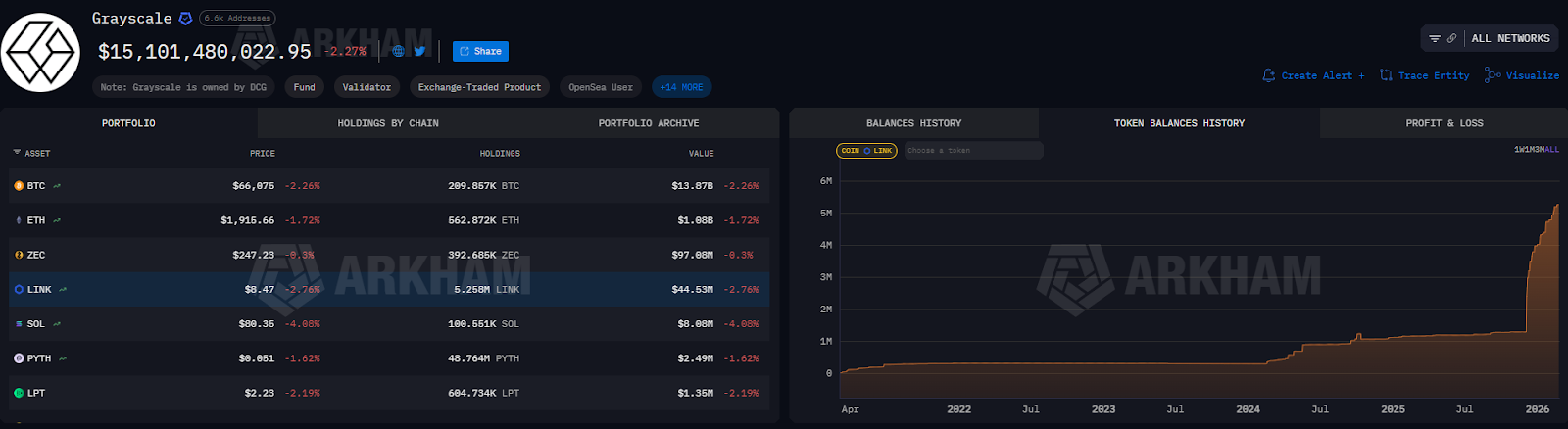
Grayscale’s LINK Holding. Source: Arkham
Exchange-traded products tracking LINK have also demonstrated unusual stability. Since regulatory approval, LINK ETFs have reportedly not recorded a single day of negative net flows. While inflows remain moderate on a daily basis, the absence of outflows indicates that institutional holders are maintaining positions rather than reacting to short-term volatility. Chainlink’s continued integration with platforms such as Polymarket, which recently recorded over $7 billion in monthly volume, reinforces its position as core infrastructure within decentralized finance.
However, analysts caution that LINK could remain in a prolonged accumulation phase. With sentiment still fragile and broader altcoin liquidity weakening, time-based consolidation may test holder patience before any structural breakout occurs.
Mutuum Finance
While established infrastructure tokens consolidate, early-stage DeFi protocols are beginning to capture attention. Recent on-chain activity surrounding Mutuum Finance suggests that larger participants are positioning ahead of further development milestones. Shortly after the announcement of its V1 protocol release on the Sepolia testnet, two notable whale transactions were recorded, one for approximately 60 ETH and another for roughly 62 ETH.
Mutuum Finance is developing a decentralized lending and borrowing protocol on Ethereum designed to operate in a fully non-custodial environment. Users interact directly with smart contracts rather than centralized intermediaries, allowing them to retain custody of their assets while participating in lending markets.
P2C and P2P Lending Framework
Mutuum Finance is structured around two complementary mechanisms: Peer-to-Contract (P2C) and Peer-to-Peer (P2P) lending.
Under the P2C model, users supply assets into shared liquidity pools governed by smart contracts. Interest rates are determined algorithmically and adjust dynamically according to utilization levels, meaning rates rise when borrowing demand increases and moderate when liquidity is abundant. This structure provides predictable automation and efficiency, particularly for widely used assets such as USDT or ETH.
The P2P model, by contrast, enables direct agreements between lenders and borrowers. Participants can negotiate specific terms, including interest rates and collateral preferences. This approach opens the door to more tailored arrangements, including lending and borrowing against alternative assets such as meme tokens like SHIB or DOGE, where liquidity conditions do not suit pooled markets. The flexibility of P2P can appeal to users seeking customized exposure beyond standardized pool parameters.
From a lending perspective, the model offers straightforward yield opportunities. For example, a participant supplying $15,000 in USDT into a liquidity pool could earn an estimated 7–8% annual percentage yield (APY), depending on borrowing demand and pool utilization. At that range, the position will generate approximately $1,050 to $1,200 annually, with returns accruing automatically through the protocol’s interest-bearing structure.
On the borrowing side, capital efficiency becomes the primary advantage. An investor holding ETH with long-term appreciation expectations may prefer not to liquidate their position. Instead, they can deposit ETH as collateral and borrow stable assets against it, accessing liquidity for new opportunities or operational needs while maintaining upside exposure to Ethereum’s price movement. This structure allows borrowers to unlock capital without interrupting their core portfolio allocation, offering strategic flexibility in volatile market conditions.
V1 Protocol Testnet Deployment
Mutuum Finance has now raised more than $20.6 million and surpassed 19,000 holders, reflecting growing participation within its ecosystem. The MUTM token is currently priced at $0.04, as development continues and engagement remains steady despite broader market consolidation.
The V1 protocol of Mutuum Finance is now running on the Sepolia testnet, allowing users to explore how the platform works in a live but simulated environment before mainnet release. After connecting a wallet set to the Sepolia network, users can mint test tokens such as ETH, USDT, WBTC, and LINK to begin testing the system.
From there, participants can supply assets into liquidity pools, borrow against collateral, and track key metrics such as borrowing limits and position safety levels. When assets are supplied, they are converted into mtTokens, which act as digital representations of a user’s deposit. These mtTokens reflect the supplied balance and increase in value over time as interest accrues from borrower activity.
This testnet access gives users a clear, hands-on understanding of how lending, borrowing, and yield generation are designed to function within the protocol.
Roadmap and Future Development
According to its published roadmap, Mutuum Finance outlines four phases of development, with Phase 3 currently underway and several milestones already completed. The team has indicated that its primary focus remains on refining and improving the core protocol before moving toward full mainnet deployment.
Beyond the lending infrastructure itself, future plans include multichain expansion, which could allow the protocol to integrate with additional blockchain ecosystems. Expanding beyond Ethereum will increase liquidity depth, broaden user access, and reduce network dependency. The roadmap also references the development of an overcollateralized stablecoin, which would allow users to mint stable assets against deposited collateral while continuing to earn yield. Such integration could enhance capital efficiency within the ecosystem and create additional internal utility for the platform.
In the current market environment, where established tokens like LINK are consolidating after major corrections, capital appears increasingly selective. Infrastructure with institutional backing continues to hold long-term relevance, while newer protocols focused on lending, borrowing, and structured incentives are building quietly in the background as they move toward deployment.