
How to Exchange Crypto: A Step-by-Step Guide
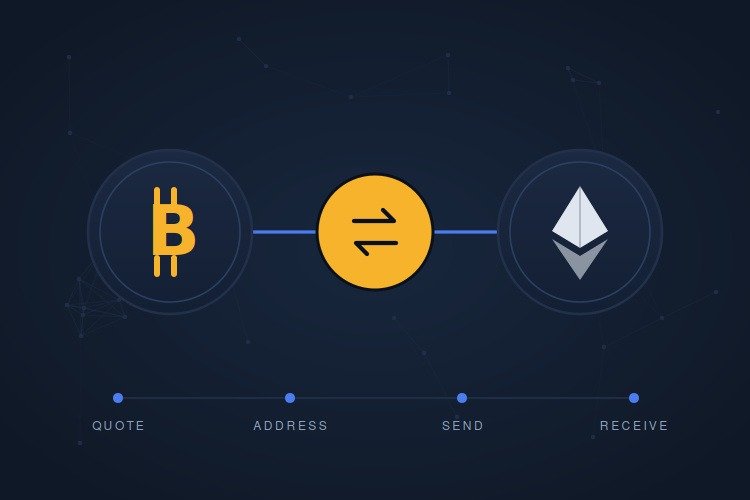
Short answer: to exchange crypto, you either trade it on an exchange (deposit, sell, buy, withdraw) or send it to an exchanger that converts it wallet-to-wallet in one operation. For a single coin-to-coin conversion, the second route takes about five minutes: get a quote, pick a fixed or floating rate, paste your receiving address, send the exact amount, wait for confirmations, check what arrived.
Now the part that actually costs people money.
Nobody gets wiped out by picking a route that's half a percent more expensive. They get wiped out by selecting the wrong network from a dropdown, or pasting an address they copied from the wrong tab. Both take one second, and neither has an undo button.

Know when your
coins move
Alerts, real-time prices, and market news — all in one app
 4.8 based on 40K reviews in the App Store and Google Play


So this guide covers both routes in the order the screens appear, with the checks that catch those mistakes before they cost you anything.
Which route should you use?
| What to compare | Trading exchange | Exchanger |
|---|---|---|
| Operations | Four (deposit, sell, buy, withdraw) | One |
| Account needed | Yes | Usually no |
| Funds held by the platform | Until you withdraw | Only during the conversion |
| You control the price | Yes, with limit orders | No, you accept the quote |
| Best for | Regular trading, liquid pairs, fiat entry | One-off conversions, thin pairs |
| Main cost | Two commissions plus spreads | Margin inside the quoted rate |
Most people typing "how to exchange crypto" want the second column. They end up in the first anyway, because that's what the search results are full of, and then spend twenty minutes learning what a maker order is to accomplish something that needed one screen.
Work out which you want before you start. It's the biggest decision in the process and it takes ten seconds.
Method 1: how to exchange crypto on a trading exchange
Check that the pair exists first. Direct A-to-B markets are rarer than people assume. If there's no direct pair, you're routing through USDT or BTC, which means two trades and two sets of costs instead of one.
Deposit on the right network. Copy the deposit address from the platform, then check that the network matches what your wallet is about to send on. If the platform shows a memo or destination tag field, that field is not optional.
Sell A, buy B. A market order fills instantly at whatever's on the book. A limit order fills at your price or sits there. On a thin pair, the gap between those two outcomes will cost you more than every fee in the transaction combined.
Withdraw to your own wallet. Pick the cheapest network your wallet supports, paste the address, then compare the first four and last four characters against your wallet. Every time.
Total damage: two commissions if you routed through an intermediate pair, the spread on each trade, plus the withdrawal fee.
Method 2: how to exchange crypto through an exchanger
Six steps, wallet to wallet.
1. Get a quote. Enter the pair and the amount, and the service shows what you'll receive. That number already has the platform's cut baked into it, which is why it's the only figure worth comparing between services. Open two or three and check the same pair at roughly the same minute, because the spread between providers on one conversion is often wider than anything you'd save hunting for a better fee schedule. Services like Eunobit show the receive amount up front, and that's the number to hold them to when the coins land.
2. Check which rate type you're getting. A floating rate tracks the market until your transfer confirms, so the amount that lands can differ slightly from the estimate. A fixed rate locks the figure for a short window and costs a little more. Plenty of exchangers run floating only, so don't assume you have a choice: find out which one applies before you send, because on a congested chain a floating quote has time to drift.
3. Enter your receiving address. This is the step that eats people. Paste it from your wallet, never type it, and confirm the address belongs to the network you selected two steps ago. A perfectly valid address on the wrong chain is still perfectly valid, and your coins will still be gone.
4. Send the exact amount. The service quoted a specific input. Send less, and you may drop under the minimum. Send more, and it might be processed at a different rate. Either one can bounce your exchange into manual review. Watch out for wallets that deduct the network fee from the amount you typed, because that's the usual reason a transfer arrives short.
5. Wait for confirmations. Both chains need them, yours and theirs. Congestion stretches this out, which is exactly why a fixed rate matters on a slow chain.
6. Check what arrived. Compare it against the quote and save the transaction ID. If anything is off, that ID is the only thing support can work with.
How to tell a good quote from a bad one
Quotes are the whole game in this route, and comparing them takes under two minutes.
Open two or three services, enter the same pair and the same amount in each, and write down the received figure. Do it within a few minutes of each other, because rates move and a comparison spread over an hour tells you nothing. Then look at the gap between the best and worst number. On a liquid pair like BTC to USDT, it is usually small. On a thin pair, it can be large enough to pay for the whole transaction several times over.
Two things people get wrong here. They compare a fixed quote against a floating one, which is not a like-for-like comparison because the fixed one has insurance priced into it. And they compare the advertised fee percentage instead of the receive amount, which is exactly the number a service can make look good while quietly widening the rate.
Check the minimum for your pair at the same time. A great quote you cannot meet the minimum on is not a quote.
How long does it take to exchange crypto?
Usually minutes, and almost none of that is the service's doing.
Four things happen in sequence: your transfer confirms on the sending chain, the service detects it, the conversion executes, and the outgoing transaction confirms on the receiving chain. The first and last steps belong to the blockchains involved. A Bitcoin transfer during a fee spike is slow everywhere. A Solana transfer is fast everywhere.
What the service controls is how many confirmations it waits for and whether the process runs without a human touching it. That's the difference between a few minutes and a few hours, and it's worth knowing before you pick a slow chain for an urgent conversion.
What does it cost to exchange crypto?
On a trading exchange, the bill has four lines: deposit cost, commission on each trade, the spread on each trade, and the withdrawal fee. Route through an intermediate pair and you pay the middle two twice.
On an exchanger, there's usually one number. The margin sits inside the quoted rate instead of appearing as a separate fee, which makes services harder to compare on paper and easier to compare in practice. You just look at what you'd receive from two or three of them for the same pair, at the same minute, and take the best one.
Either way, compare the amount that lands in your wallet. Everything else is marketing.
Run this check before you hit send
- Network confirmed on both sides. The ticker is not the network. USDT lives on several chains, and they cannot see each other.
- Address pasted from your wallet, not typed, with first and last characters compared.
- Memo or destination tag included if the receiving side asks for one.
- Amount clears the minimum after your wallet takes its own fee out.
- You reached the site from a bookmark you typed yourself, not from an ad.
- First time with this service or this pair? Send a small amount first. A few dollars buys certainty.
What if something goes wrong?
Nothing arrived. Open a block explorer and find your transaction before doing anything else. Not confirmed yet? Then it's the network, and waiting is your only move. Confirmed at the destination? Then it arrived; the delay is on their side, and you message support with the transaction ID.
You sent less than quoted. Most services either recalculate and proceed or hold it for a human to decide. Contact support. Do not send a second transfer to top it up, because now you have two unresolved transactions instead of one.
The floating rate moved against you. If the terms allowed it, that's the deal you took. The lesson is fixed rates on slow chains, not a support ticket.
Wrong network. Stop sending anything and work through it in this order. First, confirm on a block explorer which chain the transaction actually settled on. Second, check whether the receiving party controls keys on that chain, because that is the only thing that makes recovery possible at all. Some EVM-compatible chains share address formats, which is why funds sent to a BSC address that looks like an Ethereum one are sometimes retrievable. Third, message support with the transaction ID, the chain, and the exact amount. Where recovery exists, it is a manual favour that takes time and often carries a fee, not a right you can insist on. And if the address belonged to a chain nobody involved holds keys for, the funds are gone, which is the entire argument for the test transfer.
Wrong address entirely. On-chain transfers are final. If the address belongs to another platform, that platform is your only hope, and it's a thin one. This is the entire reason for the test transfer.
Frequently asked questions
Can you exchange crypto without an account?
Through an exchanger, usually yes, since the conversion happens wallet to wallet and there's nothing to fund or withdraw. Trading exchanges require an account by design, and most require identity verification before you can move meaningful amounts.
Is it safe to exchange crypto wallet to wallet?
It removes the risk of leaving a balance with a company, and it hands you full responsibility for the address and the network. For a one-off conversion, that's usually a good trade, provided you test with a small amount the first time.
What's the difference between a fixed and a floating rate?
Floating follows the market until your transfer confirms, so the final amount can differ slightly from the estimate you saw. Fixed locks the figure for a short window and costs a little more for that certainty. Many exchangers offer floating only, so check which applies rather than assuming you get to pick.
Can I reverse a crypto transfer?
No. On-chain transactions are final once confirmed. Recovery depends entirely on whoever controls the receiving address choosing to help, which is why the address and network checks matter more than anything else in this guide.
What's the cheapest way to exchange crypto?
Whichever route puts the most coin in your wallet for your specific pair, at the moment you're converting. Compare the receive amount across two or three options rather than comparing published fee schedules.
The short version
Decide first whether you need an order book or a single conversion, because that choice makes everything after it easier or harder. If it's an exchanger: compare quotes on your actual pair across two or three services, take a fixed rate when the exact amount matters, paste the address, match the network on both ends, and test small the first time.
That last point matters more with services that quote floating rates only, which includes a good share of the category, Eunobit among them. If your chain is slow that day, budget for the estimate and the final figure to differ a little.
Nearly every expensive story about exchanging crypto comes down to one of three things. Wrong network. Mistyped address. A quote that drifted while a transaction was still confirming.
All three are avoidable in the two minutes before you press send.