
How to Build a Crypto Wallet? White-Label Crypto Wallet Solutions
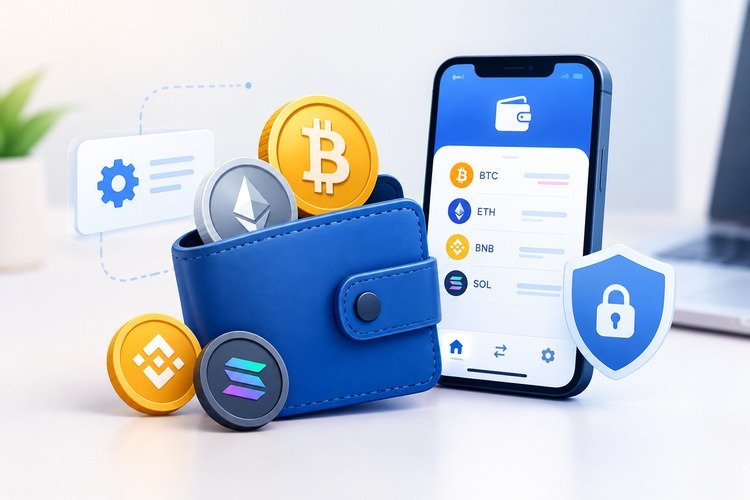
Every founder who decides to launch a digital-asset product eventually asks the same question: build the wallet in-house, or bring in a crypto wallet development company to speed things up?
Both routes can work, but they carry different timelines, budgets, and long-term control trade-offs. Here's what actually goes into building a crypto wallet, what it costs, and when a white-label crypto wallet is the smarter starting point.
What building a crypto wallet actually involves
Crypto wallet development is the process of building the software layer for holding, sending, and receiving digital assets—accounts, balances, transaction logic, security and, usually, integrations to custody and liquidity partners.
A wallet is never just a balance screen. Underneath the interface sits an account and transaction layer, a security and key-management model, compliance workflows (KYC/KYB/AML), and integrations to the providers that actually move or safeguard assets—a custody partner, a liquidity provider, and an on-ramp/off-ramp for converting between fiat and crypto. Getting any one layer wrong creates either a security risk or a product that can't scale past a pilot.
How to build a crypto wallet: the core steps
- Choose custodial or non-custodial. A custodial wallet holds private keys on the user's behalf (usually through a specialized custody partner); a non-custodial wallet leaves key control with the user. This decision shapes your compliance obligations and your entire architecture.
- Design the security and key-management model. Hot/cold wallet separation, multi-signature or MPC key schemes, and encryption standards need to be decided before a single account is created.
- Build the accounts, balances, and transaction engine. This is the core ledger logic that tracks who owns what, in which currency or asset, and validates every transfer.
- Add KYC/AML and onboarding workflows. Most jurisdictions require identity verification and transaction monitoring for any product that touches crypto-to-fiat flows.
- Integrate on-ramp/off-ramp and liquidity providers. These external partners handle the actual fiat-to-crypto and crypto-to-fiat conversion and pricing.
- Build the interface and back office. Customers need a clean app or web wallet; your operations team needs a back office for monitoring, support, and exception handling.
- Test, audit, and launch. Security audits and compliance sign-off come before any production release, not after.
How much does it cost to build a crypto wallet app?
Real-world estimates from crypto wallet development agencies put custom builds at:
- Basic, single-chain MVP: $15,000–$90,000, roughly 2–4 months.
- Mid-tier, multi-chain wallet with swaps, staking, or KYC: $50,000–$200,000, roughly 4–6 months.
- Enterprise-grade wallet with custody infrastructure, multi-sig or MPC security, and compliance audits: $200,000–$500,000+, roughly 7–14+ months.
On top of the base build, security work alone can eat 20–30% of the budget, KYC/AML integration and third-party audits typically add $10,000–$50,000 or more, and annual maintenance runs another 15–20% of the build cost.
The real cost driver isn't the interface; it's the security architecture, the compliance workflows, and the provider integrations. That's precisely why so many teams evaluate a crypto wallet app development company offering a ready-made foundation instead of pricing out a from-scratch build.
White-label crypto wallet development: build vs buy
A white label crypto wallet is pre-built software—accounts, transaction logic, security foundations, and often provider integrations—that a business rebrands and configures instead of coding from zero. White label crypto wallet development typically shortens time to market from a year-plus down to a matter of months, since the core transaction and security logic is already built and tested.
The trade-off people worry about is control, but a well-built crypto wallet white label solution doesn't have to mean a rigid black box. Vendors offering a source-code license let you deploy the platform in your own infrastructure, extend the logic, and choose your own integrations, while a SaaS delivery model favors teams that want the fastest possible start with less infrastructure overhead.
Development agency or white-label technology provider?
A search for a crypto wallet development company usually turns up two different offers. A bespoke development agency builds custom software from a blank page, billed by project or by the hour—you own the codebase, but you're paying engineering time for components (accounts, security, and ledger logic) that have already been built and tested many times over elsewhere.
A white-label crypto wallet company—a technology provider, not a development agency—licenses or subscribes you to a pre-built platform instead, so your team configures, brands, and extends existing transaction, security, and compliance logic rather than writing it from scratch.
Whichever route fits your project, check for the same fundamentals:
- Security credentials. PCI DSS Service Provider status, ISO 27001 certification, and GDPR-ready processes—not just a claim of being "secure."
- Deployment flexibility. A choice between SaaS and a source code license as your needs mature.
- API depth. A broad, documented API and webhook layer for integrating KYC, custody, and liquidity providers.
- Multi-currency and fiat support. Not just a crypto-only balance.
- Track record with regulated or near-regulated products. Case studies involving banks, EMIs, PSPs, or crypto businesses specifically, not generic fintech references.
Build a crypto wallet with SDK.finance
SDK.finance is a crypto wallet development company and modular FinTech software provider that has been building the software foundation for payment and digital-asset products since 2013. Its white-label crypto wallet solution lets a crypto or fintech business launch on a proven foundation instead of building the accounts, security, and compliance layers from zero. Its core features include
- Multi-currency wallets for fiat and crypto balances, with configurable fees, limits and pricing rules.
- KYC/AML workflow orchestration through integrated third-party providers.
- Built-in Fireblocks integration, connecting customers to custody workflows through that specialised partner - SDK.finance itself is not a custodian, bank, or EMI.
- A choice of delivery model: a Source Code Licence for teams that want to deploy, customize, and own their infrastructure, or SaaS for a faster standard start.
- 650+ API endpoints and webhooks for integrating KYC, custody, liquidity, and payment providers.
- A technology foundation built with PCI DSS Level 1 Service Provider status, ISO 27001:2022 certification, and GDPR-readiness in mind.
Conclusion
Whether you build from scratch or start from a white-label foundation, the decision comes down to how much time, budget, and in-house security expertise you have today versus how much control you want to own tomorrow. A custom build gives you a blank slate, but months of extra work before launch.
A crypto wallet development company offering a white-label foundation gets the accounts, security architecture, and compliance workflows already built and tested, so your team can focus on the product experience and go-to-market instead of reinventing the transaction layer. For most teams outside a handful of specialized crypto-native businesses, starting from a proven foundation and customizing from there is the faster, lower-risk route to a live wallet.